The CAC did not specify which experts had found a back door in Nvidia’s products or whether any tests in China had uncovered the same results. Nvidia did not immediately respond to a request for comment.
Lawmakers in Washington have expressed concern about chip smuggling and introduced a bill that would require chipmakers such as Nvidia to embed location tracking into export-controlled hardware.
Beijing has issued informal guidance to major Chinese tech groups to increase purchases of domestic AI chips in order to reduce reliance on Nvidia and support the evolution of a rival domestic chip ecosystem.
Chinese tech giant Huawei and smaller groups including Biren and Cambricon have benefited from the push to localize chip supply chains.
Nvidia said it would take nine months from restarting manufacturing to shipping the H20 to clients. Industry insiders said there was considerable uncertainty among Chinese customers over whether they would be able to take delivery of any orders if the US reversed its decision to allow its sale.
The Trump administration has faced heavy criticism, including from security experts and former officials, who argue that the H20 sales would accelerate Chinese AI development and threaten US national security.
“There are strong factions on both sides of the Pacific that don’t like the idea of renewing H20 sales,” said Triolo. “In the US, the opposition is clear, but also in China voices are saying that it will slow transition to the alternative ecosystem.”
“We have some 2,000 or 2,200 objects that I call the ‘red order of battle.'”
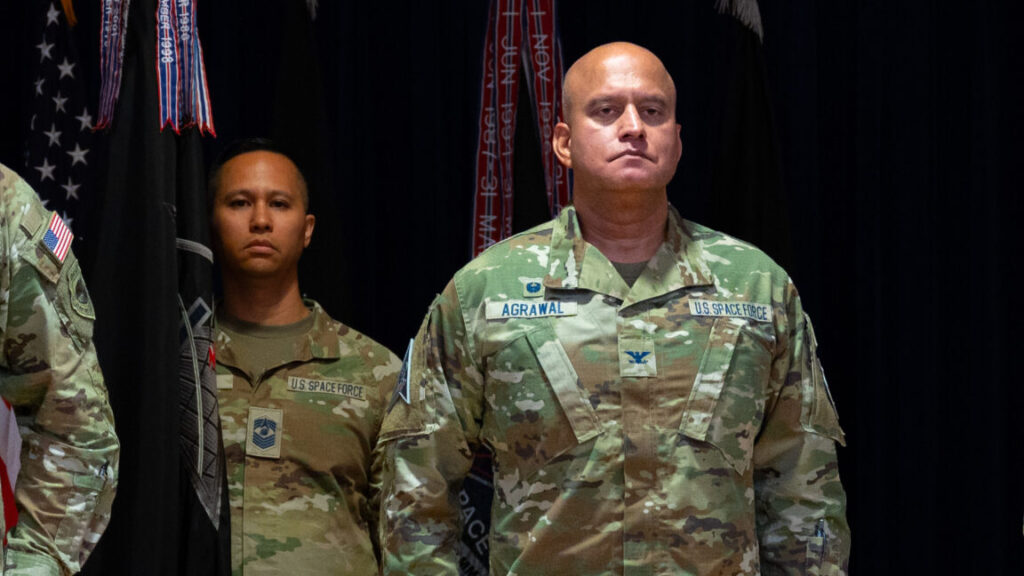
Col. Raj Agrawal participates in a change of command ceremony to mark his departure from Mission Delta 2 at Peterson Space Force Base, Colorado. Col. Barry Croker became the new commander of Mission Delta 2 on July 3.
For two years, Col. Raj Agrawal commanded the US military unit responsible for tracking nearly 50,000 human-made objects whipping through space. In this role, he was keeper of the orbital catalog and led teams tasked with discerning whether other countries’ satellites, mainly China and Russia, are peaceful or present a military threat to US forces.
This job is becoming more important as the Space Force prepares for the possibility of orbital warfare.
Ars visited with Agrawal in the final weeks of his two-year tour of duty as commander of Mission Delta 2, a military unit at Peterson Space Force Base, Colorado. Mission Delta 2 collects and fuses data from a network of sensors “to identify, characterize, and exploit opportunities and mitigate vulnerabilities” in orbit, according to a Space Force fact sheet.
This involves operating radars and telescopes, analyzing intelligence information, and “mapping the geocentric space terrain” to “deliver a combat-ready common operational picture” to military commanders. Agrawal’s job has long existed in one form or another, but the job description is different today. Instead of just keeping up with where things are in space—a job challenging enough—military officials now wrestle with distinguishing which objects might have a nefarious purpose.
From teacher to commander
Agrawal’s time at Mission Delta 2 ended on July 3. His next assignment will be as Space Force chair at the National Defense University. This marks a return to education for Agrawal, who served as a Texas schoolteacher for eight years before receiving his commission as an Air Force officer in 2001.
“Teaching is, I think, at the heart of everything I do,” Agrawal said.
He taught music and math at Trimble Technical High School, an inner city vocational school in Fort Worth. “Most of my students were in broken homes and unfortunate circumstances,” Agrawal said. “I went to church with those kids and those families, and a lot of times, I was the one bringing them home and taking them to school. What was [satisfying] about that was a lot of those students ended up living very fulfilling lives.”
Agrawal felt a calling for higher service and signed up to join the Air Force. Given his background in music, he initially auditioned for and was accepted into the Air Force Band. But someone urged him to apply for Officer Candidate School, and Agrawal got in. “I ended up on a very different path.”
Agrawal was initially accepted into the ICBM career field, but that changed after the September 11 attacks. “That was a time with anyone with a name like mine had a hard time,” he said. “It took a little bit of time to get my security clearance.”
Instead, the Air Force assigned him to work in space operations. Agrawal quickly became an instructor in space situational awareness, did a tour at the National Reconnaissance Office, then found himself working at the Pentagon in 2019 as the Defense Department prepared to set up the Space Force as a new military service. Agrawal was tasked with leading a team of 100 people to draft the first Space Force budget.
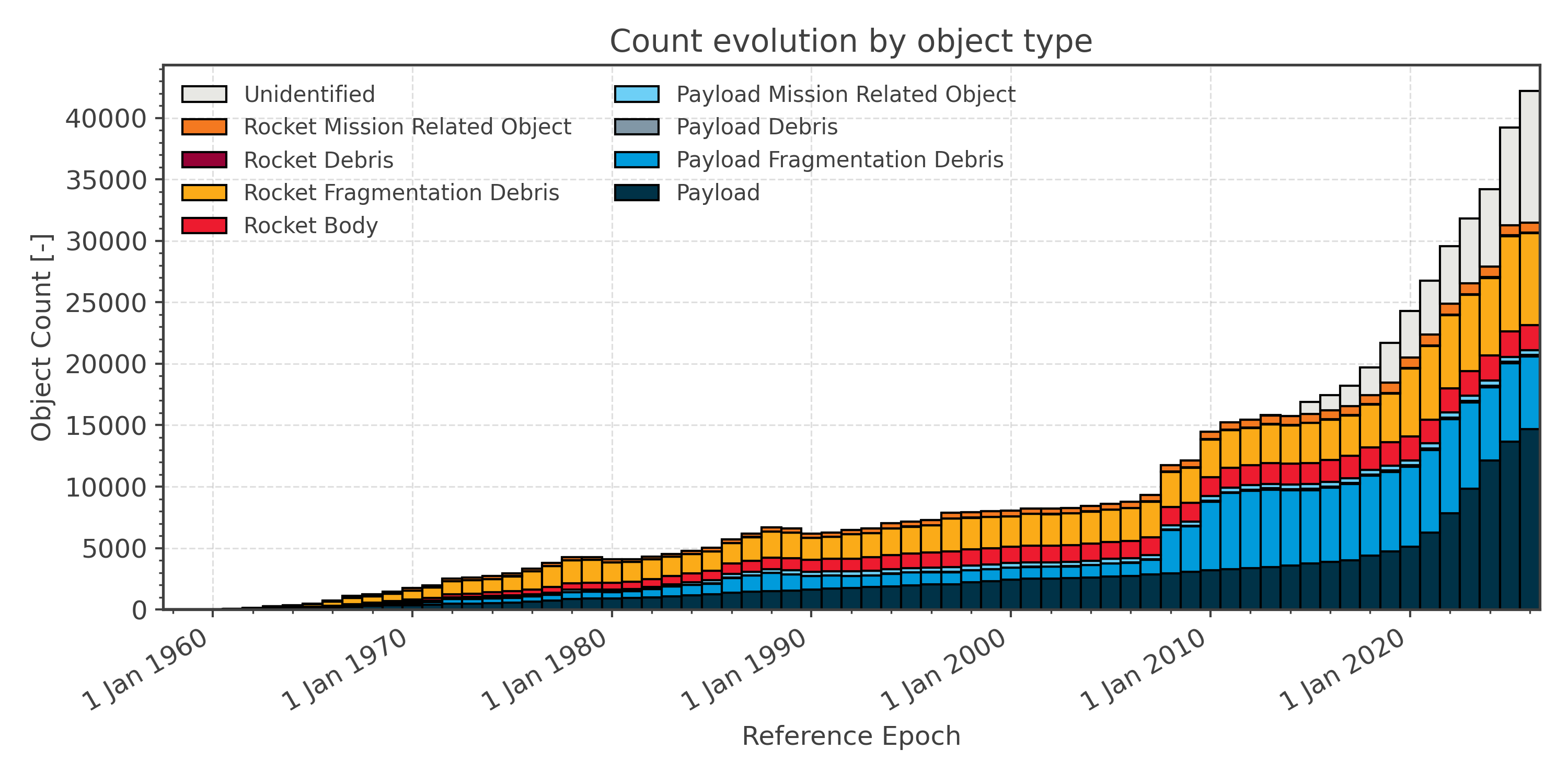
Then, he received the call to report to Peterson Space Force Base to take command of what is now Mission Delta 2, the inheritor of decades of Air Force experience cataloging everything in orbit down to the size of a softball. The catalog was stable and predictable, lingering below 10,000 trackable objects until 2007. That’s when China tested an anti-satellite missile, shattering an old Chinese spacecraft into more than 3,500 pieces large enough to be routinely detected by the US military’s Space Surveillance Network.
This graph from the European Space Agency shows the growing number of trackable objects in orbit. Credit: European Space Agency
Two years later, an Iridium communications satellite collided with a defunct Russian spacecraft, adding thousands more debris fragments to low-Earth orbit. A rapid uptick in the pace of launches since then has added to the problem, further congesting busy orbital traffic lanes a hundred miles above the Earth. Today, the orbital catalog numbers roughly 48,000 objects.
“This compiled data, known as the space catalog, is distributed across the military, intelligence community, commercial space entities, and to the public, free of charge,” officials wrote in a fact sheet describing Mission Delta 2’s role at Space Operations Command. Deltas are Space Force military units roughly equivalent to a wing or group command in the Air Force.
The room where it happens
The good news is that the US military is getting better at tracking things in space. A network of modern radars and telescopes on the ground and in space can now spot objects as small as a golf ball. Space is big, but these objects routinely pass close to one another. At speeds of nearly 5 miles per second, an impact will be catastrophic.
But there’s a new problem. Today, the US military must not only screen for accidental collisions but also guard against an attack on US satellites in orbit. Space is militarized, a fact illustrated by growing fleets of satellites—primarily American, Chinese, and Russian—capable of approaching another country’s assets in orbit, and in some cases, disable or destroy them. This has raised fears at the Pentagon that an adversary could take out US satellites critical for missile warning, navigation, and communications, with severe consequences impacting military operations and daily civilian life.
This new reality compelled the creation of the Space Force in 2019, beginning a yearslong process of migrating existing Air Force units into the new service. Now, the Pentagon is posturing for orbital warfare by investing in new technologies and reorganizing the military’s command structure.
Today, the Space Force is responsible for predicting when objects in orbit will come close to one another. This is called a conjunction in the parlance of orbital mechanics. The US military routinely issues conjunction warnings to commercial and foreign satellite operators to give them an opportunity to move their satellites out of harm’s way. These notices also go to NASA if there’s a chance of a close call with the International Space Station (ISS).
The first Trump administration approved a new policy to transfer responsibility for these collision warnings to the Department of Commerce, allowing the military to focus on national security objectives.
But the White House’s budget request for next year would cancel the Commerce Department’s initiative to take over collision warnings. Our discussion with Agrawal occurred before the details of the White House budget were made public last month, and his comments reflect official Space Force policy at the time of the interview. “In uniform, we align to policy,” Agrawal wrote on his LinkedIn account. “We inform policy decisions, but once they’re made, we align our support accordingly.”
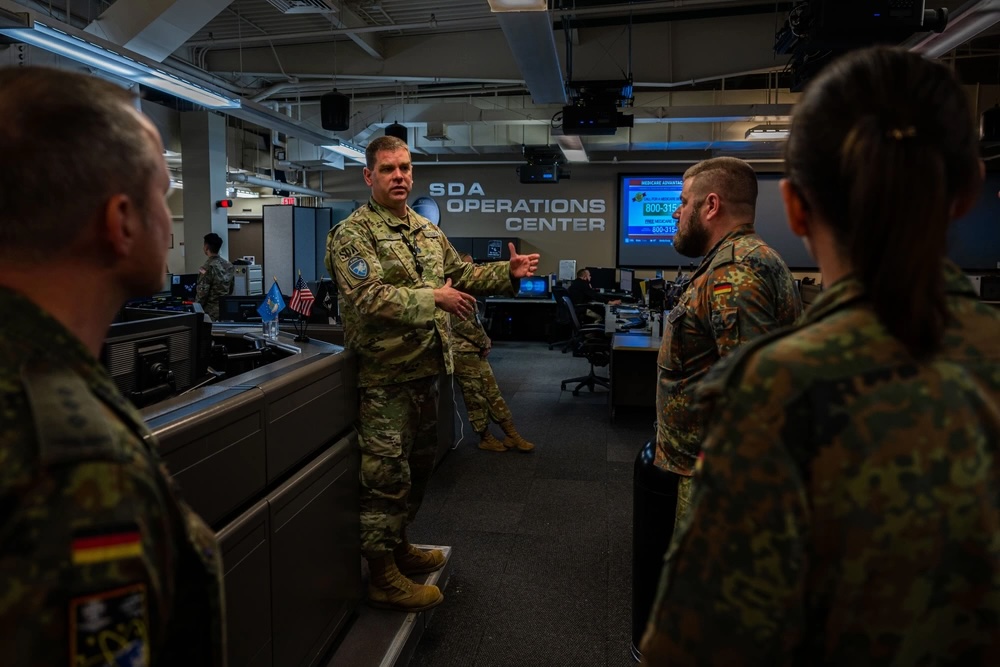
US Space Force officials show the 18th Space Defense Squadron’s operations floor to officials from the German Space Situational Awareness Centre during an “Operator Exchange” event at Vandenberg Space Force Base, California, on April 7, 2022. Credit: US Space Force/Tech. Sgt. Luke Kitterman
Let’s rewind the tape to 2007, the time of China’s game-changing anti-satellite test. Gen. Chance Saltzman, today the Space Force’s Chief of Space Operations, was a lieutenant colonel in command of the Air Force’s 614th Space Operations Squadron at the time. He was on duty when Air Force operators first realized China had tested an anti-satellite missile. Saltzman has called the moment a “pivot point” in space operations. “For those of us that are neck-deep in the business, we did have to think differently from that day on,” Saltzman said in 2023.
Agrawal was in the room, too. “I was on the crew that needed to count the pieces,” he told Ars. “I didn’t know the significance of what was happening until after many years, but the Chinese had clearly changed the nature of the space environment.”
The 2007 anti-satellite test also clearly changed the trajectory of Agrawal’s career. We present part of our discussion with Agrawal below, and we’ll share the rest of the conversation tomorrow. The text has been lightly edited for brevity and clarity.
Ars: The Space Force’s role in monitoring activities in space has changed a lot in the last few years. Can you tell me about these changes, and what’s the difference between what you used to call Space Situational Awareness, and what is now called Space Domain Awareness?
Agrawal: We just finished our fifth year as a Space Force, so as a result of standing up a military service focused on space, we shifted our activities to focus on what the joint force requires for combat space power. We’ve been doing space operations for going on seven decades. I think a lot of folks think that it was a rebranding, as opposed to a different focus for space operations, and it couldn’t be further from the truth. Compared to Space Domain Awareness (SDA), Space Situational Awareness (SSA) is kind of the knowledge we produce with all these sensors, and anybody can do space situational awareness. You have academia doing that. You’ve got commercial, international partners, and so on. But Space Domain Awareness, Gen. [John “Jay”] Raymond coined the term a couple years before we stood up the Space Force, and he was trying to get after, how do we create a domain focused on operational outcomes? That’s all we could say at the time. We couldn’t say war-fighting domain at the time because of the way of our policy, but our policy shifted to being able to talk about space as a place where, not that we want to wage war, but that we can achieve objectives, and do that with military objectives in mind.
We used to talk about detect, characterize, attribute, predict. And then Gen. [Chance] Saltzman added target onto the construct for Space Domain Awareness, so that we’re very much in the conversation of what it means to do a space-enabled attack and being able to achieve objectives in, from, and to space, and using Space Domain Awareness as a vehicle to do those things. So, with Mission Delta 2, what he did is he took the sustainment part of acquisition, software development, cyber defense, intelligence related to Space Domain Awareness, and then all the things that we were doing in Space Domain Awareness already, put all that together under one command … and called us Mission Delta 2. So, the 18th Space Defense Squadron … that used to kind of be the center of the world for Space Domain Awareness, maybe the only unit that you could say was really doing SDA, where everyone else was kind of doing SSA. When I came into command a couple years ago, and we face now a real threat to having space superiority in the space domain, I disaggregated what we were doing just in the 18th and spread out through a couple of other units … So, that way everyone’s got kind of majors and minors, but we can quickly move a mission in case we get tested in terms of cyber defense or other kinds of vulnerabilities.
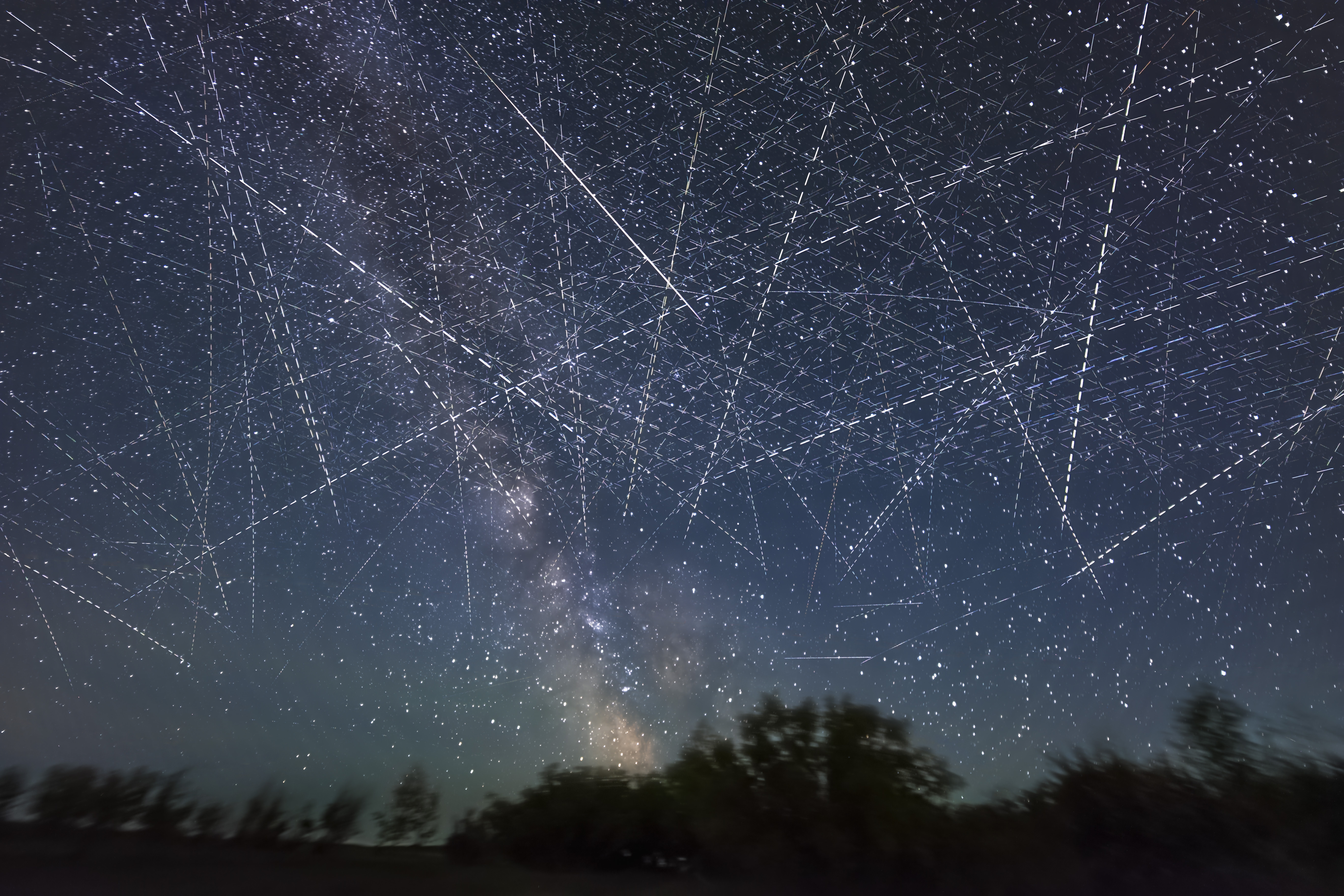
This multi-exposure image depicts a satellite-filled sky over Alberta. Credit: Alan Dyer/VWPics/Universal Images Group via Getty Images
We can’t see the space domain, so it’s not like the air domain and sea domain and land domain, where you can kind of see where everything is, and you might have radars, but ultimately it’s a human that’s verifying whether or not a target or a threat is where it is. For the space domain, we’re doing all that through radars, telescopes, and computers, so the reality we create for everyone is essentially their reality. So, if there’s a gap, if there’s a delay, if there are some signs that we can’t see, that reality is what is created by us, and that is effectively the reality for everyone else, even if there is some other version of reality in space. So, we’re getting better and better at fielding capability to see the complexity, the number of objects, and then translating that into what’s useful for us—because we don’t need to see everything all the time—but what’s useful for us for military operations to achieve military objectives, and so we’ve shifted our focus just to that.
We’re trying to get to where commercial spaceflight safety is managed by the Office of Space Commerce, so they’re training side by side with us to kind of offload that mission and take that on. We’re doing up to a million notifications a day for conjunction assessments, sometimes as low as 600,000. But last year, we did 263 million conjunction notifications. So, we want to get to where the authorities are rightly lined, where civil or commercial notifications are done by an organization that’s not focused on joint war-fighting, and we focus on the things that we want to focus on.
Ars: Thank you for that overview. It helps me see the canvas for everything else we’re going to talk about. So, today, you’re not only tracking new satellites coming over the horizon from a recent launch or watching out for possible collisions, you’re now trying to see where things are going in space and maybe even try to determine intent, right?
Agrawal: Yeah, so the integrated mission delta has helped us have intel analysts and professionals as part of our formation. Their mission is SDA as much as ours is, but they’re using an intel lens. They’re looking at predictive intelligence, right? I don’t want to give away tradecraft, but what they’re focused on is not necessarily where a thing is. It used to be that all we cared about was position and vector, right? As long as you knew an object’s position and the direction they were going, you knew their orbit. You had predictive understanding of what their element set would be, and you only had to do sampling to get a sense of … Is it kind of where we thought it was going to be? … If it was far enough off of its element set, then we would put more energy, more sampling of that particular object, and then effectively re-catalog it.
Now, it’s a different model. We’re looking at state vectors, and we’re looking at anticipatory modeling, where we have some 2,000 or 2,200 objects that I call the “red order of battle”—that are high-interest objects that we anticipate will do things that are not predicted, that are not element set in nature, but that will follow some type of national interest. So, our intel apparatus gets after what things could potentially be a risk, and what things to continue to understand better, and what things we have to be ready to hold at risk. All of that’s happening through all the organizations, certainly within this delta, but in partnership and in support of other capabilities and deltas that are getting after their parts of space superiority.
Hostile or friendly?
Ars: Can you give some examples of these red order of battle objects?
Agrawal: I think you know about Shijian-20 (a “tech demo” satellite that has evaded inspection by US satellites) and Shijian-24C (which the Space Force says demonstrated “dogfighting” in space), things that are advertised as scientific in nature, but clearly demonstrate capability that is not friendly, and certainly are behaving in ways that are unprofessional. In any other domain, we would consider them hostile, but in space, we try to be a lot more nuanced in terms of how we characterize behavior, but still, when something’s behaving in a way that isn’t pre-planned, isn’t pre-coordinated, and potentially causes hazard, harm, or contest with friendly forces, we now get in a situation where we have to talk about is that behavior hostile or not? Is that escalatory or not? Space Command is charged with those authorities, so they work through the legal apparatus in terms of what the definition of a hostile act is and when something behaves in a way that we consider to be of national security interest.
We present all the capability to be able to do all that, and we have to be as cognizant on the service side as the combatant commanders are, so that our intel analysts are informing the forces and the training resources to be able to anticipate the behavior. We’re not simply recognizing it when it happens, but studying nations in the way they behave in all the other domains, in the way that they set policy, in the way that they challenge norms in other international arenas like the UN and various treaties, and so on. The biggest predictor, for us, of hazardous behaviors is when nations don’t coordinate with the international community on activities that are going to occur—launches, maneuvers, and fielding of large constellations, megaconstellations.
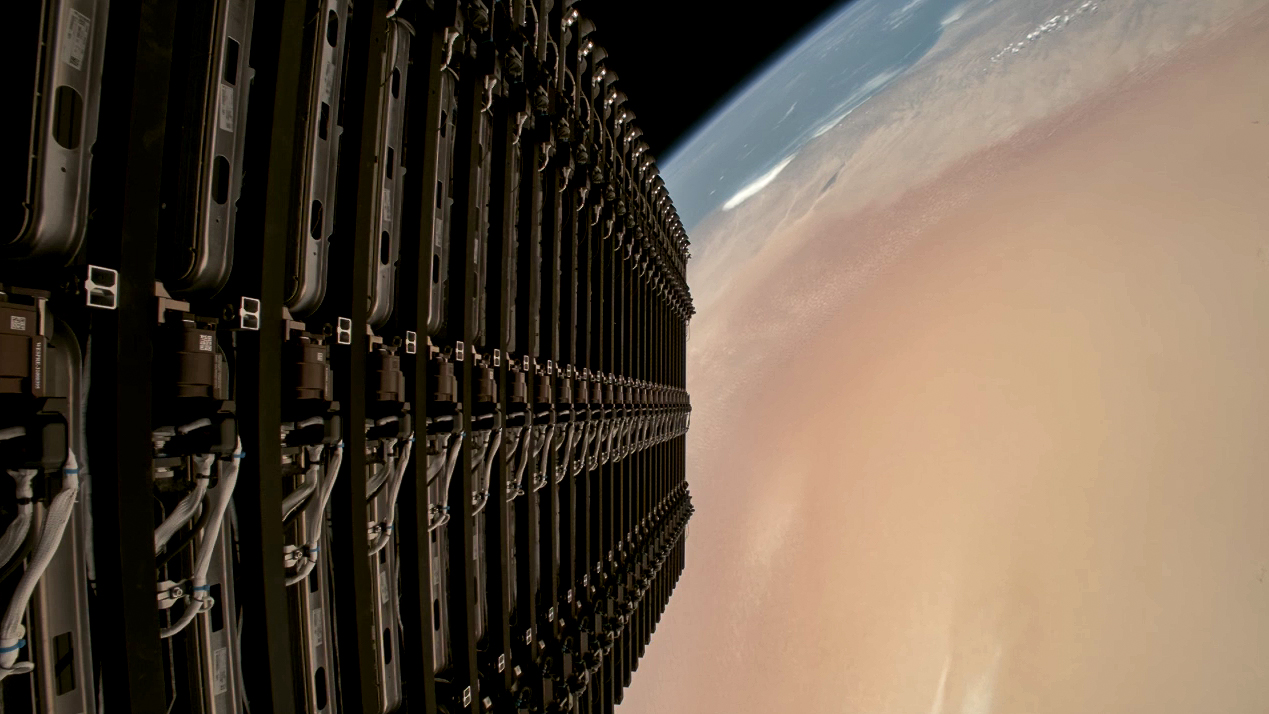
Starlink satellites. Credit: Starlink
There are nearly 8,000 Starlink satellites in orbit today. SpaceX adds dozens of satellites to the constellation each week. Credit: SpaceX
As you know, we work very closely with Starlink, and they’re very, very responsible. They coordinate and flight plan. They use the kind of things that other constellations are starting to use … changes in those elsets (element sets), for lack of a better term, state vectors, we’re on top of that. We’re pre-coordinating that. We’re doing that weeks or months in advance. We’re doing that in real-time in cooperation with these organizations to make sure that space remains safe, secure, accessible, profitable even, for industry. When you have nations, where they’re launching over their population, where they’re creating uncertainty for the rest of the world, there’s nothing else we can do with it other than treat that as potentially hostile behavior. So, it does take a lot more of our resources, a lot more of our interest, and it puts [us] in a situation where we’re posturing the whole joint force to have to deal with that kind of uncertainty, as opposed to cooperative launches with international partners, with allies, with commercial, civil, and academia, where we’re doing that as friends, and we’re doing that in cooperation. If something goes wrong, we’re handling that as friends, and we’re not having to involve the rest of the security apparatus to get after that problem.
Ars: You mentioned that SpaceX shares Starlink orbit information with your team. Is it the same story with Amazon for the Kuiper constellation?
Agrawal: Yeah, it is. The good thing is that all the US and allied commercial entities, so far, have been super cooperative with Mission Delta 2 in particular, to be able to plan out, to talk about challenges, to even change the way they do business, learning more about what we are asking of them in order to be safe. The Office of Space Commerce, obviously, is now in that conversation as well. They’re learning that trade and ideally taking on more of that responsibility. Certainly, the evolution of technology has helped quite a bit, where you have launches that are self-monitored, that are able to maintain their own safety, as opposed to requiring an entire apparatus of what was the US Air Force often having to expend a tremendous amount of resources to provide for the safety of any launch. Now, technology has gotten to a point where a lot of that is self-monitored, self-reported, and you’ll see commercial entities blow up their own rockets no matter what’s onboard if they see that it’s going to cause harm to a population, and so on. So, yeah, we’re getting a lot of cooperation from other nations, allies, partners, close friends that are also sharing and cooperating in the interest of making sure that space remains sustainable and secure.
“We’ve made ourselves responsible”
Ars: One of the great ironies is that after you figure out the positions and tracks of Chinese or Russian satellites or constellations, you’re giving that data right back to them in the form of conjunction and collision notices, right?
Agrawal: We’ve made ourselves responsible. I don’t know that there’s any organization holding us accountable to that. We believe it’s in our interests, in the US’s interests, to provide for a safe, accessible, secure space domain. So, whatever we can do to help other nations also be safe, we’re doing it certainly for their sake, but we’re doing it as much for our sake, too. We want the space domain to be safe and predictable. We do have an apparatus set up in partnership with the State Department, and with a tremendous amount of oversight from the State Department, and through US Space Command to provide for spaceflight safety notifications to China and Russia. We send notes directly to offices within those nations. Most of the time they don’t respond. Russia, I don’t recall, hasn’t responded at all in the past couple of years. China has responded a couple of times to those notifications. And we hope that, through small measures like that, we can demonstrate our commitment to getting to a predictable and safe space environment.
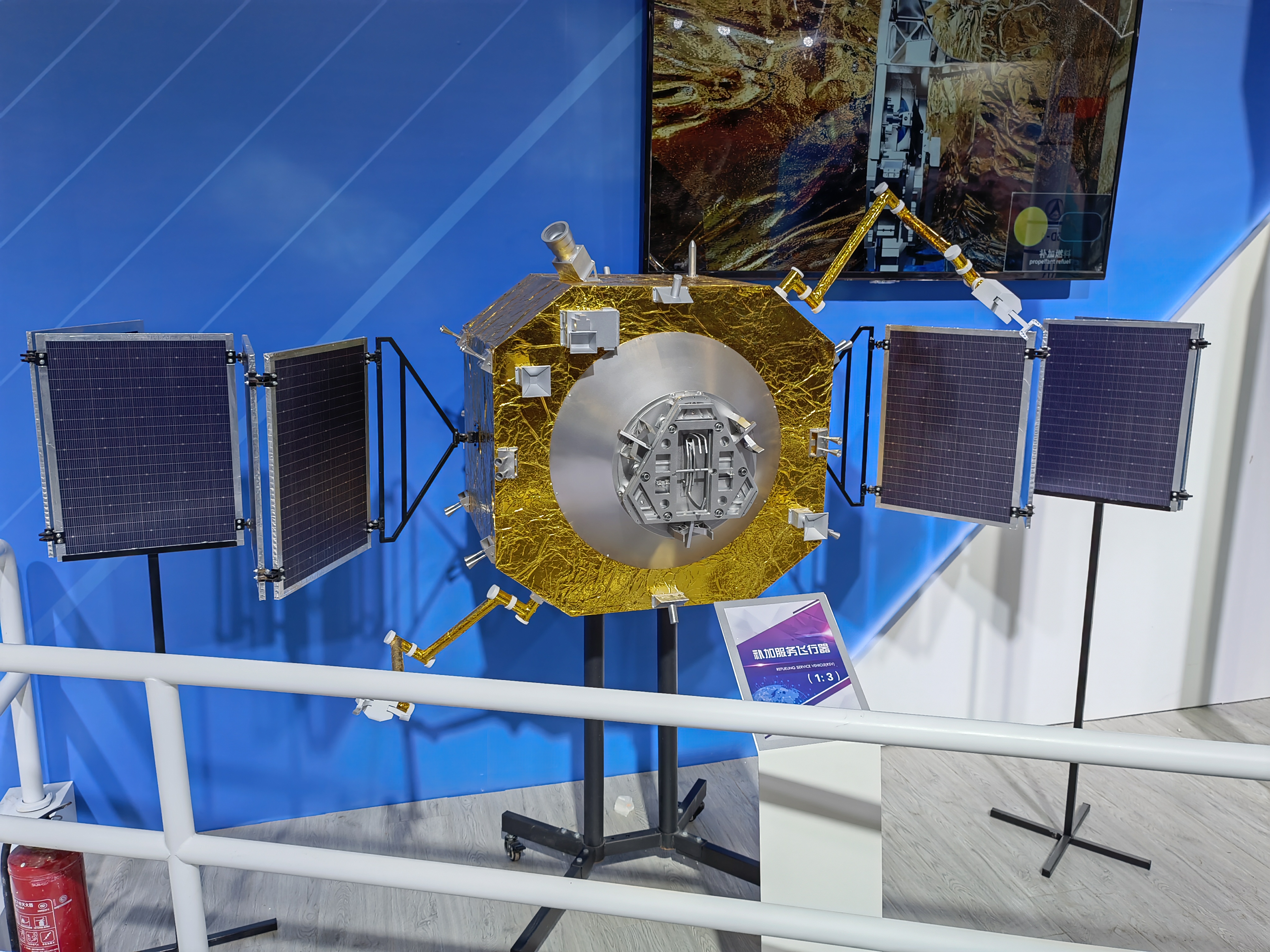
A model of a Chinese satellite refueling spacecraft on display during the 13th China International Aviation and Aerospace Exhibition on October 1, 2021, in Zhuhai, Guangdong Province of China. Credit: Photo by VCG/VCG via Getty Images
Ars: What does China say in response to these notices?
Agrawal: Most of the time it’s copy or acknowledged. I can only recall two instances where they’ve responded. But we did see some hope earlier this year and last year, where they wanted to open up technical exchanges with us and some of their [experts] to talk about spaceflight safety, and what measures they could take to open up those kinds of conversations, and what they could do to get a more secure, safer pace of operations. That, at some point, got delayed because of the holiday that they were going through, and then those conversations just halted, or at least progress on getting those conversations going halted. But we hope that there’ll be an opportunity again in the future where they will open up those doors again and have those kinds of conversations because, again, transparency will get us to a place where we can be predictable, and we can all benefit from orbital regimes, as opposed to using them exploitively. LEO is just one of those places where you’re not going to hide activity there, so you just are creating risk, uncertainty, and potential escalation by launching into LEO and not communicating throughout that whole process.
Ars: Do you have any numbers on how many of these conjunction notices go to China and Russia? I’m just trying to get an idea of what proportion go to potential adversaries.
Agrawal: A lot. I don’t know the degree of how many thousands go to them, but on a regular basis, I’m dealing with debris notifications from Russian and Chinese ASAT (anti-satellite) testing. That has put the ISS at risk a number of times. We’ve had maneuvers occur in recent history as a result of Chinese rocket body debris. Debris can’t maneuver, and unfortunately, we’ve gotten into situations with particularly those two nations that talk about wanting to have safer operations, but continue to conduct debris-causing tests. We’re going to be dealing with that for generations, and we are going to have to design capability to maneuver around those debris clouds as just a function of operating in space. So, we’ve got to get to a point where we’re not doing that kind of testing in orbit.
Ars: Would it be accurate to say you send these notices to China and Russia daily?
Agrawal: Yeah, absolutely. That’s accurate. These debris clouds are in LEO, so as you can imagine, as those debris clouds go around the Earth every 90 minutes, we’re dealing with conjunctions. There are some parts of orbits that are just unusable as a result of that unsafe ASAT test.
Stephen Clark is a space reporter at Ars Technica, covering private space companies and the world’s space agencies. Stephen writes about the nexus of technology, science, policy, and business on and off the planet.
Last week, Microsoft announced that it would no longer use China-based engineering teams to support the Defense Department’s cloud computing systems, following ProPublica’s investigation of the practice, which cybersecurity experts said could expose the government to hacking and espionage.
But it turns out the Pentagon was not the only part of the government facing such a threat. For years, Microsoft has also used its global workforce, including China-based personnel, to maintain the cloud systems of other federal departments, including parts of Justice, Treasury and Commerce, ProPublica has found.
This work has taken place in what’s known as the Government Community Cloud, which is intended for information that is not classified but is nonetheless sensitive. The Federal Risk and Authorization Management Program, the US government’s cloud accreditation organization, has approved GCC to handle “moderate” impact information “where the loss of confidentiality, integrity, and availability would result in serious adverse effect on an agency’s operations, assets, or individuals.”
The Justice Department’s Antitrust Division has used GCC to support its criminal and civil investigation and litigation functions, according to a 2022 report. Parts of the Environmental Protection Agency and the Department of Education have also used GCC.
Microsoft says its foreign engineers working in GCC have been overseen by US-based personnel known as “digital escorts,” similar to the system it had in place at the Defense Department.
Nevertheless, cybersecurity experts told ProPublica that foreign support for GCC presents an opportunity for spying and sabotage. “There’s a misconception that, if government data isn’t classified, no harm can come of its distribution,” said Rex Booth, a former federal cybersecurity official who now is chief information security officer of the tech company SailPoint.
“With so much data stored in cloud services—and the power of AI to analyze it quickly—even unclassified data can reveal insights that could harm US interests,” he said.
China’s Space Pioneer seems to be back on track a year after an accidental launch.
A SpaceX Falcon 9 rocket carrying a payload of 24 Starlink Internet satellites soars into space after launching from Vandenberg Space Force Base, California, shortly after sunset on July 18, 2025. This image was taken in Santee, California, approximately 250 miles (400 kilometers) away from the launch site. Credit: Kevin Carter/Getty Images
Welcome to Edition 8.04 of the Rocket Report! The Pentagon’s Golden Dome missile defense shield will be a lot of things. Along with new sensors, command and control systems, and satellites, Golden Dome will require a lot of rockets. The pieces of the Golden Dome architecture operating in orbit will ride to space on commercial launch vehicles. And Golden Dome’s space-based interceptors will essentially be designed as flying fuel tanks with rocket engines. This shouldn’t be overlooked, and that’s why we include a couple of entries discussing Golden Dome in this week’s Rocket Report.
As always, we welcome reader submissions. If you don’t want to miss an issue, please subscribe using the box below (the form will not appear on AMP-enabled versions of the site). Each report will include information on small-, medium-, and heavy-lift rockets, as well as a quick look ahead at the next three launches on the calendar.
Space-based interceptors are a real challenge. The newly installed head of the Pentagon’s Golden Dome missile defense shield knows the clock is ticking to show President Donald Trump some results before the end of his term in the White House, Ars reports. Gen. Michael Guetlein identified command-and-control and the development of space-based interceptors as two of the most pressing technical challenges for Golden Dome. He believes the command-and-control problem can be “overcome in pretty short order.” The space-based interceptor piece of the architecture is a different story.
Proven physics, unproven economics … “I think the real technical challenge will be building the space-based interceptor,” Guetlein said. “That technology exists. I believe we have proven every element of the physics that we can make it work. What we have not proven is, first, can I do it economically, and then second, can I do it at scale? Can I build enough satellites to get after the threat? Can I expand the industrial base fast enough to build those satellites? Do I have enough raw materials, etc.?” Military officials haven’t said how many space-based interceptors will be required for Golden Dome, but outside estimates put the number in the thousands.
The easiest way to keep up with Eric Berger’s and Stephen Clark’s reporting on all things space is to sign up for our newsletter. We’ll collect their stories and deliver them straight to your inbox.
One big defense prime is posturing for Golden Dome. Northrop Grumman is conducting ground-based testing related to space-based interceptors as part of a competition for that segment of the Trump administration’s Golden Dome missile-defense initiative, The War Zone reports. Kathy Warden, Northrop Grumman’s CEO, highlighted the company’s work on space-based interceptors, as well as broader business opportunities stemming from Golden Dome, during a quarterly earnings call this week. Warden identified Northrop’s work in radars, drones, and command-and-control systems as potentially applicable to Golden Dome.
But here’s the real news … “It will also include new innovation, like space-based interceptors, which we’re testing now,” Warden continued. “These are ground-based tests today, and we are in competition, obviously, so not a lot of detail that I can provide here.” Warden declined to respond directly to a question about how the space-based interceptors Northrop Grumman is developing now will actually defeat their targets. (submitted by Biokleen)
Trump may slash environmental rules for rocket launches. The Trump administration is considering slashing rules meant to protect the environment and the public during commercial rocket launches, changes that companies like Elon Musk’s SpaceX have long sought, ProPublica reports. A draft executive order being circulated among federal agencies, and viewed by ProPublica, directs Secretary of Transportation Sean Duffy to “use all available authorities to eliminate or expedite” environmental reviews for launch licenses. It could also, in time, require states to allow more launches or even more launch sites along their coastlines.
Getting political at the FAA … The order is a step toward the rollback of federal oversight that Musk, who has fought bitterly with the Federal Aviation Administration over his space operations, and others have pushed for. Commercial rocket launches have grown exponentially more frequent in recent years. In addition to slashing environmental rules, the draft executive order would make the head of the FAA’s Office of Commercial Space Transportation a political appointee. This is currently a civil servant position, but the last head of the office took a voluntary separation offer earlier this year.
There’s a SPAC for that. An unproven small launch startup is partnering with a severely depleted SPAC trust to do the impossible: go public in a deal they say will be valued at $400 million, TechCrunch reports. Innovative Rocket Technologies Inc., or iRocket, is set to merge with a Special Purpose Acquisition Company, or SPAC, founded by former Commerce Secretary Wilbur Ross. But the most recent regulatory filings by this SPAC showed it was in a tenuous financial position last year, with just $1.6 million held in trust. Likewise, iRocket isn’t flooded with cash. The company has raised only a few million in venture funding, a fraction of what would be needed to develop and test the company’s small orbital-class rocket, named Shockwave.
SpaceX traces a path to orbit for NASA. Two NASA satellites soared into orbit from California aboard a SpaceX Falcon 9 rocket Wednesday, commencing a $170 million mission to study a phenomenon of space physics that has eluded researchers since the dawn of the Space Age, Ars reports. The twin spacecraft are part of the NASA-funded TRACERS mission, which will spend at least a year measuring plasma conditions in narrow regions of Earth’s magnetic field known as polar cusps. As the name suggests, these regions are located over the poles. They play an important but poorly understood role in creating colorful auroras as plasma streaming out from the Sun interacts with the magnetic field surrounding Earth. The same process drives geomagnetic storms capable of disrupting GPS navigation, radio communications, electrical grids, and satellite operations.
Plenty of room for more … The TRACERS satellites are relatively small, each about the size of a washing machine, so they filled only a fraction of the capacity of SpaceX’s Falcon 9 rocket. Three other small NASA tech demo payloads hitched a ride to orbit with TRACERS, kicking off missions to test an experimental communications terminal, demonstrate an innovative scalable satellite platform made of individual building blocks, and study the link between Earth’s atmosphere and the Van Allen radiation belts. In addition to those missions, the European Space Agency launched its own CubeSat to test 5G communications from orbit. Five smallsats from an Australian company rounded out the group. Still, the Falcon 9 rocket’s payload shroud was filled with less than a quarter of the payload mass it could have delivered to the TRACERS mission’s targeted Sun-synchronous orbit.
Tianlong launch pad ready for action. Chinese startup Space Pioneer has completed a launch pad at Jiuquan spaceport in northwestern China for its Tianlong 3 liquid propellent rocket ahead of a first orbital launch, Space News reports. Space Pioneer said the launch pad passed an acceptance test, and ground crews raised a full-scale model of the Tianlong 3 rocket on the launch pad. “The rehearsal test was successfully completed,” said Space Pioneer, one of China’s leading private launch companies. The activation of the launch pad followed a couple of weeks after Space Pioneer announced the completion of static loads testing on Tianlong 3.
More to come … While this is an important step forward for Space Pioneer, construction of the launch pad is just one element the company needs to finish before Tianlong 3 can lift off for the first time. In June 2024, the company ignited Tianlong 3’s nine-engine first stage on a test stand in China. But the rocket broke free of its moorings on the test stand and unexpectedly climbed into the sky before crashing in a fireball nearby. Space Pioneer says the “weak design of the rocket’s tail structure was the direct cause of the failure” last year. The company hasn’t identified next steps for Tianlong 3, or when it might be ready to fly. Tianlong 3 is a kerosene-fueled rocket with nine main engines, similar in design architecture and payload capacity to SpaceX’s Falcon 9. Also, like Falcon 9, Tianlong 3 is supposed to have a recoverable and reusable first stage booster.
Dredging up an issue at Wallops. Rocket Lab has asked regulators for permission to transport oversized Neutron rocket structures through shallow waters to a spaceport off the coast of Virginia as it races to meet a September delivery deadline, TechCrunch reports. The request, which was made in July, is a temporary stopgap while the company awaits federal clearance to dredge a permanent channel to the Wallops Island site. Rocket Lab plans to launch its Neutron medium-lift rocket from the Mid-Atlantic Regional Spaceport (MARS) on Wallops Island, Virginia, a lower-traffic spaceport that’s surrounded by shallow channels and waterways. Rocket Lab has a sizable checklist to tick off before Neutron can make its orbital debut, like mating the rocket stages, performing a “wet dress” rehearsal, and getting its launch license from the Federal Aviation Administration. Before any of that can happen, the rocket hardware needs to make it onto the island from Rocket Lab’s factory on the nearby mainland.
Kedging bets … Access to the channel leading to Wallops Island is currently available only at low tides. So, Rocket Lab submitted an application earlier this year to dredge the channel. The dredging project was approved by the Virginia Marine Resources Commission in May, but the company has yet to start digging because it’s still awaiting federal sign-off from the Army Corps of Engineers. As the company waits for federal approval, Rocket Lab is seeking permission to use a temporary method called “kedging” to ensure the first five hardware deliveries can arrive on schedule starting in September. We don’t cover maritime issues in the Rocket Report, but if you’re interested in learning a little about kedging, here’s a link.
Any better ideas for an Exploration Upper Stage? Not surprisingly, Congress is pushing back against the Trump administration’s proposal to cancel the Space Launch System, the behemoth rocket NASA has developed to propel astronauts back to the Moon. But legislation making its way through the House of Representatives includes an interesting provision that would direct NASA to evaluate alternatives for the Boeing-built Exploration Upper Stage, an upgrade for the SLS rocket set to debut on its fourth flight, Ars reports. Essentially, the House Appropriations Committee is telling NASA to look for cheaper, faster options for a new SLS upper stage.
CYA EUS? … The four-engine Exploration Upper Stage, or EUS, is an expensive undertaking. Last year, NASA’s inspector general reported that the new upper stage’s development costs had ballooned from $962 million to $2.8 billion, and the project had been delayed more than six years. That’s almost a year-for-year delay since NASA and Boeing started development of the EUS. So, what are the options if NASA went with a new upper stage for the SLS rocket? One possibility is a modified version of United Launch Alliance’s dual-engine Centaur V upper stage that flies on the Vulcan rocket. It’s no longer possible to keep flying the SLS rocket’s existing single-engine upper stage because ULA has shut down the production line for it.
Raising Super Heavy from the deep. For the second time, SpaceX has retrieved an engine section from one of its Super Heavy boosters from the Gulf of Mexico, NASASpaceflight.com reports. Images posted on social media showed the tail end of a Super Heavy booster being raised from the sea off the coast of northern Mexico. Most of the rocket’s 33 Raptor engines appear to still be attached to the lower section of the stainless steel booster. Online sleuths who closely track SpaceX’s activities at Starbase, Texas, have concluded the rocket recovered from the Gulf is Booster 13, which flew on the sixth test flight of the Starship mega-rocket last November. The booster ditched in the ocean after aborting an attempted catch back at the launch pad in South Texas.
But why? … SpaceX recovered the engine section of a different Super Heavy booster from the Gulf last year. The company’s motivation for salvaging the wreckage is unclear. “Speculated reasons include engineering research, environmental mitigation, or even historical preservation,” NASASpaceflight reports.
Next three launches
July 26: Vega C | CO3D & MicroCarb | Guiana Space Center, French Guiana | 02: 03 UTC
July 26: Falcon 9 | Starlink 10-26 | Cape Canaveral Space Force Station, Florida | 08: 34 UTC
July 27: Falcon 9 | Starlink 17-2 | Vandenberg Space Force Base, California | 03: 55 UTC
Stephen Clark is a space reporter at Ars Technica, covering private space companies and the world’s space agencies. Stephen writes about the nexus of technology, science, policy, and business on and off the planet.
Trump’s plan was not welcomed by everyone. J.B. Branch, Big Tech accountability advocate for Public Citizen, in a statement provided to Ars, criticized Trump as giving “sweetheart deals” to tech companies that would cause “electricity bills to rise to subsidize discounted power for massive AI data centers.”
Infrastructure demands and energy requirements
Trump’s new AI plan tackles infrastructure head-on, stating that “AI is the first digital service in modern life that challenges America to build vastly greater energy generation than we have today.” To meet this demand, it proposes streamlining environmental permitting for data centers through new National Environmental Policy Act (NEPA) exemptions, making federal lands available for construction and modernizing the power grid—all while explicitly rejecting “radical climate dogma and bureaucratic red tape.”
The document embraces what it calls a “Build, Baby, Build!” approach—echoing a Trump campaign slogan—and promises to restore semiconductor manufacturing through the CHIPS Program Office, though stripped of “extraneous policy requirements.”
On the technology front, the plan directs Commerce to revise NIST’s AI Risk Management Framework to “eliminate references to misinformation, Diversity, Equity, and Inclusion, and climate change.” Federal procurement would favor AI developers whose systems are “objective and free from top-down ideological bias.” The document strongly backs open source AI models and calls for exporting American AI technology to allies while blocking administration-labeled adversaries like China.
Security proposals include high-security military data centers and warnings that advanced AI systems “may pose novel national security risks” in cyberattacks and weapons development.
Critics respond with “People’s AI Action Plan”
Before the White House unveiled its plan, more than 90 organizations launched a competing “People’s AI Action Plan” on Tuesday, characterizing the Trump administration’s approach as “a massive handout to the tech industry” that prioritizes corporate interests over public welfare. The coalition includes labor unions, environmental justice groups, and consumer protection nonprofits.
Nearly 150 employees of the National Science Foundation (NSF) sent an urgent letter of dissent to Congress on Tuesday, warning that the Trump administration’s recent “politically motivated and legally questionable” actions threaten to dismantle the independent “world-renowned scientific agency.”
Most NSF employees signed the letter anonymously, with only Jesus Soriano, the president of their local union (AFGE Local 3403), publicly disclosing his name. Addressed to Rep. Zoe Lofgren (D-Calif.), ranking member of the House Committee on Science, Space, and Technology, the letter insisted that Congress intervene to stop steep budget cuts, mass firings and grant terminations, withholding of billions in appropriated funds, allegedly coerced resignations, and the sudden eviction of NSF from its headquarters planned for next year.
Perhaps most disturbingly, the letter revealed “a covert and ideologically driven secondary review process by unqualified political appointees” that is now allegedly “interfering with the scientific merit-based review system” that historically has made NSF a leading, trusted science agency. Soriano further warned that “scientists, program officers, and staff” have all “been targeted for doing their jobs with integrity” in what the letter warned was “a broader agenda to dismantle institutional safeguards, impose demagoguery in research funding decisions, and undermine science.”
At a press conference with Lofgren on Wednesday, AFGE National president Everett Kelley backed NSF workers and reminded Congress that their oversight of the executive branch “is not optional.”
Taking up the fight, Lofgren promised to do “all” that she “can” to protect the agency and the entire US scientific enterprise.
She also promised to protect Soriano from any retaliation, as some federal workers, including NSF workers, alleged they’ve already faced retaliation, necessitating their anonymity to speak publicly. Lofgren criticized the “deep shame” of the Trump administration creating a culture of fear permeating NSF, noting that all the “horrifying” statements in the letter are “all true,” yet filed as a whistleblower complaint as if they’re sharing secrets.
“Tesla has partnered with Baidu [a Chinese search and AI group] but Baidu can’t disclose all the data points to Tesla,” Duo adds. “The real-world data is definitely more valuable.”
Home field advantage
While BYD might have home turf advantage when it comes to data collection and security, Wang’s late pivot to driverless functionality has created some risks for the group.
One is question marks over financial sustainability. Price wars among Chinese carmakers are putting margins and the industry’s balance sheet under strain as Beijing demands more action to protect suppliers in the world’s largest car market.
It has also opened up some rare gaps in BYD’s otherwise formidable vertical integration. Its market leadership has also enabled it to pressure suppliers for price cuts and extended payment terms, allowing it to rigorously control costs.
But according to Chris McNally, an analyst with US investment bank Evercore, the God’s Eye platform uses software and hardware partners, including Momenta, a Chinese group backed by General Motors in the US, and some chips from Nvidia.
BYD’s executive vice-president Stella Li said competition with Tesla in EVs and autonomous technology would accelerate innovation, ultimately making BYD a “better’” company.
Credit: Joel Saget/AFP/Getty Images
BYD’s executive vice-president Stella Li said competition with Tesla in EVs and autonomous technology would accelerate innovation, ultimately making BYD a “better’” company. Credit: Joel Saget/AFP/Getty Images
For years, the risks associated with reliance on US-made chips in particular have hovered over the Chinese car sector—plans for driverless systems could be held back at any moment by US export controls or sanctions.
“Given the geopolitical environment, no one will invest in a technology with such a high risk that they’re still relying on foreign technology,” says Raymond Tsang, an automotive technology expert with Bain in Shanghai.
However, these vulnerabilities might not persist. Analysts believe BYD will soon develop most of its driverless systems in house and increasingly swap out Nvidia chips for those made by Beijing-based Horizon Robotics. “This is the BYD way to drive costs down,” McNally says.
It would also be consistent with a broader shift towards self-reliance in key technologies, in response to Washington’s steadily increasing restrictions on technology exports to China.
Yuqian Ding, a veteran Beijing-based auto analyst with HSBC, says that while BYD has not talked about developing a robotaxi service, executives have made “very clear” their plans to develop in-house all the important software and hardware needed for autonomous vehicles.
Wang, the BYD boss, has also previously indicated to analysts that the company has all the tech and know-how to develop robots, in another potential long-term challenge to Musk.
“With more than 5 million scale per annum, they can do everything,” Ding says, adding: “That’s the ultimate goal … Their target is much closer to Tesla.”
In an interview with the Financial Times this year, BYD’s executive vice-president Stella Li said competition with Tesla in EVs and autonomous technology would accelerate innovation, ultimately making BYD a “better” company.
“In the future, if you are not producing an electric car, if you’re not introducing technology in intelligence and autonomous driving, you will be out,” she warned.
Additional reporting by Gloria Li in Hong Kong
Graphic illustration byIan Bottand data visualisation by Ray Douglas
United Launch Alliance begins stacking its third Vulcan rocket for the second time.
Visitors walk by models of a Long March 10 rocket, lunar lander, and crew spacecraft during an exhibition on February 24, 2023 in Beijing, China. Credit: Hou Yu/China News Service/VCG via Getty Images
Welcome to Edition 8.02 of the Rocket Report! It’s worth taking a moment to recognize an important anniversary in the history of human spaceflight next week. Fifty years ago, on July 15, 1975, NASA launched a three-man crew on an Apollo spacecraft from Florida and two Russian cosmonauts took off from Kazakhstan, on course to link up in low-Earth orbit two days later. This was the first joint US-Russian human spaceflight mission, laying the foundation for a strained but enduring partnership on the International Space Station. Operations on the ISS are due to wind down in 2030, and the two nations have no serious prospects to continue any partnership in space after decommissioning the station.
As always, we welcome reader submissions. If you don’t want to miss an issue, please subscribe using the box below (the form will not appear on AMP-enabled versions of the site). Each report will include information on small-, medium-, and heavy-lift rockets, as well as a quick look ahead at the next three launches on the calendar.
Sizing up Europe’s launch challengers. The European Space Agency has selected five launch startups to become eligible for up to 169 million euros ($198 million) in funding to develop alternatives to Arianespace, the continent’s incumbent launch service provider, Ars reports. The five small launch companies ESA selected are Isar Aerospace, MaiaSpace, Rocket Factory Augsburg, PLD Space, and Orbex. Only one of these companies, Isar Aerospace, has attempted to launch a rocket into orbit. Isar’s Spectrum rocket failed moments after liftoff from Norway on a test flight in March. None of these companies is guaranteed an ESA contract or funding. Over the next several months, ESA and the five launch companies will negotiate with European governments for funding leading up to ESA’s ministerial council meeting in November, when ESA member states will set the agency’s budget for at least the next two years. Only then will ESA be ready to sign binding agreements.
Let’s rank ’em … Ars Technica’s space reporters ranked the five selectees for the European Launcher Challenge in order from most likely to least likely to reach orbit. We put Munich-based Isar Aerospace, the most well-funded of the group, at the top of the list after attempting its first orbital launch earlier this year. Paris-based MaiaSpace, backed by ArianeGroup, comes in second, with plans for a partially reusable rocket. Rocket Factory Augsburg, another German company, is in third place after getting close to a launch attempt last year before its first rocket blew up on a test stand. Spanish startup PLD Space is fourth, and Britain’s Orbex rounds out the list. (submitted by EllPeaTea)
The easiest way to keep up with Eric Berger’s and Stephen Clark’s reporting on all things space is to sign up for our newsletter. We’ll collect their stories and deliver them straight to your inbox.
Japan’s Interstellar Technologies rakes in more cash. Interstellar Technologies raised 8.9 billion yen ($61.8 million) to boost the development of its Zero rocket and research and development of satellite systems, Space News reports. The money comes from Japanese financial institutions, venture capital funds, and debt financing. Interstellar previously received funding through agreements with the Japanese government and Toyota, which Interstellar says will add expertise to scale manufacturing of the Zero rocket for “high-frequency, cost-effective launches.” The methane-fueled Zero rocket is designed to deploy a payload of up to 1 metric ton (2,200 pounds) into low-Earth orbit. The unfortunate news from Interstellar’s fundraising announcement is that the company has pushed back the debut flight of the Zero rocket until 2027.
Straight up … Interstellar has aspirations beyond launch vehicles. The company is also developing a satellite communications business, and some of the money raised in the latest investment round will go toward this segment of the company. Interstellar is open about comparing its ambition to that of SpaceX. “On the satellite side, Interstellar is developing communications satellites that benefit from the company’s own launch capabilities,” the company said in a statement. “Backed by Japan’s Ministry of Internal Affairs and Communications and JAXA’s Space Strategy Fund, the company is building a vertically integrated model, similar to SpaceX’s approach with Starlink.”
Korean startup completes second-stage qual testing. South Korean launch services company Innospace says it has taken another step toward the inaugural launch of its Hanbit-Nano rocket by the year’s end with the qualification of the second stage, Aviation Week & Space Technology reports. The second stage uses an in-house-developed 34-kilonewton (7,643-pound-thrust) liquid methane engine. Innospace says the engine achieved a combustion time of 300 seconds, maintaining stability of the fuel and oxidizer supply system, structural integrity, and the launch vehicle integrated control system.
A true micro-launcher … Innospace’s rocket is modest in size and capacity, even among its cohorts in the small launch market. The Hanbit-Nano rocket is designed to launch approximately 200 pounds (90 kilograms) of payload into Sun-synchronous orbit. “With the success of this second stage engine certification test, we have completed the development of the upper stage of the Hanbit-Nano launch vehicle,” said Kim Soo-jong, CEO of Innospace. “This is a very symbolic and meaningful technological achievement that demonstrates the technological prowess and test operation capabilities that Innospace has accumulated over a long period of time, while also showing that we have entered the final stage for commercial launch. Currently, all executives and staff are doing their best to successfully complete the first stage certification test, which is the final gateway for launch, and we will make every effort to prepare for a smooth commercial launch in the second half of the year.”
Two companies forge unlikely alliance in Dubai. Two German entrepreneurs have joined forces with a team of Russian expats steeped in space history to design a rocket using computational AI models, Payload reports. The “strategic partnership” is between LEAP 71, an AI-enabled design startup, and Aspire Space, a company founded by the son of a Soviet engineer who was in charge of launching Zenit rockets from the Baikonur Cosmodrome in Kazakhstan in the 1980s. The companies will base their operations in Dubai. The unlikely pairing aims to develop a new large reusable launch vehicle capable of delivering up to 15 metric tons to low-Earth orbit. Aspire Space is a particularly interesting company if you’re a space history enthusiast. Apart from the connections of Aspire’s founder to Soviet space history, Aspire’s chief technology officer, Sergey Sopov, started his career at Baikonur working on the Energia heavy-lift rocket and Buran space shuttle, before becoming an executive at Sea Launch later in his career.
Trust the computer … It’s easy to be skeptical about this project, but it has attracted an interesting group of people. LEAP 71 has just two employees—its two German co-founders—but boasts lofty ambitions and calls itself a “pioneer in AI-driven engineering.” As part of the agreement with Aspire Space, LEAP 71 will use a proprietary software program called Noyron to design the entire propulsion stack for Aspire’s rockets. The company says its AI-enabled design approach for Aspire’s 450,000-pound-thrust engine will cut in half the time it took other rocket companies to begin test-firing a new engine of similar size. Rudenko forecasts Aspire’s entire project, including a launcher, reusable spacecraft, and ground infrastructure to support it all, will cost more than $1 billion. So far, the project is self-funded, Rudenko told Payload. (submitted by Lin Kayser)
Russia launches ISS resupply freighter. A Russian Progress supply ship launched July 3 from the Baikonur Cosmodrome in Kazakhstan atop a Soyuz-2.1a rocket, NASASpaceflight reports. Packed with 5,787 pounds (2,625 kilograms) of cargo and fuel, the Progress MS-31 spacecraft glided to an automated docking at the International Space Station two days later. The Russian cosmonauts living aboard the ISS will unpack the supplies carried inside the Progress craft’s pressurized compartment. This was the eighth orbital launch of the year by a Russian rocket, continuing a downward trend in launch activity for the Russian space program in recent years.
Celebrating a golden anniversary … The Soyuz rocket that launched Progress MS-31 was painted an unusual blue and white scheme, as it was originally intended for a commercial launch that was likely canceled after Russia’s invasion of Ukraine. It also sported a logo commemorating the 50th anniversary of the Apollo-Soyuz mission in July 1975.
Chinese rocket moves closer to first launch. Chinese commercial launch firm Orienspace is aiming for a late 2025 debut of its Gravity-2 rocket following a recent first-stage engine hot fire test, Space News reports. The “three-in-one” hot fire test verified the performance of the Gravity-2 rocket’s first stage engine, servo mechanisms, and valves that regulate the flow of propellants into the engine, according to a press release from Orienspace. The Gravity-2 rocket’s recoverable and reusable first stage will be powered by nine of these kerosene-fueled engines. The recent hot fire test “lays a solid foundation” for future tests leading up to the Gravity-2’s inaugural flight.
Extra medium … Orienspace’s first rocket, the solid-fueled Gravity-1, completed its first successful flight last year to place multiple small satellites into orbit. Gravity-2 is a much larger vehicle, standing 230 feet (70 meters) tall, the same height as SpaceX’s Falcon 9 rocket. Orienspace’s new rocket will fly in a core-only configuration or with the assistance of two solid rocket boosters. An infographic released by Orienspace in conjunction with the recent engine hot fire test indicates the Gravity-2 rocket will be capable of hauling up to 21.5 metric tons (47,400 pounds) of cargo into low-Earth orbit, placing its performance near the upper limit of medium-lift launchers.
Senator calls out Texas for trying to steal space shuttle. A political effort to remove space shuttle Discovery from the Smithsonian and place it on display in Texas encountered some pushback on Thursday, as a US senator questioned the expense of carrying out what he described as a theft, Ars reports. “This is not a transfer. It’s a heist,” said Sen. Dick Durbin (D-Ill.) during a budget markup hearing before the Senate Appropriations Committee. “A heist by Texas because they lost a competition 12 years ago.” In April, Republican Sens. John Cornyn and Ted Cruz, both representing Texas, introduced the “Bring the Space Shuttle Home Act” that called for Discovery to be relocated from the National Air and Space Museum’s Steven F. Udvar-Hazy Center in northern Virginia and displayed at Space Center Houston. They then inserted an $85 million provision for the shuttle relocation into the Senate version of the “One Big Beautiful Bill,” which, to comply with Senate rules, was more vaguely worded but was meant to achieve the same goal. That bill was enacted on July 4, when President Donald Trump signed it into law.
Dollar signs … As ridiculous as it is to imagine spending $85 million on moving a space shuttle from one museum to another, it’ll actually cost a lot more to do it safely. Citing research by NASA and the Smithsonian, Durbin said that the total was closer to $305 million, and that did not include the estimated $178 million needed to build a facility to house and display Discovery once it was in Houston. Furthermore, it was unclear if Congress even has the right to remove an artifact, let alone a space shuttle, from the Smithsonian’s collection. The Washington, DC, institution, which serves as a trust instrumentality of the US, maintains that it owns Discovery. The paperwork signed by NASA in 2012 transferred “all rights, interest, title, and ownership” for the spacecraft to the Smithsonian. “This will be the first time ever in the history of the Smithsonian someone has taken one of their displays and forcibly taken possession of it. What are we doing here? They don’t have the right in Texas to claim this,” said Durbin.
Starbase keeps getting bigger. Cameron County, Texas, has given SpaceX the green light to build an air separator facility, which will be located less than 300 feet from the region’s sand dunes, frustrating locals concerned about the impact on vegetation and wildlife, the Texas Tribune reports. The commissioners voted 3–1 to give Elon Musk’s rocket company a beachfront construction certificate and dune protection permit, allowing the company to build a facility to produce gases needed for Starship launches. The factory will separate air into nitrogen and oxygen. SpaceX uses liquid oxygen as a propellant and liquid nitrogen for testing and operations.
Saving the roads … By having the facility on site, SpaceX hopes to make the delivery of those gases more efficient by eliminating the need to have dozens of trucks deliver them from Brownsville. The company says they need more than 200 trucks of liquid nitrogen and oxygen delivered for each launch, a SpaceX engineer told the county during a meeting last week. With their application, SpaceX submitted a plan to mitigate expected negative effects on 865 square feet of dune vegetation and 20 cubic yards of dunes, as well as compensate for expected permanent impacts to 7,735 square feet of dune vegetation and 465 cubic yards of dunes. While the project will be built on property owned by SpaceX, the county holds the authority to manage the construction that affects Boca Chica’s dunes.
ULA is stacking its third Vulcan rocket. A little more than a week after its most recent Atlas V rocket launch, United Launch Alliance rolled a Vulcan booster to the Vertical Integration Facility at Cape Canaveral Space Force Station in Florida on July 2 to begin stacking its first post-certification Vulcan rocket, Spaceflight Now reports. The operation, referred to by ULA as Launch Vehicle on Stand (LVOS), is the first major milestone toward the launch of the third Vulcan rocket. The upcoming launch will be the first operational flight of ULA’s new rocket with a pair of US military payloads, following two certification flights in 2024.
For the second time … This is the second time that this particular Vulcan booster was brought to Space Launch Complex 41 in anticipation of a launch campaign. It was previously readied in late October of last year in support of the USSF-106 mission, the Space Force’s designation for the first national security launch to use the Vulcan rocket. However, plans changed as the process of certifying Vulcan to fly government payloads took longer than expected, and ULA pivoted to launch two Atlas V rockets on commercial missions from the same pad before switching back to Vulcan launch preps.
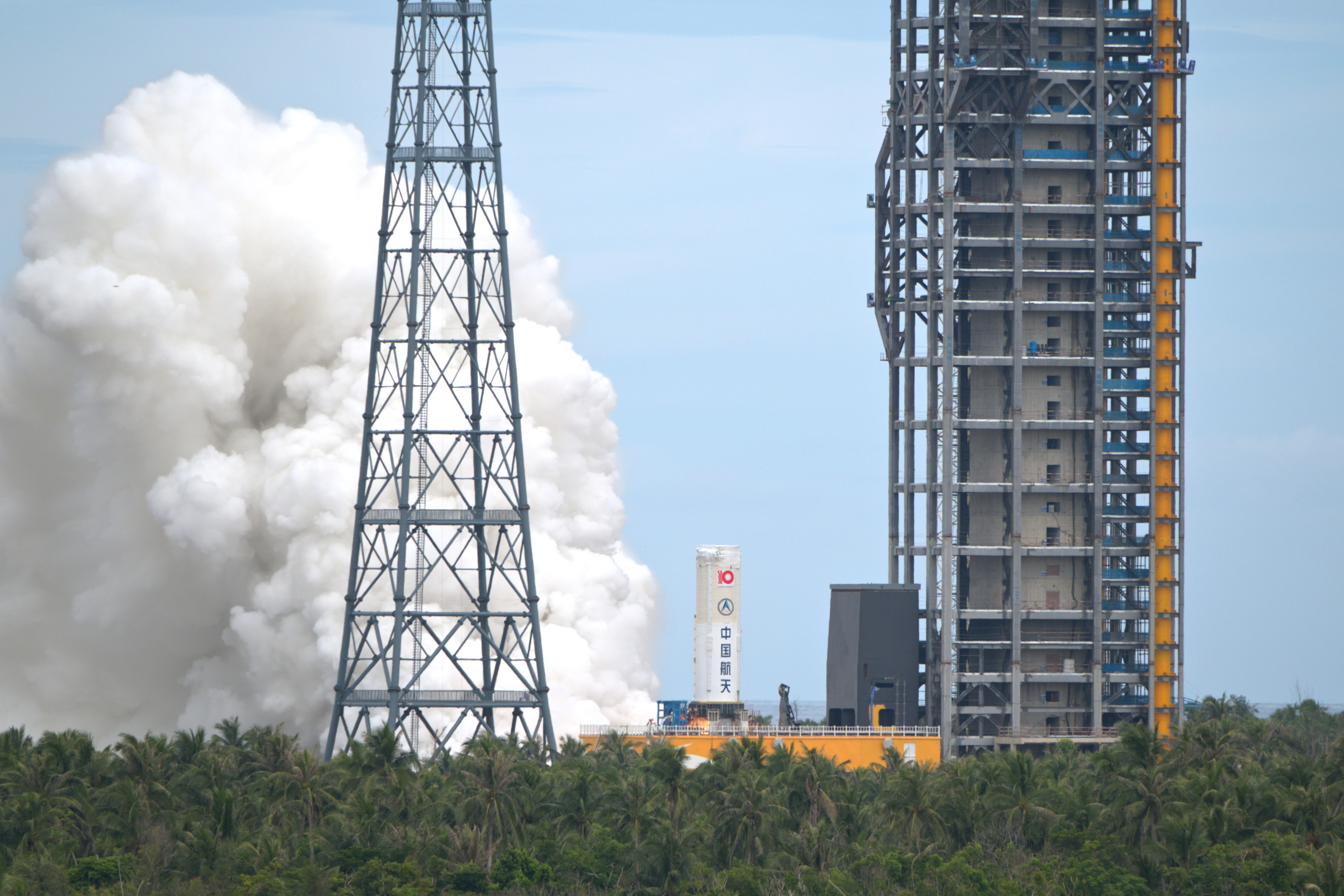
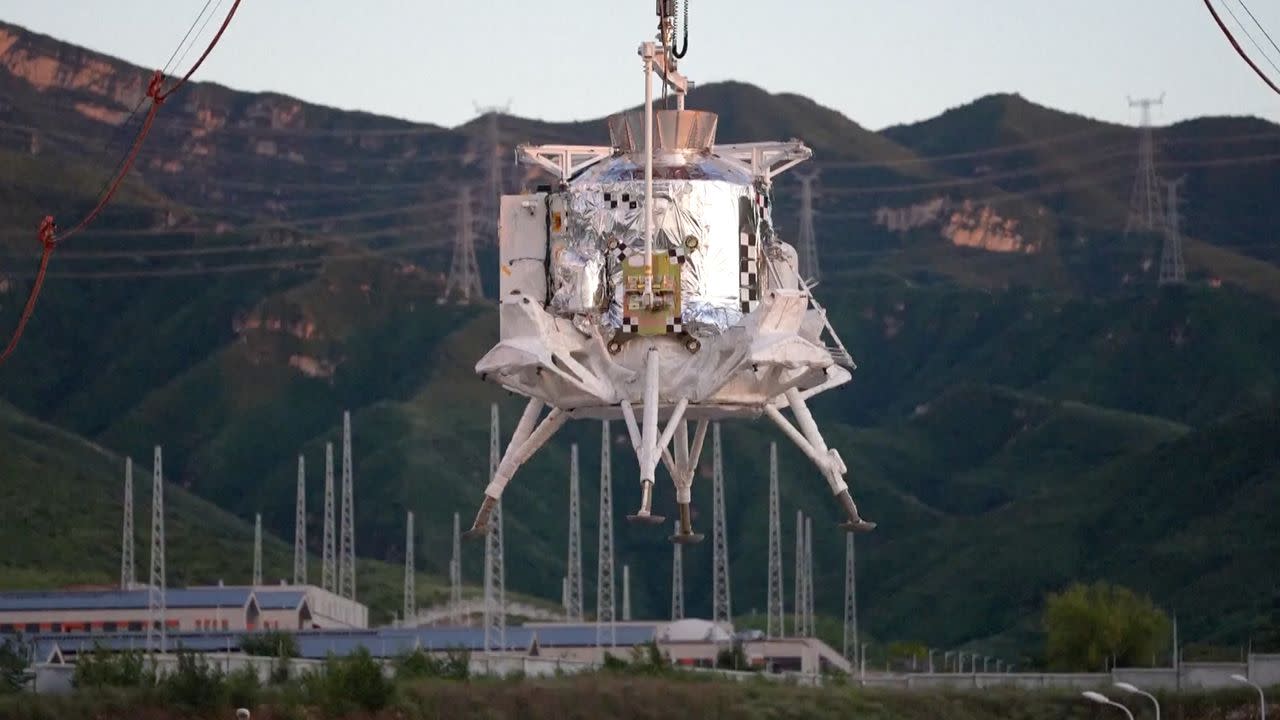
Progress report on China’s Moon rocket. China’s self-imposed deadline of landing astronauts on the Moon by 2030 is now just five years away, and we’re starting to see some tangible progress. Construction of the launch pad for the Long March 10 rocket, the massive vehicle China will use to launch its first crews toward the Moon, is well along at the Wenchang Space Launch Site on Hainan Island. An image shared on the Chinese social media platform Weibo, and then reposted on X, shows the Long March 10’s launch tower near its final height. A mobile launch platform presumably for the Long March 10 is under construction nearby.
Super heavy … The Long March 10 will be China’s most powerful rocket to date, with the ability to dispatch 27 metric tons of payload toward the Moon, a number comparable to NASA’s Space Launch System. Designed for partial reusability, the Long March 10 will use an all-liquid propulsion system and stand more than 92 meters (300 feet) tall. The rocket will launch Chinese astronauts inside the nation’s next-generation Mengzhou crew capsule, along with a lunar lander to transport crew members from lunar orbit to the surface of the Moon using an architecture similar to NASA’s Apollo program.
Next three launches
July 11: Electron | JAKE 4 | Wallops Flight Facility, Virginia | 23: 45 UTC
July 13: Falcon 9 | Dror 1 | Cape Canaveral Space Force Station, Florida | 04: 31 UTC
July 14: Falcon 9 | Starlink 15-2 | Vandenberg Space Force Base, California | 02: 27 UTC
Stephen Clark is a space reporter at Ars Technica, covering private space companies and the world’s space agencies. Stephen writes about the nexus of technology, science, policy, and business on and off the planet.
The SJ-21 and SJ-25 satellites “merged” on July 2 and have remained together since then.
This image from a telescope operated by s2a systems, a Swiss space domain awareness company, shows China’s SJ-21 and SJ-25 satellites flying near one another on June 26. Credit: s2a systems
Two Chinese satellites have rendezvoused with one another more than 20,000 miles above the Earth in what analysts believe is the first high-altitude attempt at orbital refueling.
China’s Shijian-21 and Shijian-25 satellites, known as SJ-21 and SJ-25 for short, likely docked together in geosynchronous orbit sometime last week. This is the conclusion of multiple civilian satellite trackers using open source imagery showing the two satellites coming together, then becoming indistinguishable as a single object.
Chinese officials have released no recent public information on what the two satellites are up to, but they’ve said a bit about their missions in prior statements.
SJ-25, which launched in January, is designed “for the verification of satellite fuel replenishment and life extension service technologies,” according to the Shanghai Academy of Spaceflight Technology, the Chinese state-owned contractor that developed the satellite. SJ-21 launched in 2021 and docked with a defunct Chinese Beidou navigation satellite in geosynchronous orbit, then towed it to a higher altitude for disposal before returning to the geosynchronous belt. Chinese officials described this demonstration as a test of “space debris mitigation” techniques.
More than meets the eye
These kinds of technologies are dual-use, meaning they have civilian and military applications. For example, a docking in geosynchronous orbit could foretell an emerging capability for China to approach, capture, and disable another country’s satellite. At the same time, the US Space Force is interested in orbital refueling as it seeks out ways to extend the lives of military satellites, which are often limited by finite fuel supplies.
The Space Force sometimes calls this concept dynamic space operations. While some military leaders remain skeptical about the payoff of in-space refueling, the Space Force has an agreement with Astroscale to perform the first refueling of a US military asset in orbit as soon as next year.
China appears to be poised to beat the US Space Force to the punch. The apparent docking of the two satellites last week suggests SJ-21 is the target for SJ-25’s refueling demonstration, and US officials are watching. Two of the Space Force’s inspector satellites, known by the acronym GSSAP, positioned themselves near SJ-21 and SJ-25 to get a closer look.
Retired Space Force Lt. Gen. John Shaw is a vocal proponent of dynamic space operations. Because of this, he’s interested in what happens with SJ-21 and SJ-25. Shaw was deputy commander of US Space Command before his retirement in 2023. In this role, Shaw had some oversight over GSSAP satellites as they roamed geosynchronous orbit.
“The theory behind dynamic space operations stemmed from a kind of operational frustration with our inability to conduct the full range of activities with GSSAP that we wanted to at Space Command, as the warfighter—largely due to the combination of fixed fuel availability and expected satellite lifetime,” Shaw told Ars.
As other countries, mainly China, step up their clandestine activities in orbit, military officials are asking more of the GSSAP satellites.
“It was operationally driven then, a couple years ago, but it’s now manifesting itself in much wider ways than even it did back then, particularly in the face of activities by potential adversaries,” Shaw said. “That’s why I’m more confident and even more zealous about it.”
Geosynchronous orbit is a popular location for military and commercial satellites. At an altitude of some 22,236 miles (35,786 kilometers), a satellite’s orbital velocity perfectly matches the speed of Earth’s rotation, meaning a spacecraft has a fixed view of the same region of the planet 24 hours per day. This is useful for satellites providing military forces with secure strategic communications and early warning of missile attacks.
Now, geosynchronous orbit is becoming a proving ground for new kinds of spacecraft to inspect or potentially attack other satellites. Ground-based anti-satellite missiles aren’t as useful in striking targets in high-altitude orbits, and there’s a consensus that, if you were to attack an enemy satellite, it would make more sense to use a weapons platform already in space that could move in and connect with the target without blowing it up and creating a cloud of dangerous space junk.
Keeping watch
The US military’s GSSAP satellites began launching in 2014. They carry enough propellant to maneuver around geosynchronous orbit and approach objects for closer inspection, but there’s a limit to what they can do. Six GSSAP satellites have been launched to date, but the Space Force decommissioned one of them in 2023. Meanwhile, China’s satellite operators are watching the watchers.
“We’ve seen where GSSAP safely and responsibly approaches a Chinese vehicle, and it just quickly maneuvers away,” Shaw said. “We tend to fly our GSSAPs like dirigibles, using relatively slow, minimum energy transfer approaches. The Chinese know that we do that, so it is relatively easy for them to maneuver away today to avoid such an approach.
“If tomorrow they’re able to refuel at will and operate even more dynamically, then the marginal cost of those maneuvers for them becomes even lower, and the challenge for GSSAP becomes even greater,” Shaw said.
Danish Rear Admiral Damgaard Rousøe, Danish Defence Attaché, right, observes space domain awareness data with US Space Force Lt. Col. Mark Natale, left, Joint Commercial Operations cell director, in Colorado Springs, Colorado, on September 26, 2024. Credit: US Space Force/Dalton Prejeant
China launched a satellite into geosynchronous orbit in 2016 with a robotic arm that could grab onto another object in space, then sent SJ-21 into orbit four years ago on its “space debris mitigation” mission.
Northrop Grumman launched two satellites in 2019 and 2020 that accomplished the first dockings in geosynchronous orbit. Northrop’s satellites, which it calls Mission Extension Vehicles, took control of two aging commercial communications satellites running low on fuel, maneuvering them to new locations and allowing them to continue operating for several more years. It’s easy to see that this kind of technology could be used for commercial or military purposes.
But these Mission Extension Vehicles don’t have the ability to transfer fluids from one satellite to another. That is the step China is taking with SJ-21 and SJ-25, presumably with hydrazine and nitrogen tetroxide propellants, which most satellites use because they combust on contact with one another.
US Space Command’s Joint Commercial Operations cell, which collects unclassified satellite monitoring data to bolster the military’s classified data sources, estimated the SJ-21 and SJ-25 satellites “merged” on July 2 and have remained together since then. The video below, released by s2a systems, shows SJ-25 approaching SJ-21 on June 30.
A time-lapse of yesterday’s SJ-25 / SJ-21 coverage, recorded from 08: 30 to 20: 53 UTC. pic.twitter.com/HUPWBTXZc9
The unclassified data does not confirm that the two satellites actually docked, but that is likely what happened. The satellites came together, or merged, on June 13 and June 30 but separated again within a few hours. These may have been practice runs, aborted docking attempts, or sudden maneuvers to avoid the prying eyes of the US military’s GSSAP satellites loitering nearby.
Now, the SJ-21 and SJ-25 have been flying together for more than five days with no discernible changes detected from ground-based telescopes. Thousands of miles over the equator, the two satellites appear only as dots in the viewfinders of these telescopes positioned around the globe.
What we don’t know
COMSPOC is a Pennsylvania-based company that collects and processes data from commercial satellite tracking sensors. COMSPOC fuses optical telescope imagery with radar tracking and passive radio frequency (RF) data, which uses radio signals to measure exact distances to satellites in space, to get the best possible estimate of a spacecraft’s position.
“With most telescopes… at 1 kilometer or a half a kilometer, somewhere in there, you’re going to start to lose it when they get that close,” said Paul Graziani, COMSPOC’s founder and CEO, in an interview with Ars. “I think it’d be difficult for any telescope, even a really capable one, to get within 100 meters. That seems to be a stretch for telescopes.”
That’s why it’s helpful to add radar and RF data to the mix.
“When you add all of that together, you become much better than the 1-kilometer [precision] that a ‘scope might be,” said Joe Callaro, COMSPOC’s director of operations. “RF tells you if part of that blob is moving and the other part isn’t, and even when they all become one pixel, you can tell things about that.”
Even then, companies like COMSPOC have a degree of uncertainty in their conclusions unless Chinese or US officials make a more definitive statement.
“We are not working with the government,” Callaro told Ars before last week’s apparent docking. “We are not clearing this. The charge that I have for my team is we won’t make assertions as to what’s going on. We will only tell what our software gives us as a solution. We can say, ‘Here are the elements, here’s the visual, but what it means and what it’s doing, we will not assert.’
“We will not say they’re docked because unless they told me, I wouldn’t know that,” Callaro said. “So, we will say they’ve been together for this amount of time, that the mission could have happened, and then they separated, became two, and separated at whatever speed.”
SJ-21’s behavior for the last couple of years suggested it was running empty after undertaking large propulsive maneuvers to capture the Chinese Beidou satellite and move it to a different orbit.
Callaro served as a tactician in the Air Force’s Joint Space Operations Center, then joined the Aerospace Corporation before taking the job as operations lead at COMSPOC. He doesn’t buy China’s suggestion that SJ-21 was purely an experiment in collecting space debris.
“That is not how I see that at all,” Callaro said. “The fact that we can calculate all the maneuvers it takes to get out and get back, and the fact that afterwards, it spent a couple of years basically not moving, probably because it was low on fuel, sets up the idea [that there’s more to SJ-21’s mission]. Now, SJ-25 goes out there, and it’s supposed to be a fuel tank, and it’s perfectly aligned with SJ-21 and now we see this happening, tells me that it’s much more a counter-space capability than it is a trash remove. But that’s what they say.”
Unless China makes a public statement on the refueling of SJ-21 by SJ-25, observers won’t know for sure if the servicing demo was successful until the satellites detach. Then, US officials and independent analysts will watch to see if SJ-21 makes any substantial maneuvers, which might indicate the satellite has a full tank of gas for whatever mission Chinese officials send it off to do next.
Listing image: Costfoto/Future Publishing via Getty Images
Stephen Clark is a space reporter at Ars Technica, covering private space companies and the world’s space agencies. Stephen writes about the nexus of technology, science, policy, and business on and off the planet.
Both countries agreed in Geneva last month to slash their respective tariffs by 115 percentage points and provided a 90-day window to resolve the trade war.
But the ceasefire came under pressure after Washington accused Beijing of reneging on an agreement to speed up the export of rare earths, while China criticized new US export controls.
This week’s talks to resolve the impasse were held in the historic Lancaster House mansion in central London, a short walk from Buckingham Palace, which was provided by the British government as a neutral ground for the talks.
Over the two days, the US team, which included Treasury Secretary Scott Bessent, Commerce Secretary Howard Lutnick, and US trade representative Jamieson Greer, [met with] the Chinese delegation, which was led by He Lifeng, a vice-premier responsible for the economy.
The negotiations were launched to ensure Chinese exports of rare earths to the US and American technology export controls on China did not derail broader talks between the sides.
Ahead of the first round of talks in Geneva, Bessent had warned that the high level of mutual tariffs had amounted to an effective embargo on bilateral trade.
Chinese exports to the US fell more steeply in May compared with a year earlier than at any point since the pandemic in 2020.
The US had said China was not honoring its pledge in Geneva to ease restrictions on rare earths exports, which are critical to the defense, car, and tech industries, and was dragging its feet over approving licenses for shipments, affecting manufacturing supply chains in the US and Europe.
Beijing has accused the US of “seriously violating” the Geneva agreement after it announced new restrictions on sales of chip design software to Chinese companies.
It has also objected to the US issuing new warnings on the global use of Huawei chips and canceling visas for Chinese students.
Separately, a US federal appeals court on Tuesday allowed some of Trump’s broadest tariffs to remain in place while it reviews a lower-court ruling that had blocked his “liberation day” levies on US trading partners.
The ruling extended an earlier temporary reprieve and will allow Trump to enact the measures as well as separate levies targeting Mexico, Canada, and China. The president has, however, already paused the wider “reciprocal” tariffs for 90 days.
Johnson, who heads China Strategies Group, a risk consultancy, said that China had successfully leveraged its stranglehold on rare earths to bring the US to the negotiating table in Geneva, which “left the Trump administration’s China hawks eager to demonstrate their export control weapons still have purchase.”
While it accounts for a relatively small share of the overall semiconductor industry, EDA software allows chip designers and manufacturers to develop and test the next generation of chips, making it a critical part in the supply chain.
Synopsys, Cadence Design Systems, and Siemens EDA—part of Siemens Digital Industries Software, a subsidiary of Germany’s Siemens AG—account for about 80 percent of China’s EDA market. Synopsys and Cadence did not immediately respond to requests for comment.
In fiscal year 2024, Synopsys reported almost $1 billion in China sales, roughly 16 percent of its revenue. Cadence said China accounted for $550 million or 12 percent of its revenue.
Synopsys shares fell 9.6 percent on Wednesday, while those of Cadence lost 10.7 percent.
Siemens said in a statement the EDA industry had been informed last Friday about new export controls. It said it had supported customers in China “for more than 150 years” and would “continue to work with our customers globally to mitigate the impact of these new restrictions while operating in compliance with applicable national export control regimes.”
In 2022, the Biden administration introduced restrictions on sales of the most sophisticated chip design software to China, but the companies continued to sell export control-compliant products to the country.
In his first term as president, Donald Trump banned China’s Huawei from using American EDA tools. Huawei is seen as an emerging competitor to Nvidia with its “Ascend” AI chips.
Nvidia chief executive Jensen Huang recently warned that successive attempts by American administrations to hamstring China’s AI ecosystem with export controls had failed.
Last year Synopsys entered into an agreement to buy Ansys, a US simulation software company, for $35 billion. The deal still requires approval from Chinese regulators. Ansys shares fell 5.3 percent on Wednesday.
On Wednesday the US Federal Trade Commission announced that both companies would need to divest certain software tools to receive its approval for the deal.
The export restrictions have encouraged Chinese competitors, with three leading EDA companies—Empyrean Technology, Primarius, and Semitronix—significantly growing their market share in recent years.
Shares of Empyrean, Primarius, and Semitronix rose more than 10 percent in early trading in China on Thursday.
Comet 311P/PanSTARRS was observed by the Hubble Space Telescope in 2013 with a set of six comet-like tails radiating from its main body. This object, also called P/2013 P5, is known as an active asteroid. Credit: NASA, ESA, and D. Jewitt (UCLA)
Tianwen-2’s mothership, with 11 scientific instruments, will commence the second phase of its mission after dropping off the asteroid specimens at Earth. The probe’s next journey will bring it near an enigma in the asteroid belt, named 311P/PanSTARRS, in the mid-2030s. This object is one in a rare class of objects known as active asteroids or main-belt comets, small worlds that have tails and comas like comets but loiter in orbits most commonly associated with asteroids. Tianwen-2 will be the first mission to see such an object up close.
Stepping into the Solar System
Until the last few years, China’s space program has primarily centered on the Moon as a destination for scientific exploration. The Moon remains the main target for China’s ambitions in space, with the goal of accomplishing a human lunar landing by 2030. But the country is looking farther afield, too.
With the Tianwen-1 mission in 2021, China became the second country to achieve a soft landing on Mars. After Tianwen-2, China will again go to Mars with the Tianwen-3 sample return mission, slated for launch in 2028.
China is looking at launching Tianwen-4 around 2029 to travel to Jupiter and enter orbit around Callisto, one of its four largest moons. In the 2030s, China’s roadmap includes a mission to return atmospheric samples from Venus to Earth, a Mars research station, and a probe to Neptune.
Meanwhile, NASA has sent spacecraft to study every planet in the Solar System and currently has spacecraft at or on the way to the Moon, Mars, Jupiter, a metal asteroid, and to interstellar space. Another US science mission, Dragonfly, is scheduled for launch in 2028 on a daring expedition to Saturn’s moon Titan.
But NASA’s science division is bracing for severe budget cuts proposed by President Donald Trump. In planetary science, the White House’s budget blueprint calls for canceling a joint US-European Mars Sample Return mission and several other projects, including the DAVINCI mission to Venus.