eBay

i-bought-“remove-before-flight”-tags-on-ebay-in-2010—it-turns-out-they’re-from-challenger

I bought “Remove Before Flight” tags on eBay in 2010—it turns out they’re from Challenger


40th anniversary of the Challenger tragedy

“This is an attempt to learn more…”

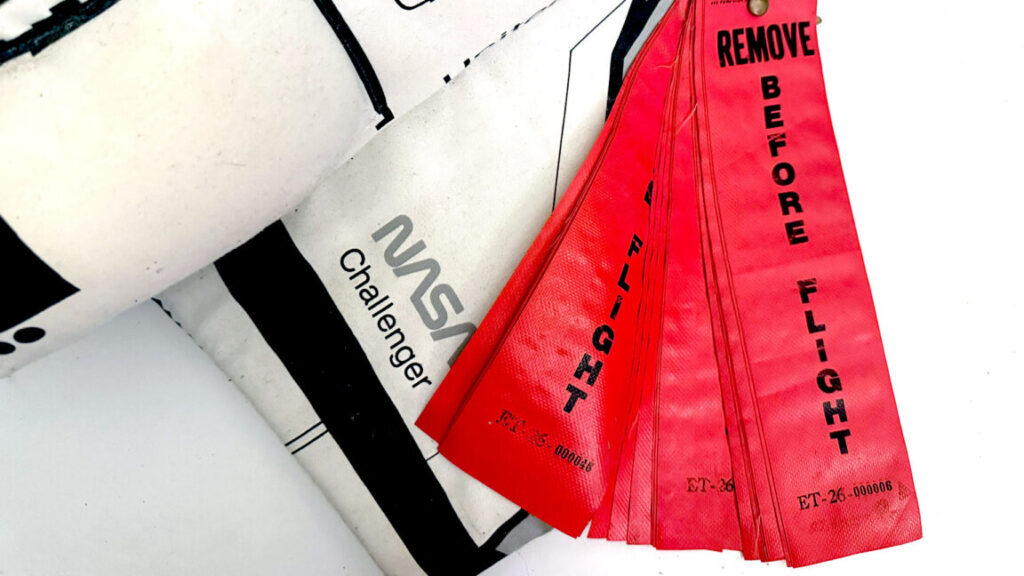
The stack of 18 “Remove Before Flight” tags as they were clipped together for sale on eBay in 2010. It was not until later that their connection to the Challenger tragedy was learned. Credit: collectSPACE.com

Forty years ago, a stack of bright red tags shared a physical connection with what would become NASA’s first space shuttle disaster. The small tags, however, were collected before the ill-fated launch of Challenger, as was instructed in bold “Remove Before Flight” lettering on the front of each.

What happened to the tags after that is largely unknown.

This is an attempt to learn more about where those “Remove Before Flight” tags went after they were detached from the space shuttle and before they arrived on my doorstep. If their history can be better documented, they can be provided to museums, educational centers, and astronautical archives for their preservation and display.

To begin, we go back 16 years to when they were offered for sale on eBay.

From handout to hold on

The advertisement on the auction website was titled “Space Shuttle Remove Before Flight Flags Lot of 18.” They were listed with an opening bid of $3.99. On January 12, 2010, I paid $5.50 as the winner.

At that point, my interest in the 3-inch-wide by 12-inch-long (7.6 by 30.5 cm) tags was as handouts for kids and other attendees at future events. Whether it was at an astronaut autograph convention, a space memorabilia show, a classroom visit, or a conference talk, having “swag” was a great way to foster interest in space history. At first glance, these flags seemed to be a perfect fit.

So I didn’t pay much attention when they first arrived. The eBay listing had promoted them only as generic examples of “KSC Form 4-226 (6/77)”—the ID the Kennedy Space Center assigned to the tags. There was no mention of their being used, let alone specifying an orbiter or specific flight. If I recall correctly, the seller said his intention had been to use them on his boat.

(Attempts to retrieve the original listing for this article were unsuccessful. As an eBay spokesperson said, “eBay does not retain transaction records or item details dating back over a decade, and therefore we do not have any information to share with you.”)

It was about a year later when I first noticed the ink stamps at the bottom of each tag. They were marked “ET-26” followed by a number. For example, the first tag in the clipped-together stack was stamped “ET-26-000006.”
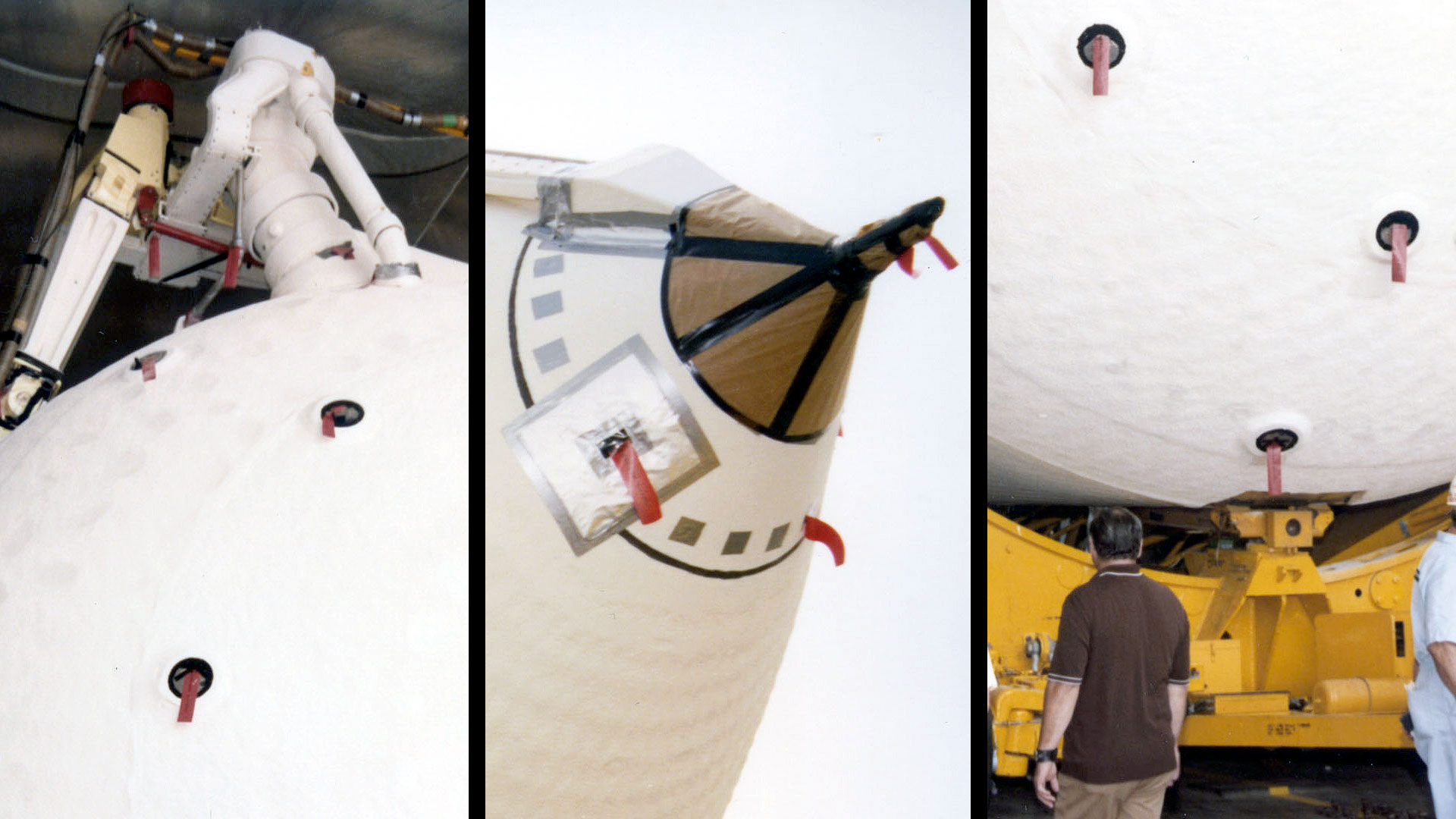
Bright red tags can be seen attached to a large component of space shuttle hardware.

The same type of “Remove Before Flight” tags that were attached to ET-26 for Challenger‘s ill-fated STS-51L mission can be seen on one of the first two external tanks before it was flown, as distinguished by the insulation having been painted white.

The same type of “Remove Before Flight” tags that were attached to ET-26 for Challenger‘s ill-fated STS-51L mission can be seen on one of the first two external tanks before it was flown, as distinguished by the insulation having been painted white. Credit: NASA via collectSPACE.com

“ET” refers to the External Tank. The largest components of the space shuttle stack, the burnt orange or brown tanks were numbered, so 26 had to be one of the earlier missions of the 30-year, 135-flight program.

A fact sheet prepared by Lockheed Martin provided the answer. The company operated at the Michoud Assembly Facility near New Orleans, where the external tanks were built before being barged to the Kennedy Space Center for launch. Part of the sheet listed each launch with its date and numbered external tank. As my finger traced down the page, it came to STS 61-B, 11/26/85, ET-22; STS 61-C, 1/12/86, ET-30; and then STS 51-L, 1/28/86… ET-26.

Removed but still connected

To be clear, the tags had no role in the loss of Challenger or its crew, including commander Dick Scobee; pilot Mike Smith; mission specialists Ronald McNair, Judith Resnik, and Ellison Onizuka; payload specialist Gregory Jarvis; and Teacher-in-Space Christa McAuliffe. Although the structural failure of the external tank ultimately resulted in Challenger breaking apart, it was a compromised O-ring seal in one of the shuttle’s two solid rocket boosters that allowed hot gas to burn through, impinging the tank.

Further, although it’s still unknown when the tags and their associated ground support equipment (e.g., protective covers, caps) were removed, it was not within hours of the launch, and in many cases, it was completed well before the vehicle reached the pad.

“They were removed later in processing at different times but definitely all done before propellant loading,” said Mike Cianilli, the former manager of NASA’s Apollo, Challenger, Columbia Lessons Learned Program. “To make sure they were gone, final walkdowns and closeouts by the ground crews confirmed removal.”
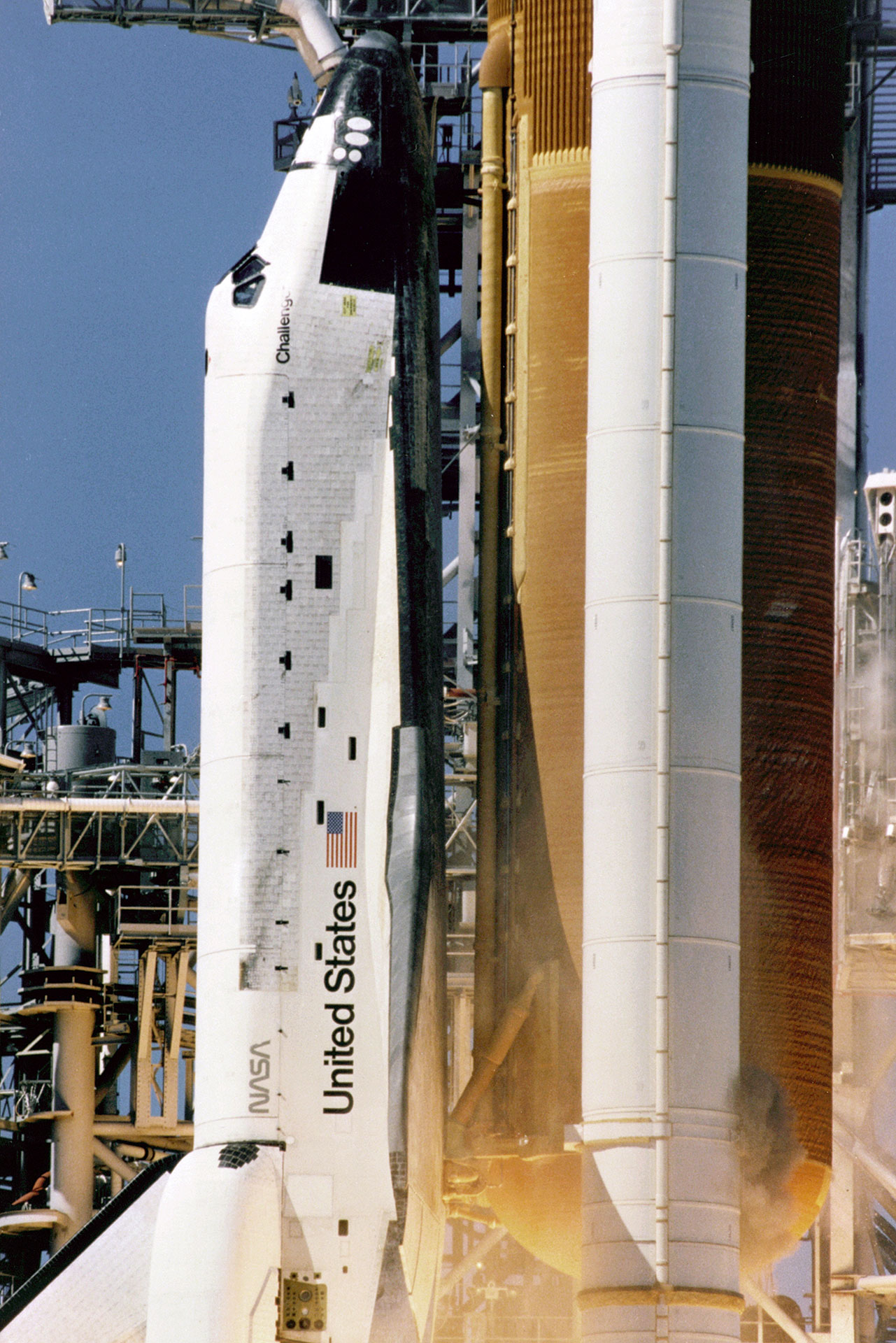
Close-up view of the liftoff of the space shuttle Challenger on its ill-fated last mission, STS-51L. A cloud of grey-brown smoke can be seen on the right side of the solid rocket booster on a line directly across from the letter “U” in United States. This was the first visible sign that an SRB joint breach may have occurred, leading to the external tank (ET-26) being compromised during its ascent.

Credit: NASA

Close-up view of the liftoff of the space shuttle Challenger on its ill-fated last mission, STS-51L. A cloud of grey-brown smoke can be seen on the right side of the solid rocket booster on a line directly across from the letter “U” in United States. This was the first visible sign that an SRB joint breach may have occurred, leading to the external tank (ET-26) being compromised during its ascent. Credit: NASA

According to NASA, approximately 20 percent of ET-26 was recovered from the ocean floor after the tragedy, and like the parts of the solid rocket boosters and Challenger, they were placed into storage in two retired missile silos at the Cape Canaveral Air Force Station (today, Space Force Station). Components removed from the vehicle before the ill-fated launch that were no longer needed likely went through the normal surplus processes as overseen by the General Services Administration, said Cianilli.

Once the tags’ association with STS-51L was confirmed, it no longer felt right to use them as giveaways. At least, not to individuals.

There are very few items directly connected to Challenger‘s last flight that museums and other public centers can use to connect their visitors to what transpired 40 years ago. NASA has placed only one piece of Challenger on public display, and that is in the exhibition “Forever Remembered” at the Kennedy Space Center Visitor Complex.

Each of the 50 US states, the Smithsonian, and the president of the United States were also presented with a small American flag and a mission patch that had been aboard Challenger at the time of the tragedy.

Having a more complete history of these tags would help meet the accession requirements of some museums and, if approved, provide curators with the information they need to put the tags on display.

Reconnecting to flight

When the tags were first identified, contacts at NASA and Lockheed, among others, were unable to explain how they ended up on eBay and, ultimately, with me.

It was 2011, and the space shuttle program was coming to its end. I was politely told that this was not the time to ask about the tags, as documents were being moved into archives and, perhaps more importantly, people were more concerned about pending layoffs. One person suggested the tags be put back in a drawer and forgotten about for another decade.

In the years since, other “Remove Before Flight” tags from other space shuttle missions have come up for sale. Some have included evidence that the tags had passed through the surplus procedures; some did not and were offered as is.
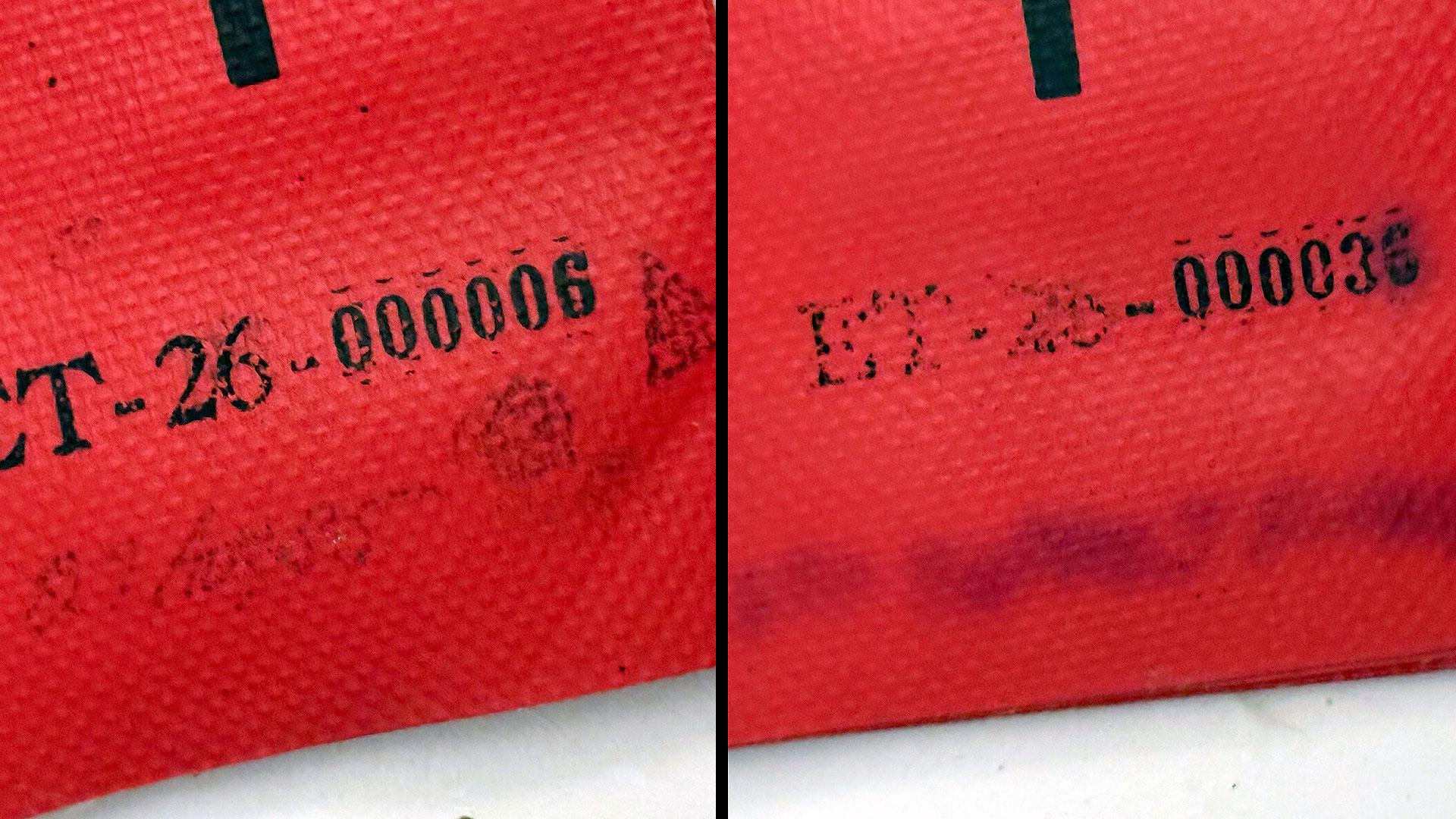
Close-up detail of two of the 18 shuttle “Return Before Flight” tags purchased off eBay. All were marked “ET-26” with a serial number. Some included additional stamps and handwritten notations. Most of the latter, though, has bled into the fabric to the point that it can no longer be read.

Close-up detail of two of the 18 shuttle “Return Before Flight” tags purchased off eBay. All were marked “ET-26” with a serial number. Some included additional stamps and handwritten notations. Most of the latter, though, has bled into the fabric to the point that it can no longer be read. Credit: collectSPACE.com

There were anecdotes about outgoing employees taking home mementos. Maybe someone saw these tags heading out as scrap (or worse, being tossed in the garbage) and, recognizing what they were, saved them from being lost to history. An agent with the NASA Office of Inspector General once said that dumpster diving was not prohibited, so long as the item(s) being dived for were not metal (due to recycling).

More recent attempts to reach people who might know anything about the specific tags have been unsuccessful, other than the few details Cianilli was able to share. An attempt to recontact the eBay seller has so far gone unanswered.

If you or someone you know worked on the external tank at the time of the STS-51L tragedy, or if you’re familiar with NASA’s practices regarding installing, retrieving, and archiving or disposing of the Remove Before Flight tags, please get in contact.
Photo of Robert Pearlman

Robert Pearlman is a space historian, journalist and the founder and editor of collectSPACE, a daily news publication and online community focused on where space exploration intersects with pop culture. He is also a contributing writer for Space.com and co-author of “Space Stations: The Art, Science, and Reality of Working in Space” published by Smithsonian Books in 2018. He is on the leadership board for For All Moonkind and is a member of the American Astronautical Society’s history committee.


I bought “Remove Before Flight” tags on eBay in 2010—it turns out they’re from Challenger Read More »

ebay-bans-illicit-automated-shopping-amid-rapid-rise-of-ai-agents

eBay bans illicit automated shopping amid rapid rise of AI agents

On Tuesday, eBay updated its User Agreement to explicitly ban third-party “buy for me” agents and AI chatbots from interacting with its platform without permission, first spotted by Value Added Resource. On its face, a one-line terms of service update doesn’t seem like major news, but what it implies is more significant: The change reflects the rapid emergence of what some are calling “agentic commerce,” a new category of AI tools designed to browse, compare, and purchase products on behalf of users.

eBay’s updated terms, which go into effect on February 20, 2026, specifically prohibit users from employing “buy-for-me agents, LLM-driven bots, or any end-to-end flow that attempts to place orders without human review” to access eBay’s services without the site’s permission. The previous version of the agreement contained a general prohibition on robots, spiders, scrapers, and automated data gathering tools but did not mention AI agents or LLMs by name.

At first glance, the phrase “agentic commerce” may sound like aspirational marketing jargon, but the tools are already here, and people are apparently using them. While fitting loosely under one label, these tools come in many forms.

OpenAI first added shopping features to ChatGPT Search in April 2025, allowing users to browse product recommendations. By September, the company launched Instant Checkout, which lets users purchase items from Etsy and Shopify merchants directly within the chat interface. (In November, eBay CEO Jamie Iannone suggested the company might join OpenAI’s Instant Checkout program in the future.)

eBay bans illicit automated shopping amid rapid rise of AI agents Read More »

ebay-listings-for-banned-chemicals-shielded-by-section-230,-judge-rules

eBay listings for banned chemicals shielded by Section 230, judge rules

No sale —

DOJ can’t force eBay to remove environmentally harmful product listings.

eBay listings for banned chemicals shielded by Section 230, judge rules

eBay has defeated a lawsuit that the US Department of Justice raised last fall, which alleged that eBay violated environmental protection and public safety laws by allowing users to sell hundreds of thousands of banned products.

Among products targeted by the DOJ suit were at least 343,011 “aftermarket products for motor vehicles” used to “tamper with or disable vehicle emissions control systems” and at least 23,000 “unregistered, misbranded, or restricted use pesticides.” The DOJ also took issue with sales of products containing methylene chloride, which is used as a “thinning agent in paint and coating removal products.” Most uses of that chemical were banned by the Environmental Protection Agency this April to prevent causing cancer, liver harm, and death.

In her order, US District Judge Orelia Merchant agreed with eBay that the DOJ failed to prove that eBay was liable for selling some of these targeted products. Ultimately, Merchant ruled that whether the products violated environmental laws or not, Section 230 barred all of the DOJ’s claims, as eBay is shielded from liability for third-party postings (in this case, listings) on its platform.

“eBay contends that it does not actually ‘sell’ any item listed on its platform,” Merchant wrote, pointing to a precedent set in a 2004 lawsuit where the jewelry company Tiffany attempted to sue eBay over counterfeit items. Merchant agreed with the Second Circuit, which affirmed that “eBay did not itself sell counterfeit Tiffany goods; only the fraudulent vendors did,” mainly due to the fact that eBay “never physically possesses” the goods that are sold on its platform. For the same reason, Merchant found that eBay never sold any of the restricted items the DOJ flagged last year.

While the entire motion to dismiss was granted, the DOJ did succeed in arguing that eBay had violated the Toxic Substances Control Act (TSCA) and the Methylene Chloride Rule by not removing some listings for products containing methylene chloride.

Under those laws, the DOJ persuasively alleged that eBay was a “retailer” who introduced and “distributed in commerce” products containing methylene chloride, Merchant’s order noted.

eBay’s attempt to defend against that claim by narrowly arguing that the TSCA should only be applied to the literal first seller to introduce a product to market not only failed, Merchant said, but also threatened to “undermine the TSCA’s regulatory scope” as a law designed to protect the public from any introduction of harmful substances.

However, none of that matters, eBay argued, because Section 230 bars that claim, too. Merchant agreed that without “allegations… eBay fails to remove third-party listings (conduct that is plainly immune under Section 230),” and the government’s complaint “would not state a claim.”

eBay vows to help prevent toxic sales

Perhaps the government had hoped that eBay might settle the lawsuit, as the company did last February in a DOJ case over the sales of pill presses. Similar to the DOJ’s bid to hold eBay liable for enabling product sales causing environmental harms, the DOJ had accused eBay of selling pill presses tied to fentanyl drug rings amid an opioid epidemic killing 100,000 people annually at its peak. Both suits were designed to stop eBay from distributing products causing harms, but only one succeeded.

In the pill press case, eBay did not invoke the Section 230 shield. Instead, eBay admitted no wrongdoing while agreeing to “pay $59 million” and voluntarily removing products targeted by the DOJ. In a statement, eBay said this was “in the best interest of the company and its shareholders as it avoids the costs, uncertainty, and distraction associated with protracted litigation.”

eBay did not appear concerned that the environmental lawsuit might have similarly long legs in court. An eBay spokesperson told Ars that the company appreciated the court’s “thoughtful review,” which “found that the government’s lawsuit should not be permitted to move forward.”

“Maintaining a safe and trusted marketplace for our global community of sellers and buyers is a fundamental principle of our business at eBay,” eBay’s spokesperson said. “As we have throughout our history, eBay will continue to invest significant resources to support its well-recognized and proactive efforts to help prevent prohibited items from being listed on our marketplace.”

Because Merchant granted eBay’s motion to dismiss the DOJ’s lawsuit over alleged environmental harms with prejudice, the DOJ will not have a chance to re-file the case in the same court but could possibly appeal to a higher court.

The DOJ declined Ars’ request for comment.

eBay listings for banned chemicals shielded by Section 230, judge rules Read More »

no-one-wanted-these-ps5-concord-discs-until-sony-stopped-making-them

No one wanted these PS5 Concord discs until Sony stopped making them

Oh, so now you want to buy it —

eBay prices have risen quickly less than a week since online game’s shutdown.

  • If you paid $40 for the physical edition of Concord, you can make a lot more than that back on eBay.

    Kyle Orland

  • The “Limited Edition” Concord-themed DualSense controller has seen some rapid resale price inflation as well.

    Kyle Orland

As recently as a week ago, a new disc copy of Sony’s team-based shooter Concord on the PlayStation 5 would set you back about $40 at most retailers. Now that Sony has shut off the game’s servers after just two weeks, you might think those now-useless discs would be practically worthless.

Instead, the physical version of Concord on PS5 has become a surprise collector’s item. An Ars analysis of nearly 300 eBay listings completed between September 3–8 shows new copies of the now-defunct game selling for a median price of $100 since the game’s shutdown. That going rate peaked at a median of $118 on September 5, up from $89.50 on September 3, before settling at $110 for eBay sales made on September 8.

Supply and demand

As usual with gaming collectibles, the price increase has less to do with playability and more to do with rarity. GameDiscoverCo analyst Simon Carless told IGN last month that he estimated an underwhelming 25,000 total sales for Concord across PS5 and PC. Even if we assume 80 percent of those sales were on the PS5, most of those console sales probably came as purely digital downloads, given long-running industry trends and the game’s focus on online play.

That means the total number of PS5 Concord discs in the wild could number in the single-digit thousands, easily making it one of the rarest physical first-party games Sony has ever released. And with Sony officially halting Concord sales as of September 3, that number isn’t going to go up anytime soon.

Sony encouraged players who purchased a physical copy of Concord to “please refer to the refund process of the retailer you purchased it from to obtain your refund.” Players who followed that advice missed out on the opportunity to make a pretty quick return on their investment through eBay reselling, though. A couple of lucky eBay sellers even pulled in nearly $500 for sealed copies of the game sold on September 5.

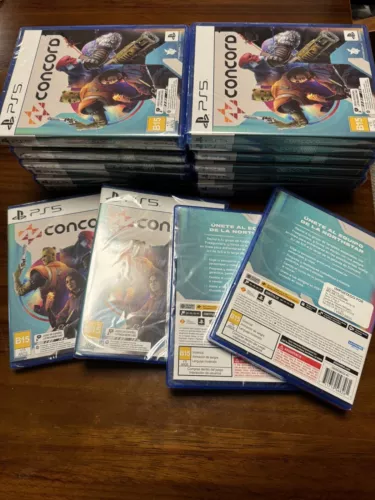
Concord discs ready to flip.” height=”400″ src=”https://cdn.arstechnica.net/wp-content/uploads/2024/09/concorddiscs-300×400.png” width=”300″>

Enlarge / One eBay seller seemed to have a lot of Concord discs ready to flip.

eBay

Even without those kinds of outliers, though, most eBay sellers have been able to get between $87 (20th percentile) and $120 (80th percentile) for new disc copies of the game since it was discontinued. That’s an easy 100 to 200 percent return on a $40 investment in well under a month. And the photos on some of those eBay listings suggest a few sellers were looking to cash in by reselling dozens of copies in individual lots.

The collector’s mania for Concord has seemingly extended to a limited edition-themed controller that Sony was selling for $85 as well. Completed eBay listings for that controller went for a median price of $252.50 on September 8, up from just $132 on September 3. Unlike the game they’re based on, though, those controllers have the benefit of still working with PS5 hardware well into the future.

The <em>Concord</em>-themed DualSense controller at least still works now that the game has been discontinued.” height=”580″ src=”https://cdn.arstechnica.net/wp-content/uploads/2024/09/concordcontroller.png” width=”580″></img><figcaption>
<p>The <em>Concord</em>-themed DualSense controller at least still works now that the game has been discontinued.</p>
<p>Sony</p>
</figcaption></figure>
<p>At the moment, it’s hard to tell how long these pricing trends will last. If there’s a wider market of PlayStation collectors looking for a rare piece of Sony history, <em>Concord</em> could become the modern equivalent of <a href=the NES’ Stadium Events—a rare but forgettable game that collectors still value. But if speculators are driving the current mania—hoping to quickly resell it for more to the next person in line—the pricing bubble could burst just as quickly as it inflated.

All that speculation could also come crashing down if Sony decides to relaunch Concord sales in the future. In the game’s shutdown announcement, Sony said it was “explor[ing] options, including those that will better reach our players.” Already, there is a tongue-in-cheek petition effort to convince Sony to do just that, with nearly 2,000 signatories to its name. “We were all busy that week,” the petition’s title reads. “Please release Concord again.”

Listing image by eBay

No one wanted these PS5 Concord discs until Sony stopped making them Read More »

long-lost-model-of-the-uss-enterprise-returned-to-roddenberry-family

Long-lost model of the USS Enterprise returned to Roddenberry family

To Boldly Return —

It showed up in an eBay listing; now Roddenberry’s son wants to show it to fans.

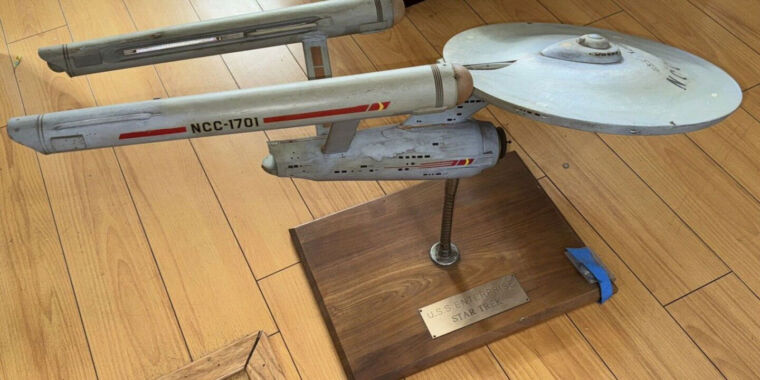
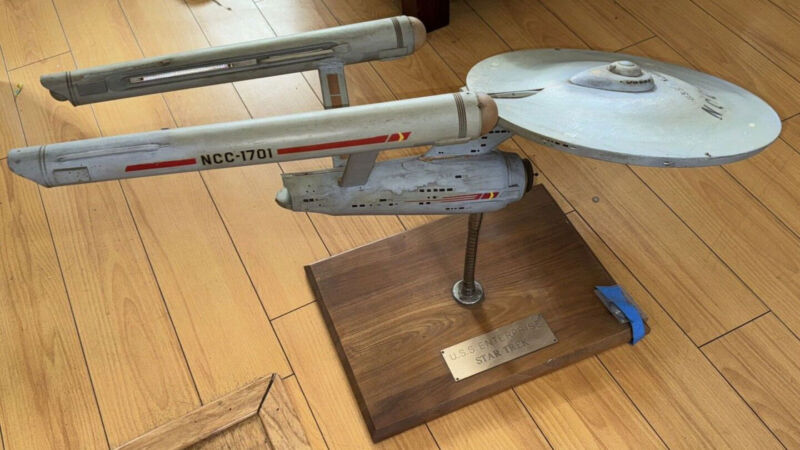
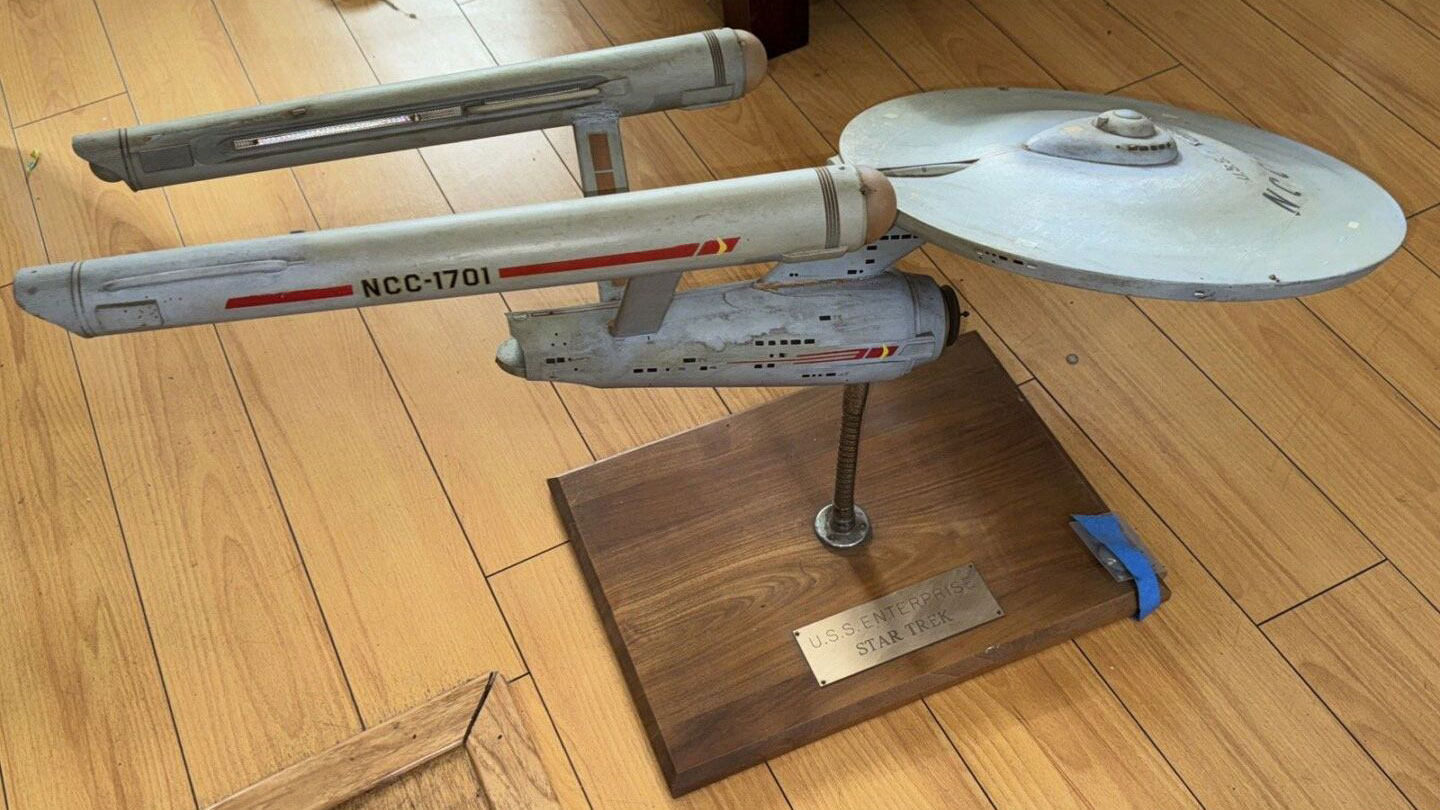
This mysterious model appeared on eBay with little fanfare.

Enlarge / This mysterious model appeared on eBay with little fanfare.

eBay

The first-ever model of Star Trek’s USS Enterprise NCC-1701 has been returned to the Roddenberry family, according to an ABC News report.

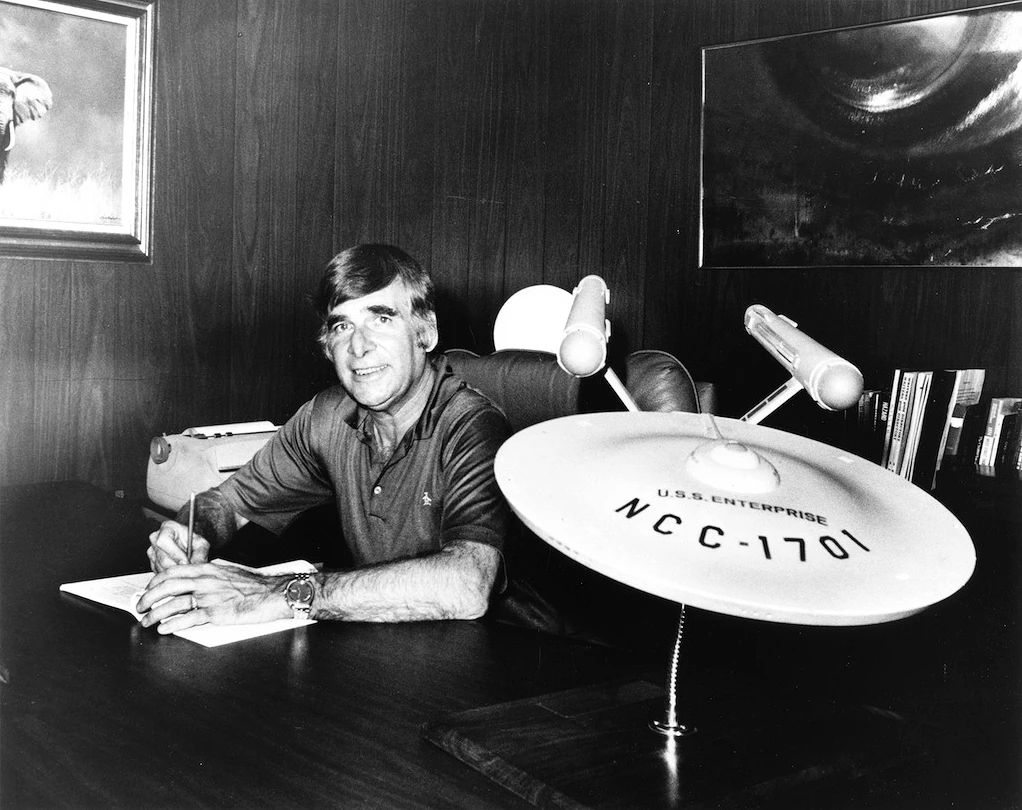
The three-foot model was used to shoot the pilot and credits scene for Star Trek’s original series in the 1960s and was used occasionally for shots throughout the series. (Typically, a larger, 11-foot model was used for shots after the pilot.) The model also sat on series creator Gene Roddenberry’s desk for several years.

It went missing in the late 1970s; historians and collectors believe it belonged to Roddenberry himself, that he lent it to a production house working on Star Trek: The Motion Picture, and that it was never returned. Its whereabouts were unknown until last fall, when a listing for a mysterious model of the Enterprise appeared on eBay.

Enthusiasts analyzed the pictures in the listing and came to believe it was the long-lost three-foot production model. They contacted the seller, who quickly took down the listing.

The eBay account that posted the item specialized in selling artifacts found in storage lockers that end up without an owner, either because of failure to pay or death.

The model appeared in this promotional image with Roddenberry.

The model appeared in this promotional image with Roddenberry.

CBS

The model was turned over by the eBay seller to Texas-based Heritage Auctions. News spread that it had been discovered, and Gene Roddenberry’s son, Eugene “Rod” Roddenberry, made public statements that he would like to see it returned to his family.

After that, there were months of silence, and its fate was unknown—until now. Heritage Auctions announced that it had given the model to Rod Roddenberry. Details of the exchange have not been shared, but Roddenberry said he did compensate Heritage in some way.

Heritage reached out directly to Roddenberry upon acquiring the object and reportedly decided to return it because it was “the right thing to do.” Roddenberry said that he “felt it important to reward that and show appreciation for that” but didn’t disclose a sum.

Promotional images of the model with William Shatner and Leonard Nimoy.

Promotional images of the model with William Shatner and Leonard Nimoy.

Roddenberry also revealed what he has planned for the model:

This is not going home to adorn my shelves. This is going to get restored and we’re working on ways to get it out so the public can see it, and my hope is that it will land in a museum somewhere.

He runs a group called the Roddenberry Foundation that has scanned and digitized many relics from Star Trek’s ideation and production over the years, so it’s likely the Foundation will get a crack at the model, too.

Listing image by eBay

Long-lost model of the USS Enterprise returned to Roddenberry family Read More »

ebay-lays-off-1,000-employees,-about-9-percent-of-full-time-workforce

eBay lays off 1,000 employees, about 9 percent of full-time workforce

eBay layoffs —

Cutting 1,000 jobs, eBay says “headcount and expenses have outpaced” growth.

A large eBay logo on a sign near the company headquarters building.

Getty Images | Justin Sullivan

eBay is laying off approximately 1,000 employees in a move that reduces its full-time workforce by 9 percent, the company announced yesterday. eBay also plans “to scale back the number of contracts we have within our alternate workforce over the coming months,” CEO Jamie Iannone wrote in a message to staff that was titled, “Ensuring eBay’s Long-Term Success.”

Iannone cited “the challenging macroeconomic environment” and said that eBay has too many employees. “While we are making progress against our strategy, our overall headcount and expenses have outpaced the growth of our business,” he wrote.

eBay asked all US-based employees to work from home on Wednesday “to provide some space and privacy” for conversations in which laid-off employees were to be given the bad news. The 1,000 layoffs come nearly one year after eBay eliminated 500 employees.

eBay reported $2.5 billion of revenue in its most recent quarterly earnings, for Q3 2023, a rise of 5 percent year over year. Q3 2023 net income was $1.3 billion, whereas the company had reported a net loss of $70 million in Q3 2022. eBay’s Q3 operating income was $455 million, down from $568 million the previous year.

eBay exceeded earnings expectations

eBay also said it “returned $783 million to shareholders in Q3, including $651 million of share repurchases and $132 million paid in cash dividends.” eBay’s stock price was up 0.48 percent today but has fallen about 5 percent this month.

“In Q3, we met or exceeded expectations across all of our key financial metrics,” eBay Chief Financial Officer Steve Priest said at the time. “Our strong balance sheet and operational rigor enable us to adapt to the evolving changes in this dynamic macro environment. We will continue to be prudent with cost efficiencies, saving to invest for the future, while remaining good stewards of capital for our shareholders.”

Even though eBay beat earnings estimates in Q3, The Wall Street Journal pointed out some challenges facing the company going forward. “The company has been under pressure amid rising competition from the likes of Amazon.com and Walmart, as well as from emerging Chinese retailers such as Temu and Shein,” the WSJ wrote. “High interest rates and sticky inflation in the US and other major economies have also weighed on consumers’ discretionary spending.”

eBay’s layoff announcement is the latest in a string of job cuts in the tech industry. Amazon this month announced layoffs of 500 employees at Twitch and several hundred more at its MGM and Prime Video divisions. Google announced layoffs of 100 employees at YouTube after previously laying off hundreds of workers in several other divisions.

eBay lays off 1,000 employees, about 9 percent of full-time workforce Read More »

ebay-hit-with-$3m-fine,-admits-to-“terrorizing-innocent-people”

eBay hit with $3M fine, admits to “terrorizing innocent people”

“Never-ending nightmare” —

eBay must pay maximum fine for putting Massachusetts couple “through pure hell.”

eBay hit with $3M fine, admits to “terrorizing innocent people”

eBay has agreed to pay $3 million—the maximum criminal penalty possible—after employees harassed, intimidated, and stalked a Massachusetts couple in retaliation for their critical reporting of the online marketplace in 2019.

“Today’s settlement holds eBay criminally and financially responsible for emotionally, psychologically, and physically terrorizing the publishers of an online newsletter out of fear that bad publicity would adversely impact their Fortune 500 company,” Jodi Cohen, the special agent in charge of the Federal Bureau of Investigation Boston Division, said in a Justice Department press release Thursday.

eBay’s harassment campaign against the couple, David and Ina Steiner, stretched for 18 days in August 2019 and was led by the company’s former senior director of safety and security, Jim Baugh. It started when then-CEO Devin Wenig and then-chief communications officer Steven Wymer decided to “take down” the Steiners after growing frustrated with their coverage of eBay in a newsletter called EcommerceBytes.

Executing the “take down,” Baugh and six co-conspirators “put the victims through pure hell,” acting US attorney Joshua S. Levy wrote in the DOJ’s press release.

The former eBay employees turned the Steiners’ world “upside-down through a never-ending nightmare of menacing and criminal acts,” Levy said. That included “sending anonymous and disturbing deliveries,” such as “a book on surviving the death of a spouse, a bloody pig mask, a fetal pig and a funeral wreath and live insects,” the DOJ said. The intimidation also included publishing a series of “Craigslist posts inviting the public for sexual encounters at the victims’ home.”

But the intimidation did not stop there. After sending tweets and DMs threatening to visit the couple’s home, former eBay employees escalated the criminal activity by traveling to Massachusetts and installing a GPS tracker on the Steiners’ car. Spotting their stalkers, the Steiners called local police, who coordinated with the FBI to investigate what Levy called an “unprecedented stalking campaign” fueled by eBay’s toxic corporate culture.

Once police got involved, the former eBay employees tried to cover their tracks. Baugh and his team falsified records and deleted evidence to throw the cops “off the trail,” the DOJ said. Baugh was also caught making false statements to police and internal investigators and subsequently became the first eBay employee involved who was imprisoned in 2022 for “terrorizing innocent people,” Levy said.

In a press release, eBay confirmed that the company admitted to all the relevant facts that law enforcement uncovered in the case.

“The company’s conduct in 2019 was wrong and reprehensible,” said Jamie Iannone, eBay’s CEO. “From the moment eBay first learned of the 2019 events, eBay cooperated fully and extensively with law enforcement authorities. We continue to extend our deepest apologies to the Steiners for what they endured.”

Cohen acknowledged that the settlement “cannot erase the significant distress this couple suffered” but said that the DOJ hopes slapping eBay with the maximum fine “will deter others from engaging in similar conduct.”

“No one should ever feel unsafe in their own home,” Cohen said.

Ars could not immediately reach the Steiners’ lawyer for comment on the settlement.

Under eBay’s agreement with the DOJ, eBay must “retain an independent corporate compliance monitor” to ensure the company’s corporate culture never pushes employees to engage in such criminal conduct again.

All seven former eBay employees have been convicted on felony charges, the DOJ said. As the “ringleader,” Baugh was sentenced to 57 months in federal prison. Others have received prison sentences between 12 and 24 months. Two former employees were sentenced to a year of home confinement. One co-conspirator has pleaded guilty and is still awaiting sentencing.

In the end, the DOJ said that “eBay was charged criminally with two counts of stalking through interstate travel, two counts of stalking through electronic communications services, one count of witness tampering, and one count of obstruction of justice, and has entered into a deferred prosecution agreement.”

Through the deferred prosecution agreement, eBay must remain compliant and fully cooperate with the DOJ’s terms for three years. If that process is successful, the US attorney will “dismiss the criminal information against eBay.”

The DOJ announced criminal penalties during Stalking Awareness Month, when advocates work to raise awareness that stalking is a serious crime.

After taking responsibility for the misconduct of its former employee, eBay seems ready to put the harassment campaign in its past.

“Since these events occurred, new leaders have joined the company and eBay has strengthened its policies, procedures, controls and training,” eBay said. “eBay remains committed to upholding high standards of conduct and ethics and to making things right with the Steiners.”

eBay hit with $3M fine, admits to “terrorizing innocent people” Read More »