exoplanets

researchers-spot-saturn-sized-planet-in-the-“einstein-desert”

Researchers spot Saturn-sized planet in the “Einstein desert”


Rogue, free-floating planets appear to have two distinct origins.

Most of the exoplanets we’ve discovered have been in relatively tight orbits around their host stars, allowing us to track them as they repeatedly loop around them. But we’ve also discovered a handful of planets through a phenomenon that’s called microlensing. This occurs when a planet passes between the line of sight between Earth and another star, creating a gravitational lens that distorts the star, causing it to briefly brighten.

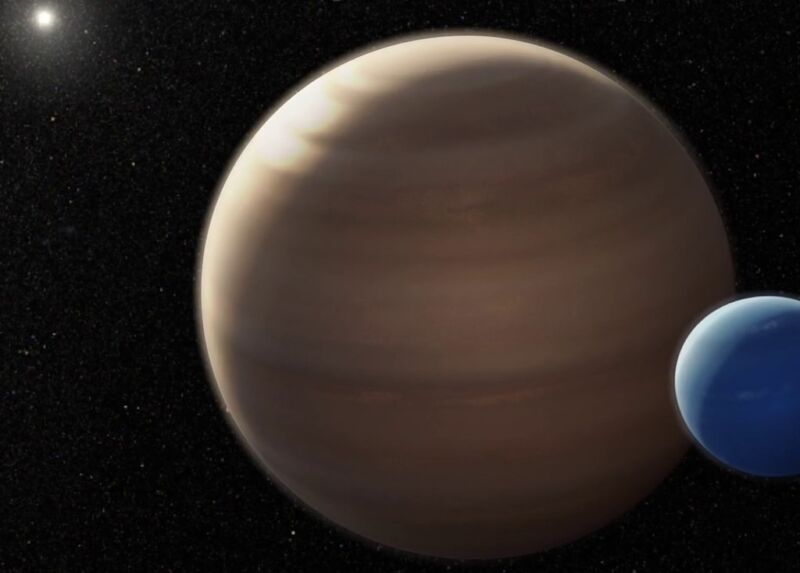
The key thing about microlensing compared to other methods of finding planets is that the lensing planet can be nearly anywhere on the line between the star and Earth. So, in many cases, these events are driven by what are called rogue planets: those that aren’t part of any exosolar system at all, but they drift through interstellar space. Now, researchers have used microlensing and the fortuitous orientation of the Gaia space telescope to spot a Saturn-sized planet that’s the first found in what’s called the “Einstein desert,” which may be telling us something about the origin of rogue planets.

Going rogue

Most of the planets we’ve identified are in orbit around stars and formed from the disks of gas and dust that surrounded the star early in its history. We’ve imaged many of these disks and even seen some with evidence of planets forming within them. So how do you get a planet that’s not bound to any stars? There are two possible routes.

The first involves gravitational interactions, either among the planets of the system or due to an encounter between the exosolar system and a passing star. Under the right circumstances, these interactions can eject a planet from its orbit and send it hurtling through interstellar space. As such, we should expect them to be like any typical planet, ranging in mass from small, rocky bodies up to gas giants. An alternative method of making a rogue planet starts with the same process of gravitational collapse that builds a star—but in this case, the process literally runs out of gas. What’s left is likely to be a large gas giant, possibly somewhere between Jupiter and a brown dwarf star in mass.

Since these objects are unlinked to any exosolar system, they’re not going to have any regular interactions with stars; our only way of spotting them is through microlensing. And microlensing tells us very little about the size of the planet. To figure things out, we would need some indication of things like how distant the star and planet are, and how big the star is.

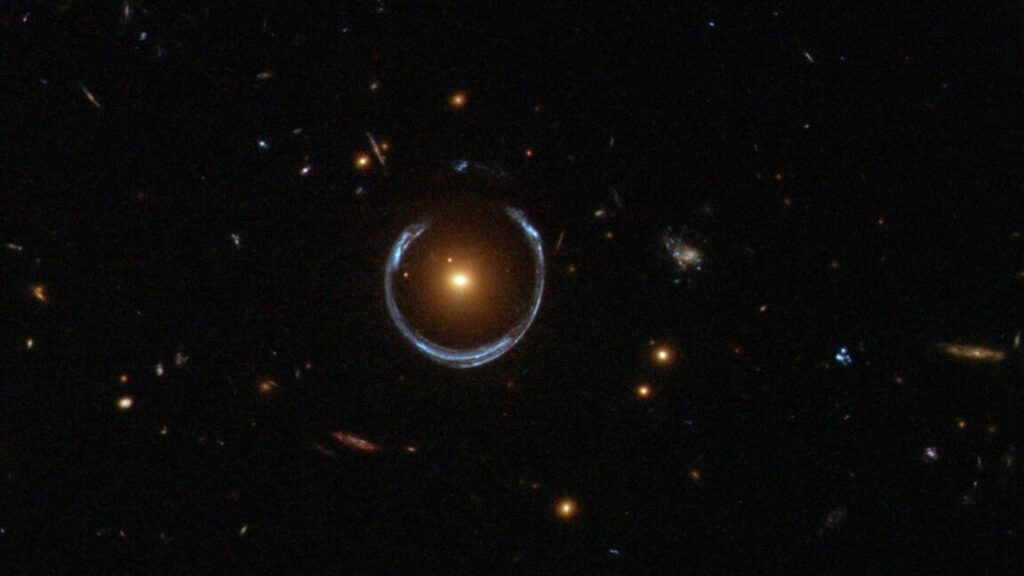
That doesn’t mean that microlensing events have told us nothing. We can identify the size of the Einstein ring, the circular ring of light that forms when the planet and star are perfectly lined up from Earth’s perspective. Given that information and some of the remaining pieces of info mentioned above, we can figure out the planet’s mass. But even without that, we can make some inferences using statistical models.

Studies of collections of microlensing events (these collections are small, typically in the dozens, because these events are rare and hard to spot) have identified a distinctive pattern. There’s a cluster of relatively small Einstein rings that are likely to have come from relatively small planets. Then, there’s a gap, followed by a second cluster that’s likely to be made by far larger planets. The gap between the two has been termed the “Einstein desert,” and there has been considerable discussion regarding its significance and whether it’s even real or simply a product of the relatively small sample size.

Sometimes you get lucky

All of which brings us to the latest microlensing event, which was picked up by two projects that each gave it a different but equally compelling name. To the Korea Microlensing Telescope Network, the event was KMT-2024-­BLG-­0792. For the Optical Gravitational Lensing Experiment, or OGLE, it was OGLE-­2024-­BLG-­0516. We’ll just call it “the microlensing event” and note that everyone agrees that it happened in early May 2024.

Both of those networks are composed of Earth-based telescopes, and so they only provide a single perspective on the microlensing event. But we got lucky that the European Space Agency’s space telescope Gaia was oriented in a way that made it very easy to capture images. “Serendipitously, the KMT-­2024-­BLG-­0792/OGLE-­2024-­BLG-­0516 microlensing event was located nearly perpendicular to the direction of Gaia’s precession axis,” the researchers who describe this event write. “This rare geometry caused the event to be observed by Gaia six times over a 16-­hour period.”

Gaia is also located at the L2 Lagrange point, which is a considerable distance from Earth. That’s far enough away that the peak of the events’ brightness, as seen from Gaia’s perspective, occurred nearly two hours later than it did for telescopes on Earth. This let us determine the parallax of the microlensing event, and thus its distance. Other images of the star from before or after the event indicated it was a red giant in the galactic bulge, which also gave us a separate check on its likely distance and size.

Using the parallax and the size of the Einstein ring, the researchers determined that the planet involved was roughly 0.2 times the mass of Jupiter, which makes it a bit smaller than the mass of Saturn. Those estimates are consistent with a statistical model that took the other properties into account. The measurements also placed it squarely in the middle of the Einstein desert—the first microlensing event we’ve seen there.

That’s significant because it means we can orient the Einstein desert to a specific mass of a planet within it. Because of the variability of things like distance and the star’s size, not every planet that produces a similar-sized Einstein ring will be similar in size, but statistics suggest that this will typically be the case. And that’s in keeping with one of the potential explanations for the Einstein desert: that it represents the gap in size between the two different methods of making a rogue planet.

For the normal planet formation scenario, the lighter the planet is, the easier it is to be ejected, so you’d expect a bias toward small, rocky bodies. The Saturn-sized planet seen here may be near the upper limit of the sorts of bodies we’d typically see being ejected from an exosolar system. By contrast, the rogue planets that form through the same mechanisms that give us brown dwarfs would typically be Jupiter-sized or larger.

That said, the low number of total microlensing events still leaves the question of the reality of the Einstein gap an open question. Sticking with the data from the Korea Microlensing Telescope Network, the researchers find that the frequency of other detections suggests that we’d have a 27 percent chance of detecting just one item in the area of the Einstein desert even if the desert wasn’t real and detections were equal probably across the size range. So, as is often the case, we’re going to need to let the network do its job for a few years more before we have the data to say anything definitive.

Science, 2026. DOI: 10.1126/science.adv9266 (About DOIs).

Photo of John Timmer

John is Ars Technica’s science editor. He has a Bachelor of Arts in Biochemistry from Columbia University, and a Ph.D. in Molecular and Cell Biology from the University of California, Berkeley. When physically separated from his keyboard, he tends to seek out a bicycle, or a scenic location for communing with his hiking boots.

Researchers spot Saturn-sized planet in the “Einstein desert” Read More »

the-$4.3-billion-space-telescope-trump-tried-to-cancel-is-now-complete

The $4.3 billion space telescope Trump tried to cancel is now complete


“We’re going to be making 3D movies of what is going on in the Milky Way galaxy.”

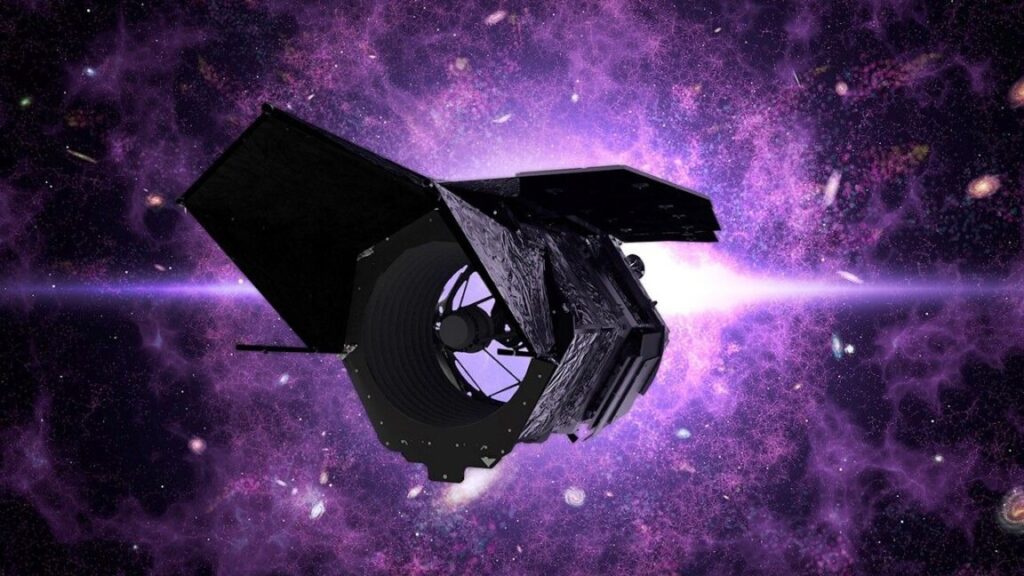
Artist’s concept of the Nancy Grace Roman Space Telescope. Credit: NASA Goddard Space Flight Center Scientific Visualization Studio

A few weeks ago, technicians inside a cavernous clean room in Maryland made the final connection to complete assembly of NASA’s Nancy Grace Roman Space Telescope.

Parts of this new observatory, named for NASA’s first chief astronomer, recently completed a spate of tests to ensure it can survive the shaking and intense sound of a rocket launch. Engineers placed the core of the telescope inside a thermal vacuum chamber, where it withstood the airless conditions and extreme temperature swings it will see in space.

Then, on November 25, teams at NASA’s Goddard Space Flight Center in Greenbelt, Maryland, joined the inner and outer portions of the Roman Space Telescope. With this milestone, NASA declared the observatory complete and on track for launch as soon as fall 2026.

“The team is ecstatic,” said Jackie Townsend, the observatory’s deputy project manager at Goddard, in a recent interview with Ars. “It has been a long road, but filled with lots of successes and an ordinary amount of challenges, I would say. It’s just so rewarding to get to this spot.”

An ordinary amount of challenges is not something you usually hear a NASA official say about a one-of-a-kind space mission. NASA does hard things, and they usually take more time than originally predicted. Astronomers endured more than 10 years of delays, fixes, and setbacks before the James Webb Space Telescope finally launched in 2021.

Webb is the largest telescope ever put into space. After launch, Webb had to perform a sequence of more than 50 major deployment steps, with 178 release mechanisms that had to work perfectly. Any one of the more than 300 single points of failure could have doomed the mission. In the end, Webb unfolded its giant segmented mirror and delicate sunshield without issue. After a quarter-century of development and more than $11 billion spent, the observatory is finally delivering images and science results. And they’re undeniably spectacular.

The completed Nancy Grace Roman Space Telescope, seen here with its solar panels deployed inside a clean room at NASA’s Goddard Space Flight Center in Maryland. Credit: NASA/Jolearra Tshiteya

Seeing far and wide

Roman is far less complex, with a 7.9-foot (2.4-meter) primary mirror that is nearly three times smaller than Webb’s. While it lacks Webb’s deep vision, Roman will see wider swaths of the sky, enabling a cosmic census of billions of stars and galaxies near and far (on the scale of the Universe). This broad vision will support research into dark matter and dark energy, which are thought to make up about 95 percent of the Universe. The rest of the Universe is made of regular atoms and molecules that we can see and touch.

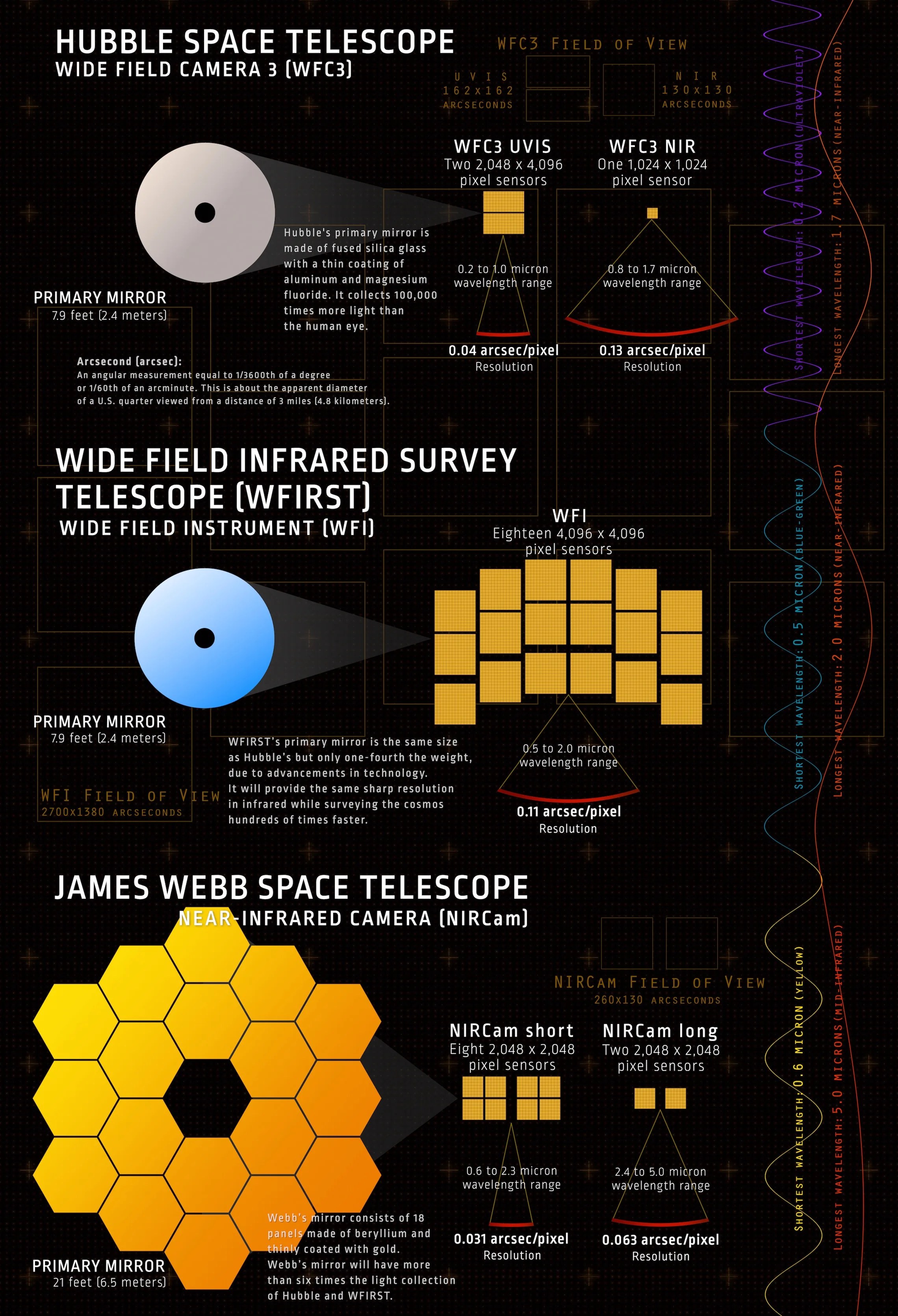
It is also illustrative to compare Roman with the Hubble Space Telescope, which has primary mirrors of the same size. This means Roman will produce images with similar resolution to Hubble. The distinction lies deep inside Roman, where technicians have delicately laid an array of detectors to register the faint infrared light coming through the telescope’s aperture.

“Things like night vision goggles will use the same basic detector device, just tuned to a different wavelength,” Townsend said.

These detectors are located in Roman’s Wide Field Instrument, the mission’s primary imaging camera. There are 18 of them, each 4,096×4,096 pixels wide, combining to form a roughly 300-megapixel camera sensitive to visible and near-infrared light. Teledyne, the company that produced the detectors, says this is the largest infrared focal plane ever made.

The near-infrared channel on Hubble’s Wide Field Camera 3, which covers much the same part of the spectrum as Roman, has a single 1,024-pixel detector.

“That’s how you get to a much higher field-of-view for the Roman Space Telescope, and it was one of the key enabling technologies,” Townsend told Ars. “That was one place where Roman invested significant dollars, even before we started as a mission, to mature that technology so that it was ready to infuse into this mission.”

With these detectors in its bag, Roman will cover much more cosmic real estate than Hubble. For example, Roman will be able to re-create Hubble’s famous Ultra Deep Field image with the same sharpness, but expand it to show countless stars and galaxies over an area of the sky at least 100 times larger.

This infographic illustrates the differences between the sizes of the primary mirrors and detectors on the Hubble, Roman, and Webb telescopes. Credit: NASA

Roman has a second instrument, the Roman Coronagraph, with masks, filters, and adaptive optics to block out the glare from stars and reveal the faint glow from objects around them. It is designed to photograph planets 100 million times fainter than their stars, or 100 to 1,000 times better than similar instruments on Webb and Hubble. Roman can also detect exoplanets using the tried-and-true transit method, but scientists expect the new telescope will find a lot more than past space missions, thanks to its wider vision.

“With Roman’s construction complete, we are poised at the brink of unfathomable scientific discovery,” said Julie McEnery, Roman’s senior project scientist at NASA Goddard, in a press release. “In the mission’s first five years, it’s expected to unveil more than 100,000 distant worlds, hundreds of millions of stars, and billions of galaxies. We stand to learn a tremendous amount of new information about the universe very rapidly after Roman launches.”

Big numbers are crucial for learning how the Universe works, and Roman will feed vast volumes of data down to astronomers on Earth. “So much of what physics is trying to understand about the nature of the Universe today needs large number statistics in order to understand,” Townsend said.

In one of Roman’s planned sky surveys, the telescope will cover in nine months what would take Hubble between 1,000 and 2,000 years. In another survey, Roman will cover an area equivalent to 3,455 full moons in about three weeks, then go back and observe a smaller portion of that area repeatedly over five-and-a-half days—jobs that Hubble and Webb can’t do.

“We will do fundamentally different science,” Townsend said. “In some subset of our observations, we’re going to be making 3D movies of what is going on in the Milky Way galaxy and in distant galaxies. That is just something that’s never happened before.”

Getting here and getting there

Roman’s promised scientific bounty will come at a cost of $4.3 billion, including expenses for development, manufacturing, launch, and five years of operations.

This is about $300 million more than NASA expected when it formally approved Roman for development in 2020, an overrun the agency blamed on complications related to the coronavirus pandemic. Otherwise, Roman’s budget has been stable since NASA officials finalized the mission’s architecture in 2017, when it was still known by a bulky acronym: WFIRST, the Wide Field InfraRed Survey Telescope.

At that time, the agency reclassified the Roman Coronagraph as a technology demonstration, allowing managers to relax their requirements for the instrument and stave off concerns about cost growth.

Roman survived multiple attempts by the first Trump administration to cancel the mission. Each time, Congress restored funding to keep the observatory on track for launch in the mid-2020s. With Donald Trump back in the White House, the administration’s budget office earlier this year again wanted to cancel Roman. Eventually, the Trump administration released its fiscal year 2026 budget request in May, calling for a drastic cut to Roman, but not total cancellation.

Once again, both houses of Congress signaled their opposition to the cuts, and the mission remains on track for launch next year, perhaps as soon as September. This is eight months ahead of the schedule NASA has publicized for Roman for the last few years.

Townsend told Ars the mission escaped the kind of crippling cost overruns and delays that afflicted Webb through careful planning and execution. “Roman was under a cost cap, and we operated to that,” she said. “We went through reasonable efforts to preclude those kinds of highly complex deployments that lead you to having trouble in integration and test.”

The outer barrel section of the Roman Space Telescope inside a thermal vacuum chamber at NASA’s Goddard Space Flight Center, Maryland. Credit: NASA/Sydney Rohde

There are only a handful of mechanisms that must work after Roman’s launch. They include a deployable cover designed to shield the telescope’s mirror during launch and solar array wings that will unfold once Roman is in space. The observatory will head to an observing post about a million miles (1.5 million kilometers) from Earth.

“We don’t have moments of terror for the deployment,” Townsend said. “Obviously, launch is always a risk, the tip-off rates that you have when you separate from the launch vehicle… Then, obviously, getting the aperture door open so that it’s deployed is another one. But these feel like normal aerospace risks, not unusual, harrowing moments for Roman.”

It also helps that Roman will use a primary mirror gifted to NASA by the National Reconnaissance Office, the US government’s spy satellite agency. The NRO originally ordered the mirror for a telescope that would peer down on the Earth, but the spy agency no longer needed it. Before NASA got its hands on the surplus mirror in 2012, scientists working on the preliminary design for what became Roman were thinking of a smaller telescope.

The larger telescope will make Roman a more powerful tool for science, and the NRO’s donation eliminated the risk of a problem or delay manufacturing a new mirror. But the upside meant NASA had to build a more massive spacecraft and use a bigger rocket to accommodate it, adding to the observatory’s cost.

Tests of Roman’s components have gone well this year. Work on Roman continued at Goddard through the government shutdown in the fall. On Webb, engineers uncovered one problem after another as they tried to verify the observatory would perform as intended in space. There were leaky valves, tears in the Webb’s sunshield, a damaged transducer, and loose screws. With Roman, engineers so far have found no “significant surprises” during ground testing, Townsend said.

“What we always hope when you’re doing this final round of environmental tests is that you’ve wrung out the hardware at lower levels of assembly, and it looks like, in Roman’s case, we did a spectacular job at the lower level,” she said.

With Roman now fully assembled, attention at Goddard will turn to an end-to-end functional test of the observatory early next year, followed by electromagnetic interference testing, and another round of acoustic and vibration tests. Then, perhaps around June of next year, NASA will ship the observatory to Kennedy Space Center, Florida, to prepare for launch on a SpaceX Falcon Heavy rocket.

“We’re really down to the last stretch of environmental testing for the system,” Townsend said. “It’s definitely already seen the worst environment until we get to launch.”

Photo of Stephen Clark

Stephen Clark is a space reporter at Ars Technica, covering private space companies and the world’s space agencies. Stephen writes about the nexus of technology, science, policy, and business on and off the planet.

The $4.3 billion space telescope Trump tried to cancel is now complete Read More »
3d-map-of-exoplanet-atmosphere-shows-wacky-climate

3D map of exoplanet atmosphere shows wacky climate

Last year, astronomers discovered an unusual Earth-size exoplanet they believe has a hemisphere of molten lava, with its other hemisphere tidally locked in perpetual darkness. And at about the same time, a different group discovered a rare small, cold exoplanet with a massive outer companion 100 times the mass of Jupiter.

Meet Tylos

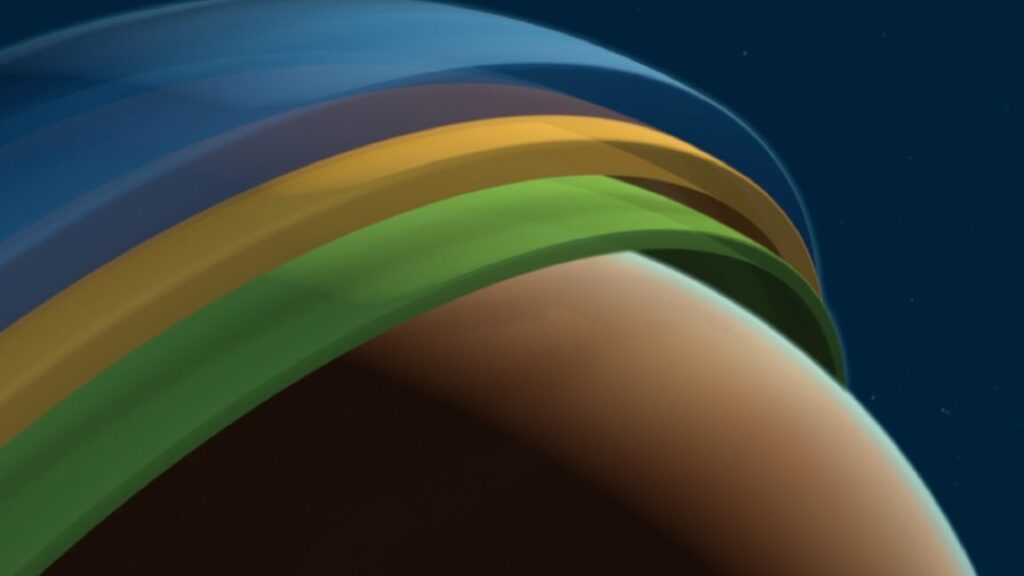
The different layers of the atmosphere on WASP-121b.

This latest research relied on observational data collected by the European South Observatory’s (ESO) Very Large Telescope, specifically, a spectroscopic instrument called ESPRESSO that can process light collected from the four largest VLT telescope units into one signal. The target exoplanet, WASP-121b—aka Tylos—is located in the Puppis constellation about 900 light-years from Earth. One year on Tylos is equivalent to just 30 hours on Earth, thanks to the exoplanet’s close proximity to its host star. Since one side is always facing the star, it is always scorching, while the exoplanet’s other side is significantly colder.

Those extreme temperature contrasts make it challenging to figure out how energy is distributed in the atmospheric system, and mapping out the 3D structure can help, particularly with determining the vertical circulation patterns that are not easily replicated in our current crop of global circulation models, per the authors. For their analysis, they combined archival ESPRESSO data collected on November 30, 2018, with new data collected on September 23, 2023. They focused on three distinct chemical signatures to probe the deep atmosphere (iron), mid-atmosphere (sodium), and shallow atmosphere (hydrogen).

“What we found was surprising: A jet stream rotates material around the planet’s equator, while a separate flow at lower levels of the atmosphere moves gas from the hot side to the cooler side. This kind of climate has never been seen before on any planet,” said Julia Victoria Seidel of the European Southern Observatory (ESO) in Chile, as well as the Observatoire de la Côte d’Azur in France. “This planet’s atmosphere behaves in ways that challenge our understanding of how weather works—not just on Earth, but on all planets. It feels like something out of science fiction.”

Nature, 2025. DOI: 10.1038/s41586-025-08664-1

Astronomy and Astrophysics, 2025. DOI: 10.1051/0004-6361/202452405  (About DOIs).

3D map of exoplanet atmosphere shows wacky climate Read More »

webb-directly-images-giant-exoplanet-that-isn’t-where-it-should-be

Webb directly images giant exoplanet that isn’t where it should be

How do you misplace that? —

Six times bigger than Jupiter, the planet is the oldest and coldest yet imaged.

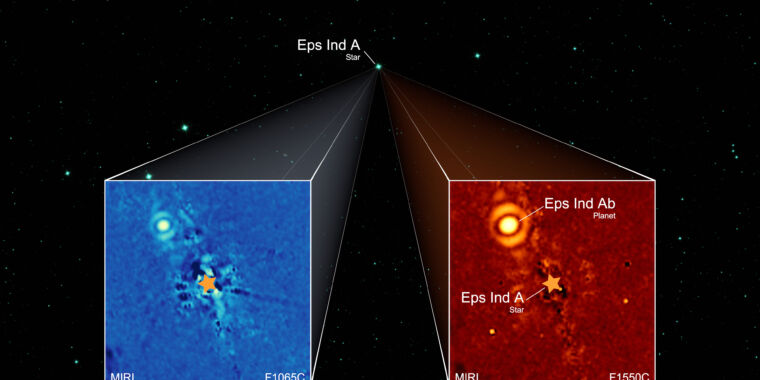
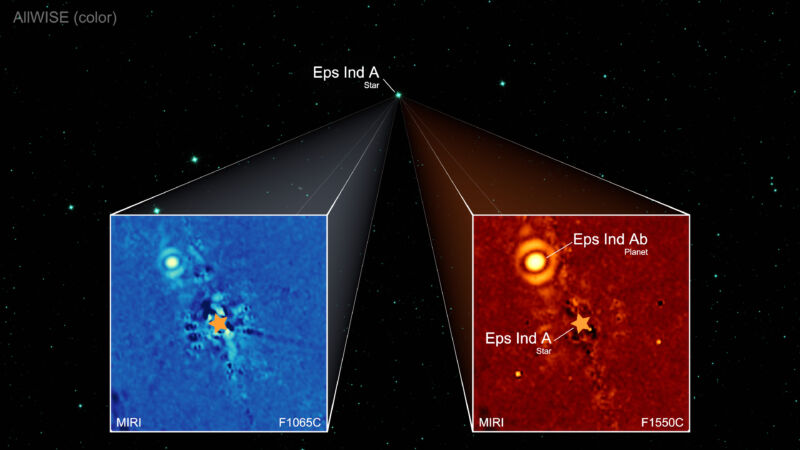
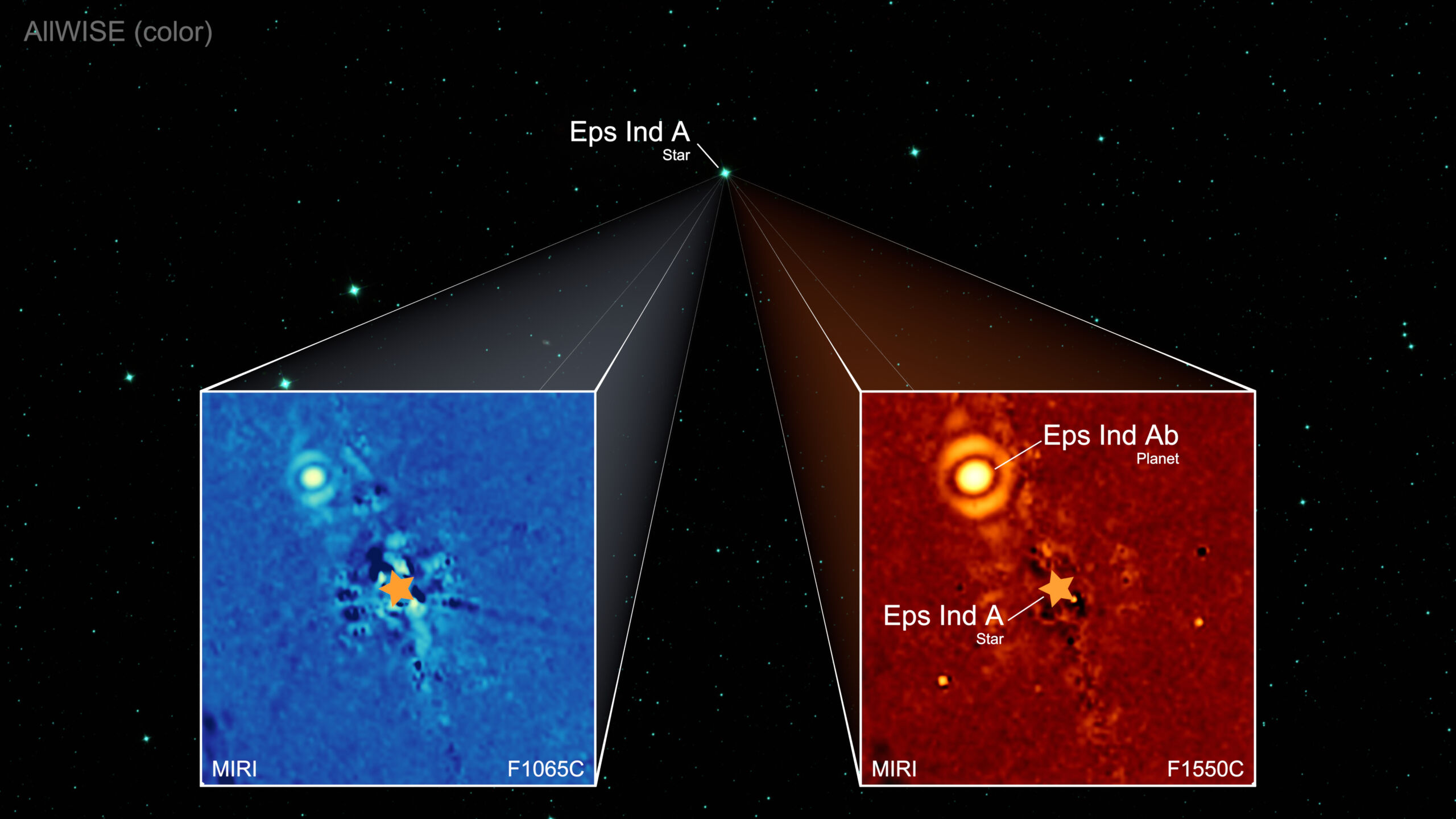
A dark background with read and blue images embedded in it, both showing a single object near an area marked with an asterisk.

Enlarge / Image of Epsilon Indi A at two wavelengths, with the position of its host star indicated by an asterisk.

T. Müller (MPIA/HdA), E. Matthews (MPIA)

We have a couple of techniques that allow us to infer the presence of an exoplanet based on its effects on the light coming from its host star. But there’s an alternative approach that sometimes works: image them directly. It’s much more limited, since the planet has to be pretty big and orbiting far away enough from its star to avoid having light coming from the planet swamped by the far more intense starlight.

Still, it has been done. Massive exoplanets have been captured relatively shortly after their formation, when the heat generated by the collapse of material into the planet causes them to glow in the infrared. But the Webb telescope is far more sensitive than any infrared observatory we’ve ever built, and it has managed to image a relatively nearby exoplanet that’s roughly as old as the ones in our Solar System.

Looking directly at a planet

What do you need to directly image a planet that’s orbiting a star light-years away? The first thing is a bit of hardware called a coronagraph attached to your telescope. This is responsible for blocking the light from the star the planet is orbiting; without it, that light will swamp any other sources in the exosolar system. Even with a good coronagraph, you need the planets to be orbiting at a significant distance from the star so that they’re cleanly separated from the signal being blocked by the coronagraph.

Then, you need the planet to emit a fair bit of light. While the right surface composition might allow the planet to be highly reflective, that’s not going to be a great option considering the distances we’d need the planet to be orbiting to be visible at all. Instead, the planets we’ve spotted so far have been young and still heated by the processes that brought material together to form a planet in the first place. Being really big doesn’t hurt matters either.

Put that all together, and what you expect to be able to spot is a very young, very distant planet that’s massive enough to fall into the super-Jupiter category.

But the launch of the Webb Space Telescope has given us new capabilities in the infrared range, and a large international team of researchers pointed it at a star called Epsilon Indi A. It’s a bit less than a dozen light years away (which is extremely close in astronomical terms), and the star is both similar in size and age to the Sun, making it an interesting target for observations. Perhaps most significantly previous data had suggested a large exoplanet would be found, based on indications that the star was apparently shifting as the exoplanet tugged on it during its orbit.

And there was in fact an indication of a planet there. It just didn’t look much like the expected planet. “It’s about twice as massive, a little farther from its star, and has a different orbit than we expected,” said Elisabeth Matthews, one of the researchers involved.

At the moment, there’s no explanation for the discrepancy. The odds of it being an unrelated background object are extremely small. And a reanalysis of data on the motion of Epsilon Indi A suggests that this is likely to be the only large planet in the system—there could be additional planets, but they’d be much smaller. So, the researchers named the planet Epsilon Indi Ab, even though that was the same name given to the planet that doesn’t seem to match this one’s properties.

Big, cold, and a bit enigmatic

The revised Epsilon Indi Ab is a large planet, estimated at roughly six times the mass of Jupiter. It’s also orbiting at roughly the same distance as Neptune. It’s generally bright across the mid-infrared, consistent with a planet that’s roughly 275 Kelvin—not too far off from room temperature. That’s also close to what we would estimate for its temperature simply based on the age of the planet. That makes it the coolest exoplanet ever directly imaged.

While the signal from the planet was quite bright at a number of wavelengths, the planet couldn’t even be detected in one area of the spectrum (3.5 to 5 micrometers, for the curious). That’s considered an indication that the planet has high levels of elements heavier than helium, and a high ratio of carbon to oxygen. The gap in the spectrum may influence estimates of the planet’s age, so further observations will probably need to be conducted to clarify why there are no emissions at these wavelengths.

The researchers also suggest that imaging more of these cool exoplanets should be a priority, given that we should be cautious about extrapolating anything from a single example. So, in that sense, this first exoplanet imaging provides an important confirmation that, with Webb and its coronagraph, we’ve now got the tools we need to do so, and they work very well.

Nature, 2024. DOI: 10.1038/s41586-024-07837-8  (About DOIs).

Webb directly images giant exoplanet that isn’t where it should be Read More »

mini-neptune-turned-out-to-be-a-frozen-super-earth

Mini-Neptune turned out to be a frozen super-Earth

Like Earth, but super —

The density makes it look like a water world, but its dim host star keeps it cool.

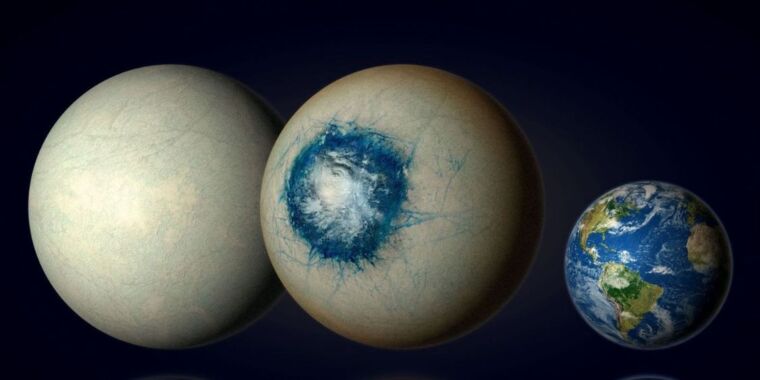
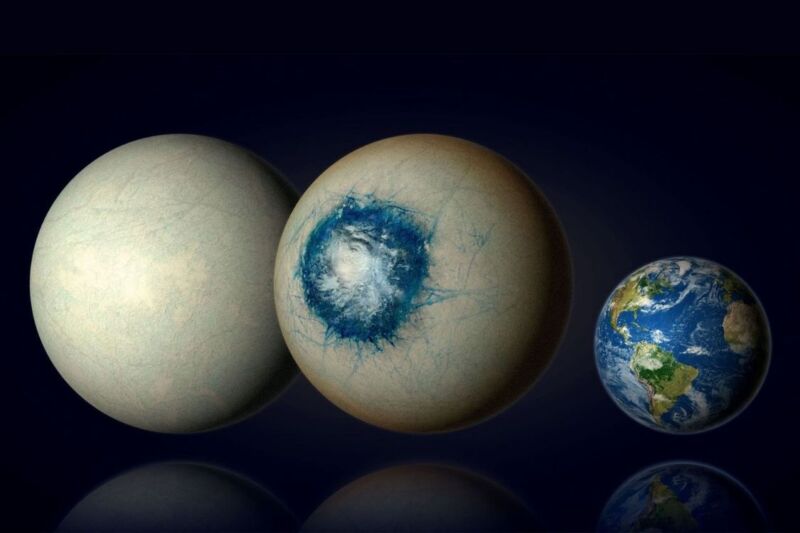
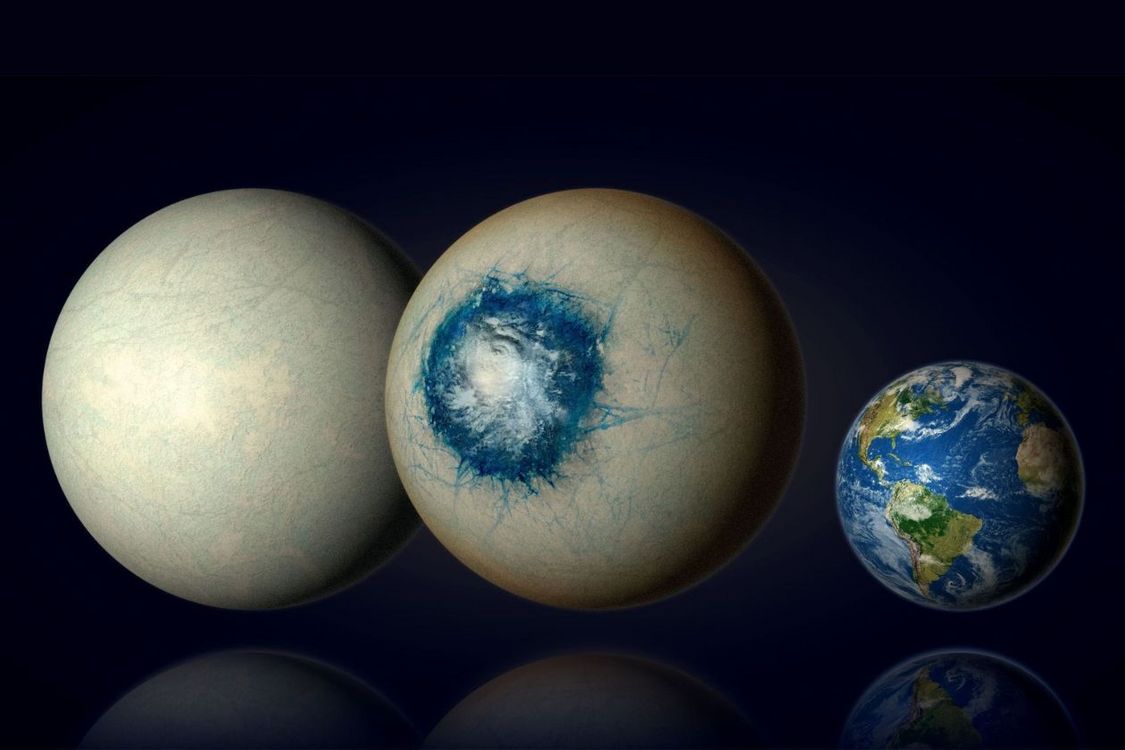
Image of three planets on a black background, with the two on the left being mostly white, indicating an icy composition. The one on the right is much smaller, and represents Earth.

Enlarge / Renditions of a possible composition of LHS 1140 b, with a patch of ocean on the side facing its host star. Earth is included at right for scale.

Of all the potential super-Earths—terrestrial exoplanets more massive than Earth—out there, an exoplanet orbiting a star only 40 light-years away from us in the constellation Cetus might be the most similar to have been found so far.

Exoplanet LHS 1140 b was assumed to be a mini-Neptune when it was first discovered by NASA’s James Webb Space Telescope toward the end of 2023. After analyzing data from those observations, a team of researchers, led by astronomer Charles Cadieux, of Université de Montréal, suggest that LHS 1140 b is more likely to be a super-Earth.

If this planet is an alternate version of our own, its relative proximity to its cool red dwarf star means it would most likely be a gargantuan snowball or a mostly frozen body with a substellar (region closest to its star) ocean that makes it look like a cosmic eyeball. It is now thought to be the exoplanet with the best chance for liquid water on its surface, and so might even be habitable.

Cadieux and his team say they have found “tantalizing evidence for a [nitrogen]-dominated atmosphere on a habitable zone super-Earth” in a study recently published in The Astrophysical Journal Letters.

Sorry, Neptune…

In December 2023, two transits of LHS 1140 b were observed with the NIRISS (Near-Infrared Imager and Slitless Spectrograph) instrument aboard Webb. NIRISS specializes in detecting exoplanets and revealing more about them through transit spectroscopy, which picks up the light of an orbiting planet’s host star as it passes through the atmosphere of that planet and travels toward Earth. Analysis of the different spectral bands in that light can then tell scientists about the specific atoms and molecules that exist in the planet’s atmosphere.

To test the previous hypothesis that LHS 1140 b is a mini-Neptune, the researchers created a 3D global climate model, or GCM. This used complex math to explore different combinations of factors that make up the climate system of a planet, such as land, oceans, ice, and atmosphere. Several different GCMs of a mini-Neptune were compared with the light spectrum observed via transit spectroscopy. The model for a mini-Neptune typically involves a gas giant with a thick, cloudless or nearly cloudless atmosphere dominated by hydrogen, but the spectral bands of this model did not match NIRISS observations.

With the possibility of a mini-Neptune being mostly ruled out (though further observations and analysis will be needed to confirm this), Cadieux’s team turned to another possibility: a super-Earth.

An Earth away from Earth?

The spectra observed with NIRISS were more in line with GCMs of a super-Earth. This type of planet would typically have a thick nitrogen or CO2-rich atmosphere enveloping a rocky surface on which there was some form of water, whether in frozen or liquid form.

The models also suggested a secondary atmosphere, which is an atmosphere formed after the original atmosphere of light elements, (hydrogen and helium) escaped during early phases of a planet’s formation. Secondary atmospheres are formed from heavier elements released from the crust, such as water vapor, carbon dioxide, and methane. They’re usually found on warm, terrestrial planets (Earth has a secondary atmosphere).

The most significant Webb/NIRISS data that did not match the GCMs was that the planet has a lower density (based on measurements of its size and mass) than expected for a rocky world. This is consistent with a water world with a mass that’s about 10 to 20 percent water. Based on this estimate, the researchers think that LHS 1140 b might even be a hycean planet—an ocean planet that has most of the attributes of a super-Earth, but an atmosphere dominated by hydrogen instead of nitrogen.

Since it orbits a dim star closely enough to be tidally locked, some models suggest a mostly icy planet with a substellar liquid ocean on its dayside.

While LHS 1140 b may be a super-Earth, the hycean planet hypothesis might end up being ruled out. Hycean planets are prone to the runaway greenhouse effect, which occurs when enough greenhouse gases accumulate in a planet’s atmosphere and prevent heat from escaping. Liquid water will eventually evaporate on a planet that cannot cool itself off.

Though we are getting closer to finding out what kind of planet LHS 1140 b is, and whether it could be habitable, further observations are needed. Cadieux wants to continue this research by comparing NIRISS data with data on other super-Earths that had previously been collected by Webb’s Near-Infrared Spectrograph, or NIRSpec, instrument. At least three transit observations of the planet with Webb’s MIRI, or Mid-Infrared instrument, are also needed to make sure stellar radiation is not interfering with observations of the planet itself.

“Given the limited visibility of LHS 1140b, several years’ worth of observations may be required to detect its potential secondary atmosphere,” the researchers said in the same study.

So could this planet really be a frozen exo-earth? The suspense is going to last a few years.

The Astrophysical Journal Letters, 2024.  DOI:  10.3847/2041-8213/ad5afa

Mini-Neptune turned out to be a frozen super-Earth Read More »

glow-of-an-exoplanet-may-be-from-starlight-reflecting-off-liquid-iron

Glow of an exoplanet may be from starlight reflecting off liquid iron

For all the glory —

A phenomenon called a “glory” may be happening on a hellishly hot giant planet.

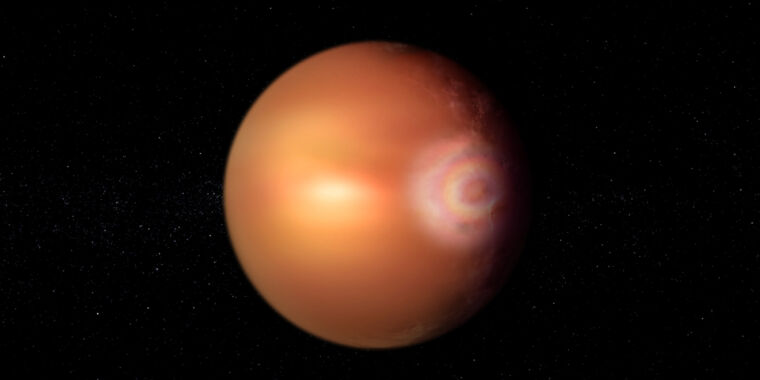
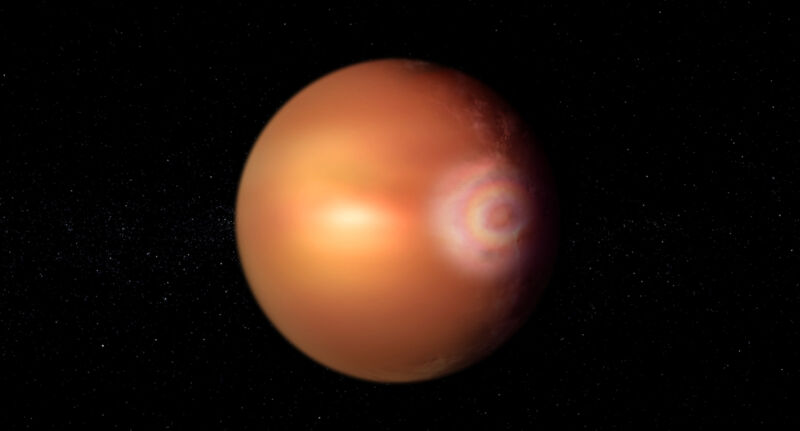
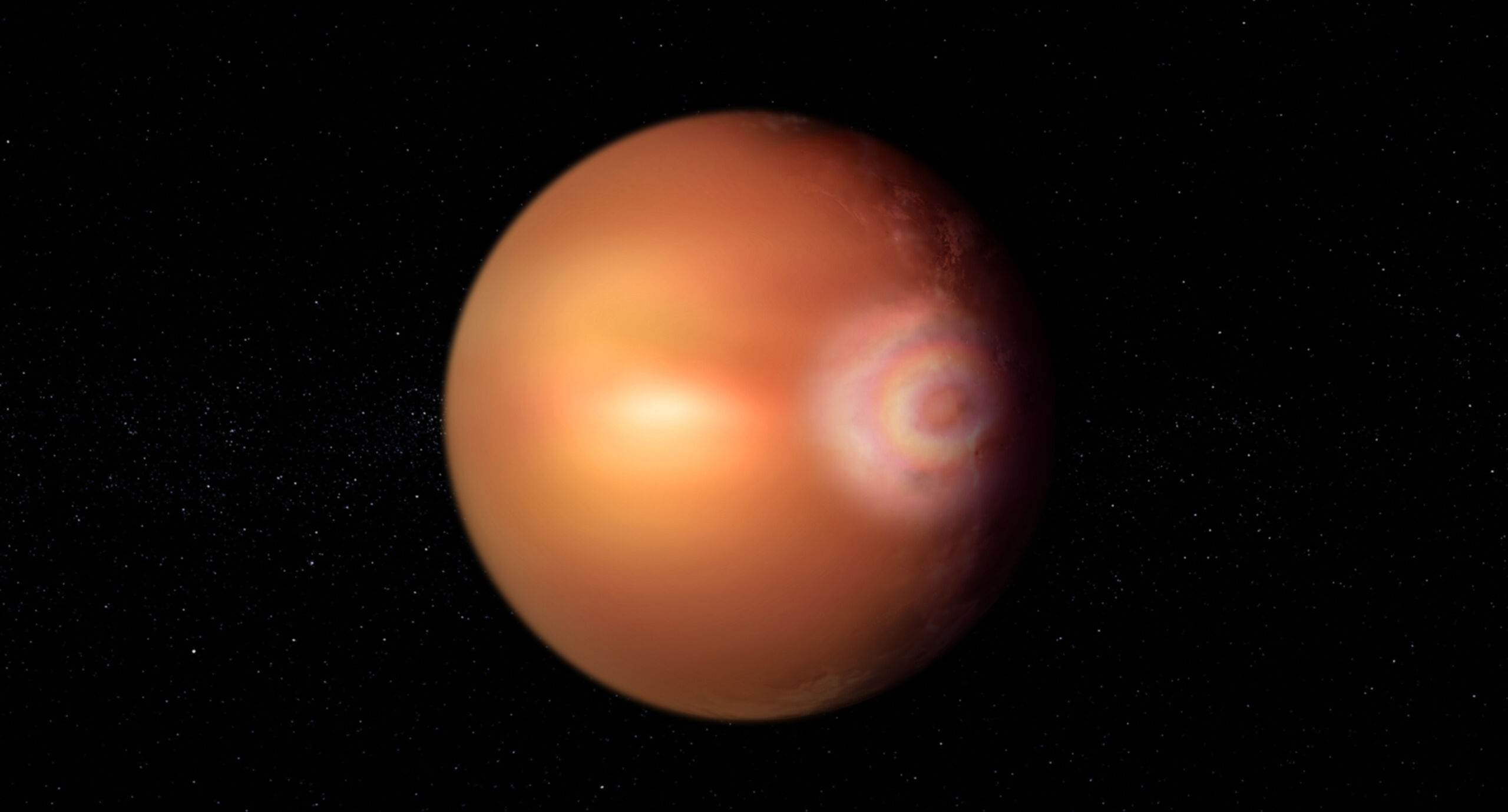
Image of a planet on a dark background, with an iridescent circle on the right side of the planet.

Enlarge / Artist impression of a glory on exoplanet WASP-76b.

Do rainbows exist on distant worlds? Many phenomena that happen on Earth—such as rain, hurricanes, and auroras—also occur on other planets in our Solar System if the conditions are right. Now we have evidence from outside our Solar System that one particularly strange exoplanet might even be displaying something close to a rainbow.

Appearing in the sky as a halo of colors, a phenomenon called a “glory” occurs when light hits clouds made up of a homogeneous substance in the form of spherical droplets. It might be the explanation for a mystery regarding observations of exoplanet WASP-76B. This planet, a scorching gas giant that experiences molten iron rain, has also been observed to have more light on its eastern terminator (a line used to separate the day side from the night side) than its western terminator. Why was there more light on one side of the planet?

After observing it with the CHEOPS space telescope, then combining that with previous observations from Hubble, Spitzer, and TESS, a team of researchers from ESA and the University of Bern in Switzerland now think that the most likely reason for the extra light is a glory.

Seeing the light

Over three years, CHEOPS made 23 observations of WASP-76B in both visible and infrared light. These included phase curves, transits, and secondary eclipses. Phase curves are continuous observations that track a planet’s complete revolution and show changes in its phase or the part of its illuminated side that is facing the telescope. The telescope may see more or less of that side as the planet orbits its star. Phase curves can determine the change in the total brightness of the planet and star as the planet orbits.

Secondary eclipses happen when a planet passes behind its host star and is eclipsed by it. The light seen during such an eclipse can later be compared with the total light both before and after the occultation to give us a sense of the light that’s reflected off the planet. Hot Jupiters like WASP-76B are commonly observed through secondary eclipses.

Phase-curve observations can continue while the planet is eclipsing its star. While it was observing the phase curve of WASP-76B, CHEOPS saw a pre-eclipse excess of light on its night side. This had also been seen in TESS phase-curve and secondary-eclipse observations that had been made earlier.

End of the rainbow?

An advantage of WASP-76b is that it is an ultra-hot Jupiter, so at least its day side does not have the clouds and hazes that often obscure the atmospheres of cooler hot Jupiters. This makes atmospheric emissions much easier to detect. That we had already observed an asymmetry in iron content between the day-side and night-side terminators, discovered in a previous study, made the planet especially intriguing. There was not much gaseous iron in the upper atmosphere of the day-side limb compared to that of the night-side limb. This is probably because it rains iron on the day side of WASP-76b, which then condenses into clouds of iron on the night side.

Observations from Hubble suggested that thermal inversion—when the air near the surface of a planet begins cooling—was occurring on the night side. Cooling on that side would cause iron that had previously condensed into clouds, rained down onto the day side, and then evaporated from the intense heat to condense again. Drops of liquid iron can then form clouds.

These clouds are critical since light from the host star, reflecting off these drops in those clouds, can create the effect of a glory.

“Explaining the observation with the glory effect would require spherical droplets of highly reflective, spherically shaped aerosols and clouds on the planet’s eastern hemisphere,” the researchers said in a paper recently published in Astronomy & Astrophysics.

Glories have been seen off Earth before. They are also known to form in the clouds of Venus. Just like WASP-76b, more pre-eclipse light was observed on Venus, so while a glory is all but definite for the exoplanet, future observations with a more powerful telescope could help determine how similar the phenomenon on WASP-76 is to that on Venus. If they match, this will be the first glory ever observed on an exoplanet.

If future research figures out a definite way to tell whether this is really a glory, these phenomena could tell us more about the atmospheric makeup of exoplanets, depending on the kinds of elements or molecules light is reflecting off of. They might even give away the presence of water, which could mean habitability. While the hypothesized glory on WASP-76b has not been definitively demonstrated, it is anything but a rainbow in the dark.

Astronomy & Astrophysics, 2024. DOI: 10.1051/0004-6361/202348270

Glow of an exoplanet may be from starlight reflecting off liquid iron Read More »

why-interstellar-objects-like-‘oumuamua-and-borisov-may-hold-clues-to-exoplanets

Why interstellar objects like ‘Oumuamua and Borisov may hold clues to exoplanets

celestial nomads —

Two celestial interlopers in Solar System have scientists eagerly anticipating more.

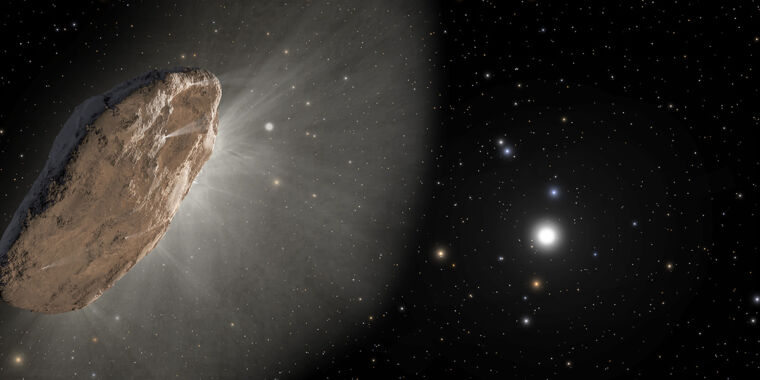
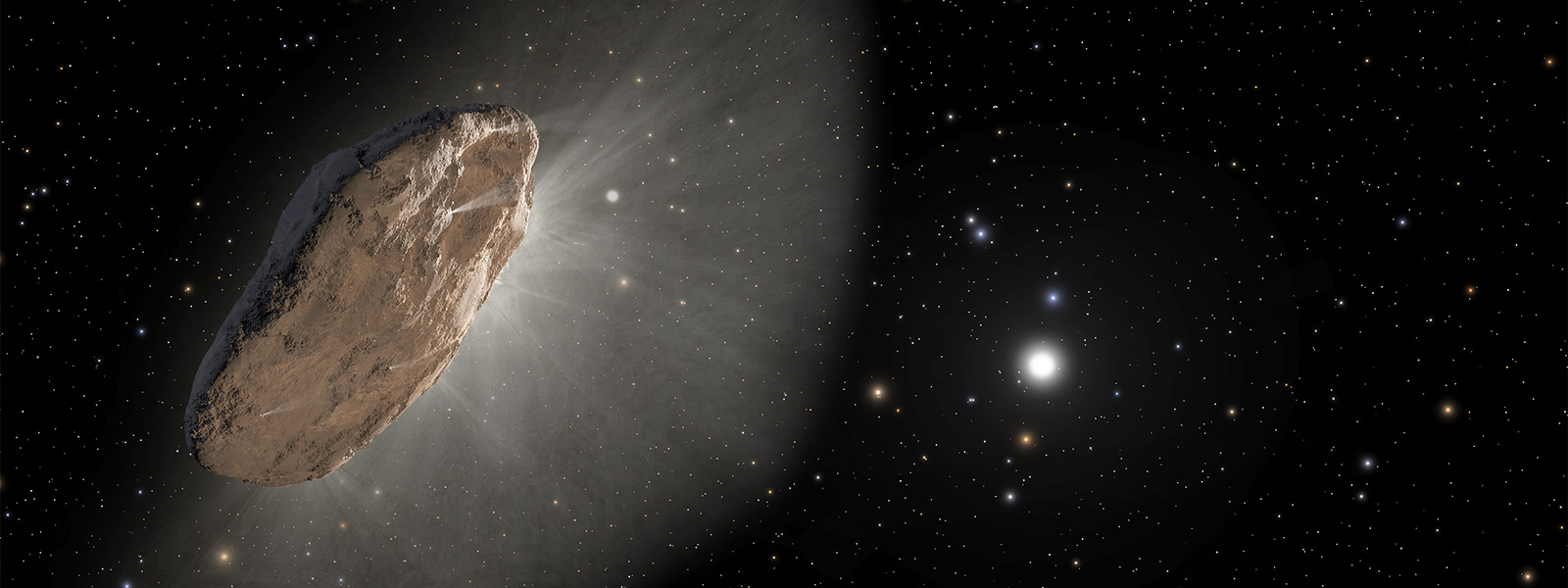
The first interstellar interloper detected passing through the Solar System, 1l/‘Oumuamua, came within 24 million miles of the Sun in 2017

Enlarge / The first interstellar interloper detected passing through the Solar System, 1l/‘Oumuamua, came within 24 million miles of the Sun in 2017. It’s difficult to know exactly what ‘Oumuamua looked like, but it was probably oddly shaped and elongated, as depicted in this illustration.

On October 17 and 18, 2017, an unusual object sped across the field of view of a large telescope perched near the summit of a volcano on the Hawaiian island of Maui. The Pan-STARRS1 telescope was designed to survey the sky for transient events, like asteroid or comet flybys. But this was different: The object was not gravitationally bound to the Sun or to any other celestial body. It had arrived from somewhere else.

The mysterious object was the first visitor from interstellar space observed passing through the Solar System. Astronomers named it 1I/‘Oumuamua, borrowing a Hawaiian word that roughly translates to “messenger from afar arriving first.” Two years later, in August 2019, amateur astronomer Gennadiy Borisov discovered the only other known interstellar interloper, now called 2I/Borisov, using a self-built telescope at the MARGO observatory in Nauchnij, Crimea.

While typical asteroids and comets in the Solar System orbit the Sun, ‘Oumuamua and Borisov are celestial nomads, spending most of their time wandering interstellar space. The existence of such interlopers in the Solar System had been hypothesized, but scientists expected them to be rare. “I never thought we would see one,” says astrophysicist Susanne Pfalzner of the Jülich Supercomputing Center in Germany. At least not in her lifetime.

With these two discoveries, scientists now suspect that interstellar interlopers are much more common. Right now, within the orbit of Neptune alone, there could be around 10,000 ‘Oumuamua-size interstellar objects, estimates planetary scientist David Jewitt of UCLA, coauthor of an overview of the current understanding of interstellar interlopers in the 2023 Annual Review of Astronomy and Astrophysics.

Researchers are busy trying to answer basic questions about these alien objects, including where they come from and how they end up wandering the galaxy. Interlopers could also provide a new way to probe features of distant planetary systems.

But first, astronomers need to find more of them.

“We’re a little behind at the moment,” Jewitt says. “But we expect to see more.”

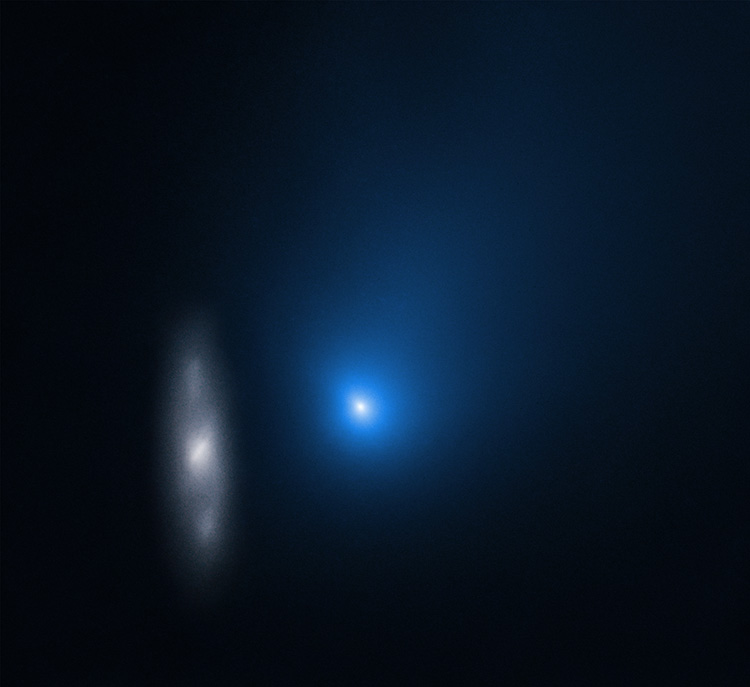
2I/Borisov appears as a fuzzy blue dot in front of a distant spiral galaxy (left) in this November 2019 image taken by the Hubble Space Telescope when the object was approximately 200 million miles from Earth.

Enlarge / 2I/Borisov appears as a fuzzy blue dot in front of a distant spiral galaxy (left) in this November 2019 image taken by the Hubble Space Telescope when the object was approximately 200 million miles from Earth.

Alien origins

At least since the beginning of the 18th century, astronomers have considered the possibility that interstellar objects exist. More recently, computer models have shown that the Solar System sent its own population of smaller bodies into the voids of interstellar space long ago due to gravitational interactions with the giant planets.

Scientists expected most interlopers to be exocomets composed of icy materials. Borisov fit this profile: It had a tail made of gases and dust created by ices that evaporated during its close passage to the Sun. This suggests that it originated in the outer region of a planetary system where temperatures were cold enough for gases like carbon monoxide to have frozen into its rocks. At some point, something tossed Borisov, roughly a kilometer across, out of its system.

One potential culprit is a stellar flyby. The gravity of a passing star can eject smaller bodies, known as planetesimals, from the outer reaches of a system, according to a recent study led by Pfalzner. A giant planet could also eject an object from the outer regions of a planetary system if an asteroid or comet gets close enough for the planet’s gravitational tug to speed up the smaller body enough for it to escape its star’s hold. Close approaches can also happen when planets migrate across their planetary systems, as Neptune is thought to have done in the early Solar System.

Why interstellar objects like ‘Oumuamua and Borisov may hold clues to exoplanets Read More »

astronomers-found-ultra-hot,-earth-sized-exoplanet-with-a-lava-hemisphere

Astronomers found ultra-hot, Earth-sized exoplanet with a lava hemisphere

Like Kepler-10 b, illustrated above, the exoplanet HD 63433 d is a small, rocky planet in a tight orbit of its star.

Enlarge / Like Kepler-10 b, illustrated above, newly discovered exoplanet HD 63433 d is a small, rocky planet in a tight orbit of its star.

NASA/Ames/JPL-Caltech/T. Pyle

Astronomers have discovered an unusual Earth-sized exoplanet they believe has a hemisphere of molten lava, with its other hemisphere tidally locked in perpetual darkness. Co-authors and study leaders Benjamin Capistrant (University of Florida) and Melinda Soares-Furtado (University of Wisconsin-Madison) presented the details yesterday at a meeting of the American Astronomical Society in New Orleans. An associated paper has just been published in The Astronomical Journal. Another paper published today in the journal Astronomy and Astrophysics by a different group described the discovery of a rare small, cold exoplanet with a massive outer companion 100 times the mass of Jupiter.

As previously reported, thanks to the massive trove of exoplanets discovered by the Kepler mission, we now have a good idea of what kinds of planets are out there, where they orbit, and how common the different types are. What we lack is a good sense of what that implies in terms of the conditions on the planets themselves. Kepler can tell us how big a planet is, but it doesn’t know what the planet is made of. And planets in the “habitable zone” around stars could be consistent with anything from a blazing hell to a frozen rock.

The Transiting Exoplanet Survey Satellite (TESS) was launched with the intention of helping us figure out what exoplanets are actually like. TESS is designed to identify planets orbiting bright stars relatively close to Earth, conditions that should allow follow-up observations to figure out their compositions and potentially those of their atmospheres.

Both Kepler and TESS identify planets using what’s called the transit method. This works for systems in which the planets orbit in a plane that takes them between their host star and Earth. As this occurs, the planet blocks a small fraction of the starlight that we see from Earth (or nearby orbits). If these dips in light occur with regularity, they’re diagnostic of something orbiting the star.

This tells us something about the planet. The frequency of the dips in the star’s light tells us how long an orbit takes, which tells us how far the planet is from its host star. That, combined with the host star’s brightness, tells us how much incoming light the planet receives, which will influence its temperature. (The range of distances at which temperatures are consistent with liquid water is called the habitable zone.) And we can use that, along with how much light is being blocked, to figure out how big the planet is.

But to really understand other planets and their potential to support life, we have to understand what they’re made of and what their atmosphere looks like. While TESS doesn’t answer those questions, it’s designed to find planets with other instruments that could answer them.

Astronomers found ultra-hot, Earth-sized exoplanet with a lava hemisphere Read More »

seeking-another-earth?-look-for-low-carbon-dioxide

Seeking another Earth? Look for low carbon dioxide

Where’d all the CO2 go? —

In our own Solar System, Earth has far lower CO2 concentrations than its neighbors.

Image of a series of planets with different surfaces, arrayed in front of a star.

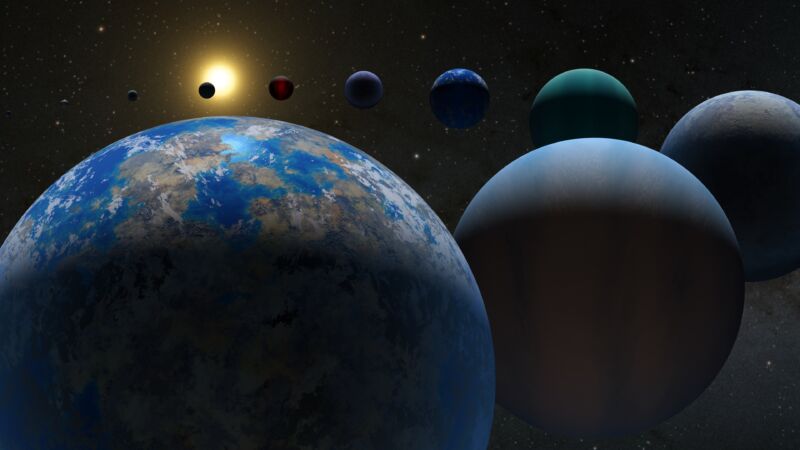
What do we need to find if we want to discover another Earth? If an exoplanet is too far away for even the most powerful telescopes to search directly for water or certain biosignatures, is there something else that may tell us about the possibility of habitability? The answer could be carbon dioxide.

Led by Amaury Triaud and Julien de Wit, an international team of researchers is now proposing that the absence of CO2 in a planet’s atmosphere potentially increases the chances of liquid water on its surface. Earth’s own atmosphere is depleted of CO2. Unlike dry Mars and Venus, which have high concentrations of CO2 in their atmospheres, oceans on our planet have taken immense amounts of carbon dioxide out of the atmosphere because the gas dissolves in water. CO2 deficits in exoplanet atmospheres might mean the same.

Another molecule could be a sign of a habitable planet: ozone. Many organisms on Earth (especially plants) breathe carbon dioxide and release oxygen. This oxygen reacts with sunlight and becomes O3, or ozone, which is easier to detect than atmospheric oxygen. The presence of ozone and the absence of carbon dioxide could mean a habitable, and even inhabited, planet.

Anyone—or anything—out there?

There is a difference between a planet orbiting within what is considered a habitable zone and actual habitability. Habitability is defined by the researchers as “a planet’s capacity to retain large reservoirs of surface liquid water,” as they state in a study recently published in Nature Astronomy.

Proving that water actually exists could hypothetically be done in many ways. The problem is that most existing telescopes, no matter how advanced, are incapable of pulling them all off. Finding liquid water from light years away is not as easy as seeing the glimmer of a lake, though that is possible at short distances, like those within our own Solar System. (When sunlight reflects off a body of surface liquid, what scientists refer to as a “glint” can be seen, which is how the lakes and oceans on Saturn’s moon Titan were discovered.)

Beyond water, other factors could determine habitability. Besides atmospheric properties, these include (but are not limited to) the orbit of a planet, plate tectonics, magnetic fields, and how it is affected by its star.

When less is more

Triaud, de Wit, and their team argue that it’s worth trying to identify potentially habitable planets that belong to a system similar to ours. If there is a system with several terrestrial planets that are close in size and have atmospheres, this makes it possible to compare carbon dioxide content in their atmospheres and see if there is a significant deficit in one or more planets compared to the others.

While a CO2 deficit does not guarantee that there is liquid water on the surface, it should give scientists a reason to observe the planet or planets in question more closely. We don’t have to look far from Earth to see why this makes sense. Not only has most of the carbon dioxide in our planet’s atmosphere been depleted by its oceans, but plate tectonics also bury it in the crust. The amount of early Earth’s atmospheric carbon dioxide that ended up trapped in rocks is almost equal to the amount of CO2 in the entire atmosphere of Venus.

There is another advantage to searching for this deficit. Because it’s an especially strong infrared light absorber, CO2 is rather easy to detect. Telescopes that are around today, including NASA’s James Webb Telescope and ESO’s Very Large Telescope, as well as ESO’s upcoming Extremely Large Telescope, have infrared vision that can easily search for CO2 signatures.

So what if we did find a planet that showed a deficit of CO2 and the presence of ozone? The researchers think the combination of both could mean not just a few microbial life forms but, at least hypothetically, a planet alive with organisms.

“Life on Earth is planet-shaping,” the team said in the same study. “Planet-shaping life is really what astronomers are after.”

Nature Astronomy, 2023.  DOI:  10.1038/s41550-023-02157-9

Seeking another Earth? Look for low carbon dioxide Read More »

researchers-argue-back-and-forth-about-whether-we’ve-spotted-an-exomoon

Researchers argue back and forth about whether we’ve spotted an exomoon

That’s no moon! —

Years after Kepler shut down, people are arguing over whether it spotted exomoons.

Image of two planets orbiting together around a distant star.

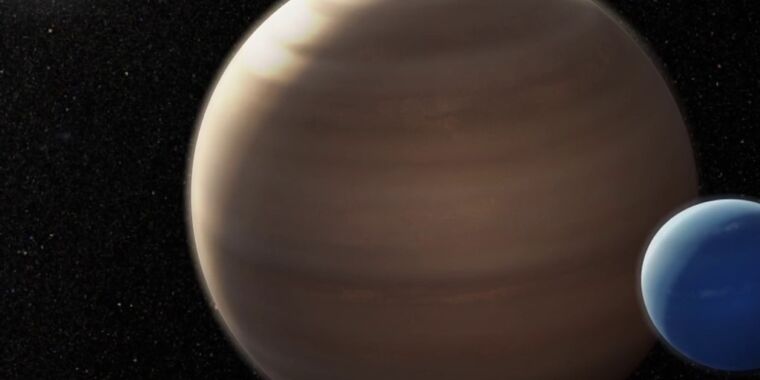
In 2017, the astronomy world was abuzz at the announcement that exoplanet Kepler-1625b potentially had its own moon—an exomoon. This was the first hint anyone had seen of an exomoon, and was followed five years later by another candidate around the planet Kepler-1708b.

There are over five thousand exoplanets discovered so far, and we don’t know for certain whether any have moons orbiting, which is what made these announcements so exciting. Exomoons provide more potentially habitable areas in which we can search for extraterrestrial life, and the study of moons can be a valuable window into the formation of the host planet.

But there has been much debate about these exomoon candidates, with multiple groups combing through the data obtained from the Kepler and Hubble space telescopes.

The most recent paper on the topic, published by astronomers in Germany, has come to the conclusion that the exomoon candidates around Kepler-1625b and Kepler-1708b are unlikely. Previous work has also cast doubt on the exomoon candidate around Kepler-1625b.

This is not a clear cut case, though. David Kipping, the leader of the group that made both original discoveries, and assistant professor of astronomy at Columbia University, disagrees with the new analysis. He and his group are in the process of preparing a manuscript that responds to the latest publication.

A needle in a haystack

The most common method of detecting exoplanets is the transit method. This technique measures the brightness of a star, and looks for a small dip in brightness that corresponds to a planet transiting in front of the star.

Stellar photometry can be extended to look for exomoons, an approach pioneered by Kipping. As well as the main dip caused by the planet, if a moon is orbiting the planet you should be able to see an additional, smaller dip   caused by the moon also shielding some of the star’s light.

An example of what a transit detection of an exomoon might look like.

As moons are smaller they generate a smaller signal, making them more challenging to spot. But what makes this particular case even more challenging is that the host stars Kepler-1625 and Kepler-1708 aren’t that bright. This makes the light dip even fainter—in fact these systems   have to have large moons to be within the threshold of what the Kepler space telescope can detect.

Models, models, models

Until scientists get more data from James Webb, or future missions such as ESA’s PLATO launch, it’s all down to what they can do with the existing numbers.

“The aspects here that are relevant are how the data itself is processed, what physics you put in when you’re modelling that data, and then what possible false positive signals might be out there that could reproduce the sort of signal that you’re looking for,” Eamonn Kerins, senior lecturer in astronomy at the University of Manchester who was not involved with the study, told Ars. “I think this whole debate centers around those questions essentially,” he added.

One key phenomenon that needs accurate modelling is known as the stellar limb darkening effect. Stars, including our Sun, appear dimmer at their edge than at the centre due to effects of the stellar atmosphere. As this affects the apparent brightness of the star, it’s clearly important to understand in the context of searching for exomoons by measuring a star’s brightness.

“We have models for this, but we don’t really know exactly how a specific star behaves in terms of this stellar limb darkening effect,” said René Heller, lead author of the study and astrophysicist at the Max Planck Institute for Solar System Research, in an interview for Ars. How specific stars behave can be deduced, but this isn’t always trivial. By including improved models for stellar limb darkening, the authors found that they can explain signals previously attributed to an exomoon.

Data processing is also paramount, especially a type of processing known as detrending. This takes into account long-term variability in the brightness data that is caused by random stellar variation and instrument variability, among other things. The new research shows that the statistical outcome, moon or no moon, is extremely dependent on how you carry out this detrending.

What’s more, the authors say that the data obtained from the Hubble telescope, which is primarily where the claim for the moon around Kepler-1625b comes from, can’t be properly detrended and thus shouldn’t be relied on for exomoon searches.

Two sides

Until more data is obtained, this is likely to remain an ongoing scientific discussion with no definitive conclusion.

Kerins points out that Kipping and his team have been very measured in their announcements. “They’re very, very careful to not claim it as a cast-iron detection. They’ve done comprehensive testing of the data they’ve been given, and really I think the difference here is all about what physics you put in, how you process the data, and ultimately the fact that the Kepler data set is really on the edge of finding exomoons.”

Heller, though, remains unconvinced. “My impression is that in the Kepler data, we and also other teams have done what’s currently possible and there’s no compelling object that really sticks out.”

Moons far outnumber planets in our own Solar System—two hundred and ninety to eight to date—so it’s reasonable to assume that we will come across exomoons as we continue exploring the skies. “It would be quite extraordinary, I think, if we continue to go over the next few years and not find an exomoon,” said Kerins. “I think it can only be a matter of time.”

Nature Astronomy, 2023.  DOI: 10.1038/s41550-023-02148-w

Ivan Paul is a freelance writer based in the UK, finishing his PhD in cancer research. He is on Twitter @ivan_paul_.

Researchers argue back and forth about whether we’ve spotted an exomoon Read More »