Last year, Ford set a new industry record: It issued 152 safety recalls, almost twice the previous high set by General Motors back in 2014. More than 24 million vehicles were recalled in the US last year, and more than half—13 million—were either Fords or Lincolns. By contrast, Tesla issued 11 recalls, affecting just 745,000 vehicles.
Truth be told, Ford’s not doing too hot in 2026, either; it’s currently leading the National Highway Traffic Safety Administration’s chart for recalls this year, with 10 on the books already. The latest is a big one, affecting almost 4.4 million trucks, vans, and SUVs.
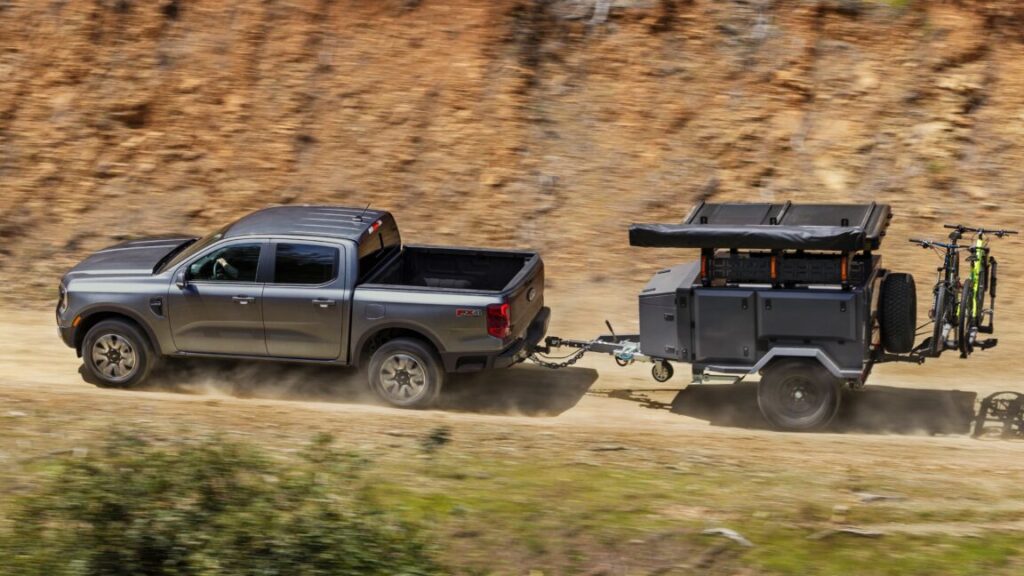
The recall affects the Ford Maverick (model years 2022–2026), Ford Ranger (MY 2024–2026), Ford Expedition (MY 2022–2026), Ford E-Transit (MY 2026), Ford F-150 (MY 2021–2026), Ford F-250 SD (MY 2022–2026), and the Lincoln Navigator (MY 2022–2026). Just the F-150s alone number 2.3 million.
The problem is with the vehicles’ integrated trailer module, which allows the trailer’s lights and brakes to work in conjunction with those of the towing vehicle. According to the recall notice, a “software vulnerability within the ITRM allows for a potential race condition to occur between the ITRM and the CAN Standy [sic] Control bit (STBCC) during initial power-up.” If that happens, the trailer will have no lights or brakes, and you’ll get a pop-up alert on the main instrument display.
A smaller battery means a cheaper truck, but customers still expect plenty of range.
Early design concepts for the mid-size electric truck on Ford’s Universal Electric Vehicle Platform. Credit: Ford
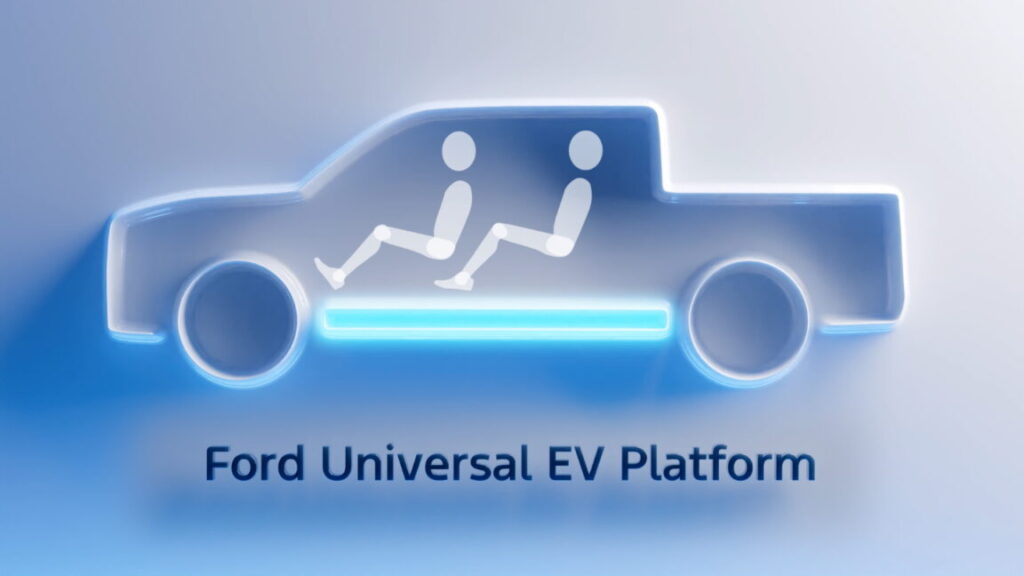
The electric car transition isn’t going great for America’s domestic automakers, but it’s far from over. Ford may have ended production of the full-size F-150 Lightning pickup truck, but next year, it will debut a new “Universal EV Platform,” beginning with a midsize truck that it says will start at a much more reasonable $30,000, if all goes to plan. The company seems serious about the idea, having created an internal “skunkworks” several years ago to design this new affordable platform from first principles.
Doing more with less is the key: fewer components and using less energy to go the same distance. Now, the company has given us a clearer picture of how it plans to make that happen.
A few years ago, Ford and its crosstown rival bet that full-size pickup truck customers would be wowed enough by instant torque and minuscule running costs to overlook how towing heavily diminished range. They created electric versions of their bestselling behemoths, packed with clever features like power sockets for job sites and the ability to power a home during an emergency.
Largely, though, truck buyers weren’t willing to overlook those things. People who may have still been interested were put off by sticker shock as supply chain chaos and dealership avarice inflated prices far beyond what was originally expected. Now those bets are unwinding—at a cost to Ford of almost $20 billion.
Smaller, cheaper? We got it.
Meanwhile, Ford appears to have been listening. Instead of making a full-size pickup with a starting price north of $60,000, it’s aiming to produce something more midsized (more interior space than a Toyota RAV4, it says), starting at half that. And it will only succeed if it can get away with using a smaller battery than you’d find between the frame rails of an F-150 Lightning. About 40 percent of the vehicle cost is the battery, Ford says.
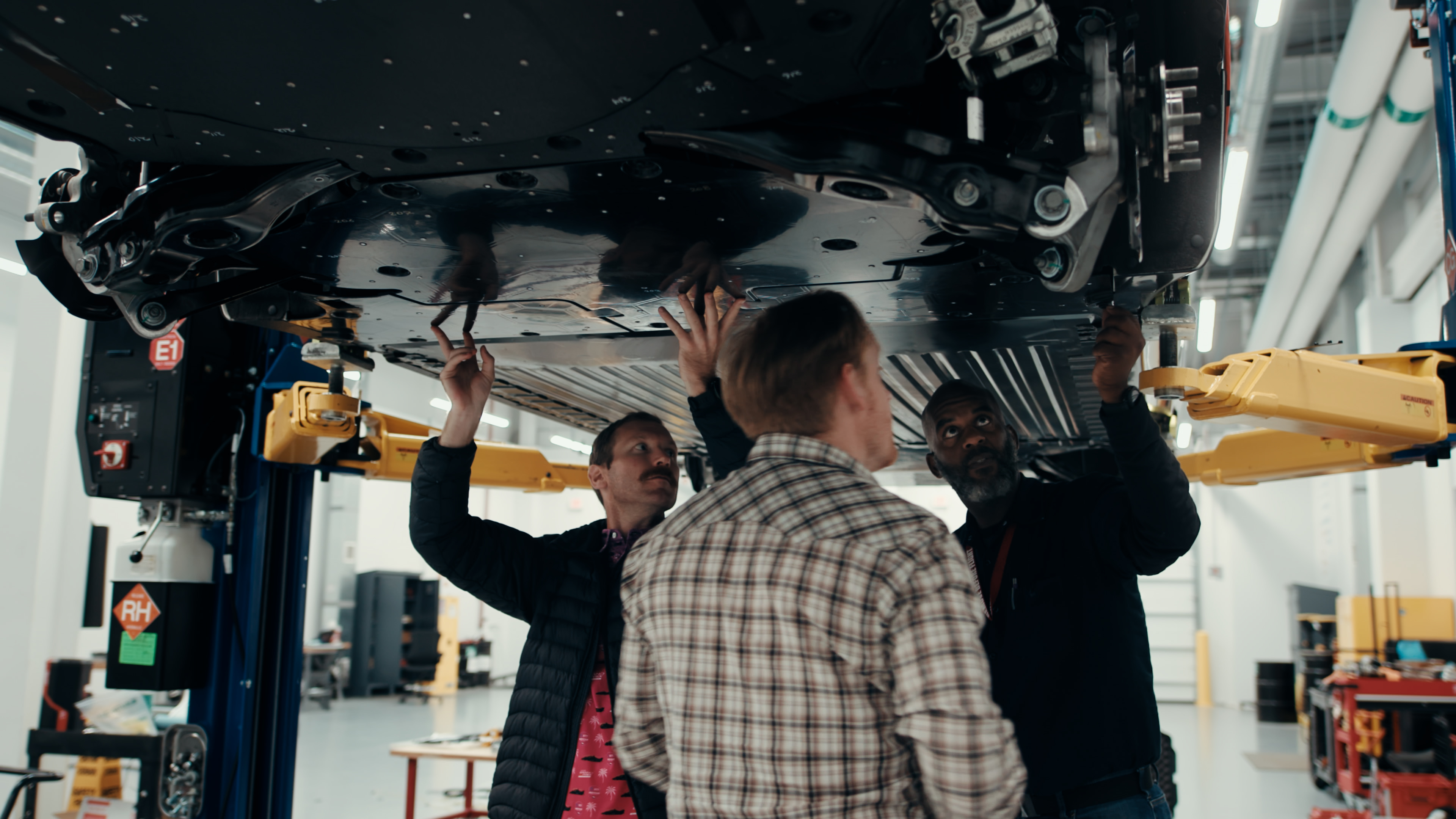
Underbody aerodynamics are extremely important.
Credit: Ford
Underbody aerodynamics are extremely important. Credit: Ford
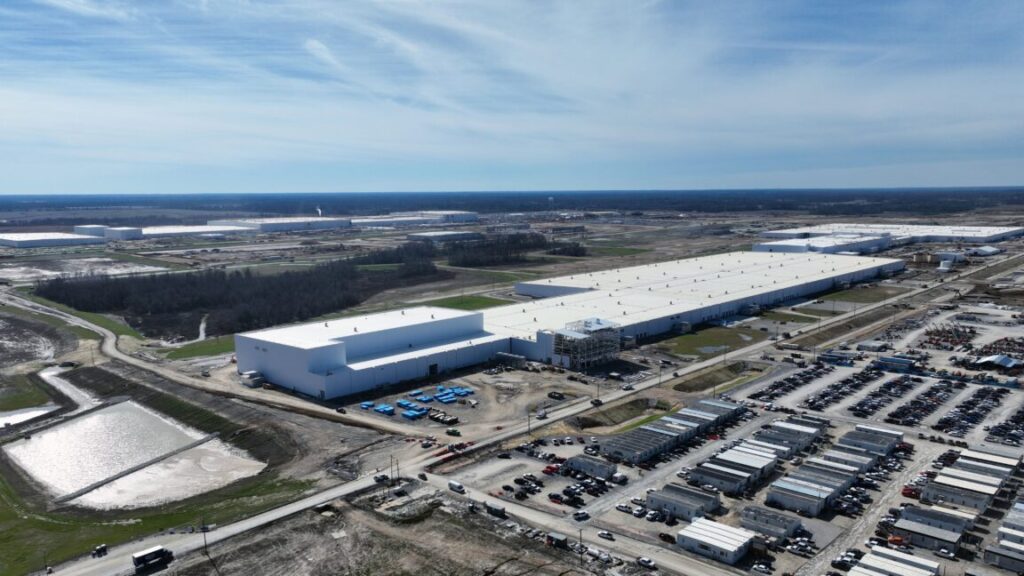
We’ve known for some time that the plan included new prismatic lithium iron phosphate cells made in Michigan. The pickup will be assembled at Ford’s Louisville plant with a new, more efficient process that uses 40 percent fewer workstations than a traditional Ford assembly line.
If you want to provide more range with less energy and a smaller battery pack, you need a more efficient vehicle. Too much weight is a bad thing, and at highway speeds, aerodynamic efficiency matters most of all. But designing a new vehicle (or platform) is not simple—it involves many different departments, each with its own priorities.
“For example, the aerodynamics team always wants a lower roof for less aerodynamic drag; the occupant package team wants a higher roof for more headroom, while the interiors team wants to decrease the cabin size to reduce the cost,” said Alan Clarke, executive director of Ford’s advanced EV development. “Usually, these groups negotiate until they find a ‘middle ground,’ one that inevitably ends in a trade-off led by yet another department tasked with making tradeoffs on behalf of the customer.”
To get everyone on the same page, Ford instituted what it calls “bounties” to help engineers evaluate the trade-offs involved in design decisions.
“Now, the aerodynamics team and interior team share the same goal, and both understood that adding even 1 mm to the roof height would mean $1.30 in additional battery cost or .055 miles [0.089 km] of range. With bounties, each team has a common objective to maximize range while decreasing battery cost—a direct linkage to giving our customers more,” Clarke said.
15 percent better efficiency
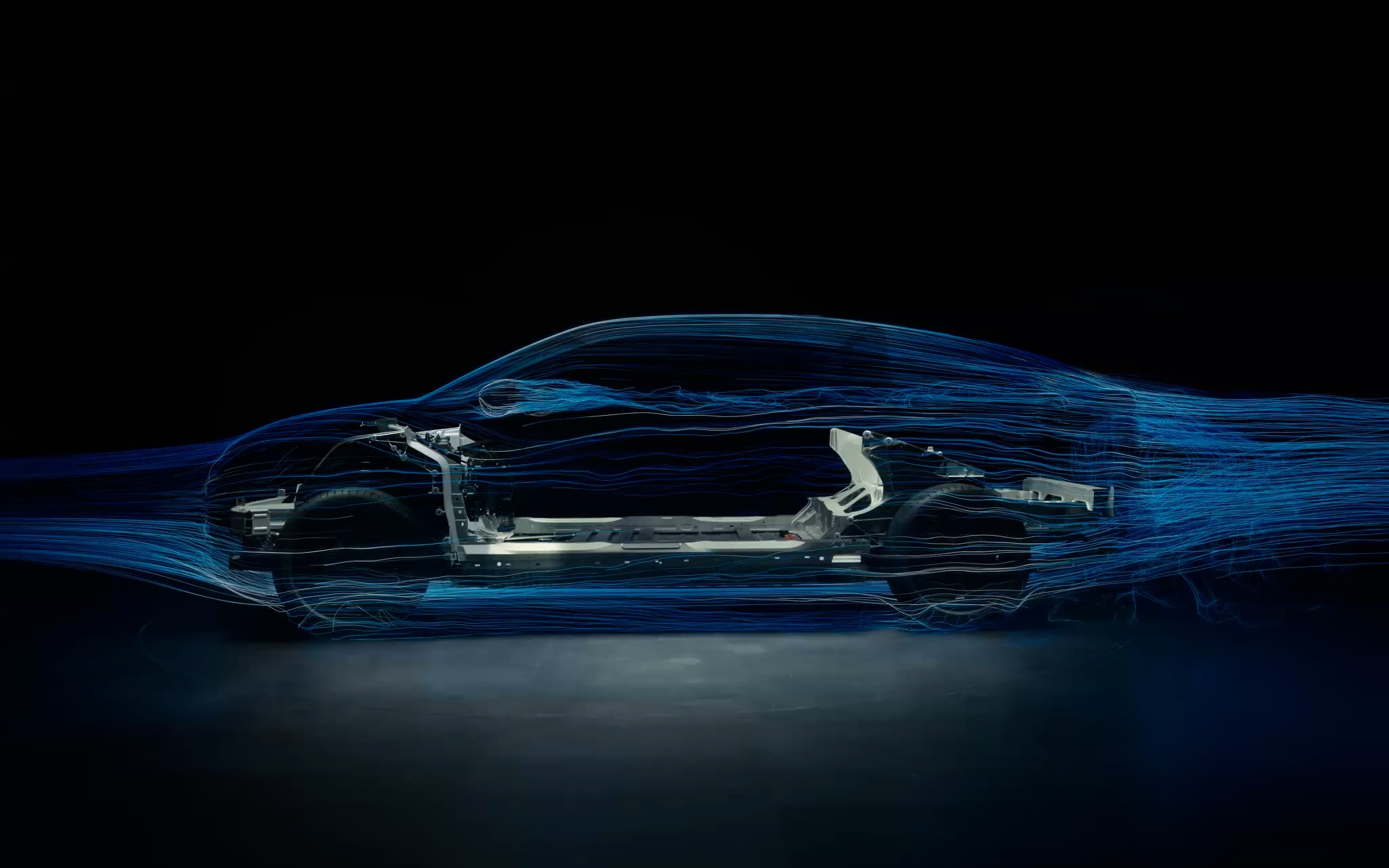
The wake from the front wheels helps prevent the rear wheels from creating even more drag as they rotate. The underside of the drive units has been aero-optimized, with the driveshafts angled to minimize friction. The traditional pickup-truck shape isn’t the ideal starting point for an extremely low-drag vehicle, but Ford has shaped the cab to help airflow continue over the back in a teardrop shape, ignoring the bed, until it meets the top of the tailgate. “To the air, it’s no longer a truck,” said Saleem Merkt, head of aerodynamics for Ford’s advanced EV development.
A prototype illustration of the aerodynamic efficiency of Ford’s mid-size electric truck.
Credit: Ford
A prototype illustration of the aerodynamic efficiency of Ford’s mid-size electric truck. Credit: Ford
Like Merkt, many of the aerodynamicists working on the EV platform have a background in Formula 1, and Ford says it used their “fail fast, learn faster” mentality to good effect. They introduced the wind tunnel early in the truck’s development, using a modular approach that allowed them to swap 3D-printed or machined parts in and out to test new configurations quickly.
“[F]rom under-body shields to front fascia to suspension—in as little as minutes. We tested thousands of 3D-printed components, including versions of the suspension and drive units that didn’t even exist as functional prototypes yet,” Merkt said. “Since these 3D-printed parts were accurate within fractions of a millimeter of our simulations, it allowed us to develop a deeper, data-driven understanding of how every single detail impacts range and efficiency in the real world.”
In addition to the wind-shaping roof, Merkt’s team redesigned the side mirrors to use a single actuator for both adjusting the glass and folding the mirror. “Now that the mirror body no longer needs internal ‘wiggle room’ for the glass to move independently, we were able to shrink the entire housing by over 20 percent. This reduction in frontal area and mass unlocks a more aerodynamic shape, adding an estimated 1.5 miles of range,” Merkt said.
On their own, each small optimization adds only a little more range. Together, though, they add up to a meaningful improvement over any midsize truck on the market, Ford says.
Large castings, fewer wires, smarter electronics
Large castings are a hot trend in the automotive industry right now. As long as you have good quality control, using single castings instead of assemblies made from dozens or hundreds of components can save time and weight. For the 2027 electric pickup, Ford is using just two front and rear structural parts, each a single aluminum casting. For comparison, the Ford Maverick pickup uses 146 structural parts in the front and rear, Ford says. And since unicastings require fewer fasteners and adhesives, Ford needs fewer robots on the assembly line.
The battery uses a cell-to-structure architecture, meaning more of the pack’s volume is taken up by cells, increasing energy density. And there’s a flexible one-piece circuit board on top. A shorter (and therefore lighter) wiring harness is made possible by a switch to 48 V for the low-voltage system. Ford has designed the new platform’s charging system entirely in-house, creating a single high- and low-voltage power-electronics unit for the entire EV. This includes bidirectional charging, although the company has stuck with 400 V for the high-voltage system rather than moving to 800 V or greater. And the pickup will be an entirely software-defined vehicle. Instead of having dozens of discrete electronic control units, each with a single job, the EV will use a zonal architecture with five powerful computers, with one overseeing each zone.
Details like the exact price, EPA range estimate, and sale date will come later, the company told us.
Jonathan is the Automotive Editor at Ars Technica. He has a BSc and PhD in Pharmacology. In 2014 he decided to indulge his lifelong passion for the car by leaving the National Human Genome Research Institute and launching Ars Technica’s automotive coverage. He lives in Washington, DC.
Cast your mind back to 2021. Electric vehicles were hot stuff, buoyed by Tesla’s increasingly stratospheric valuation and a general optimism fueled by what would turn out to be the most significant climate-focused spending package in US history. For some time, automakers had been promising an all-electric future, and they started laying the groundwork to make that happen, partnering with battery suppliers and the like.
Take Ford—that year, it announced a joint venture with SK to build a pair of battery factories, one in Kentucky, the other in Tennessee. BlueOvalSK represented an $11.4 billion investment that would create 11,000 jobs, we were told, and an annual output of 60 GWh from both plants.
Four years later, things look very different. EV subsidies are dead, as is any inclination by the current government to hold automakers accountable for selling too many gas guzzlers. EV-heavy product plans have been thrown out, and designs for new combustion-powered cars are being dusted off and spiffed up. Fewer EVs means a lower need for batteries, and today we saw that in evidence when it emerged that Ford and SK On are ending their battery factory joint venture.
The news has not exactly shocked industry-watchers. Ford started to throttle back on the EV hype in 2024, throwing out not one but two EV strategies by that August. Disappointing F-150 Lightning sales saw Ford postpone a fully electric replacement (which is supposed to be built in Tennessee) in favor of a smaller midsize electric truck—supposedly much cheaper to build—due in 2027.
Divorce
As for the two plants, a Ford subsidiary will assume full ownership of Blue Oval City in Kentucky, with SK On taking full ownership of the plant in Tennessee. According to Reuters, SK On decided to end the partnership due to the declining prospects of EV sales in the US. Instead, it intends to focus the Tennessee plant’s output on the energy storage market.
I came across possibly one of the weirdest official automotive accessories this morning, courtesy of a friend’s social media feed. It’s called the “Truckle,” and it’s a hand-crafted silver and bronze belt buckle that might be the envy of every other cowboy out there, since this one has a place to keep your F-150’s key fob without ruining the lines of your jeans.
The Truckle was designed by Utah-based A Cut Above Buckles, with a hand-engraved F-150 on the bump in the front. Behind the truck? Storage space for a Ford truck key fob, which should fit any F-150 from model year 2018 onward.
“You can put your key fob in the buckle—all your remote features work while it’s in the buckle,” designer Andy Andrews told the Detroit Free Press. “Once you have it in there, you’re not going to lose that key fob. You’re not going to be scratching your head (wondering) where it’s at. It’s right there with you in the Truckle.”
The limited edition Truckle is probably only for serious F-150 fans, though; at $200, it’s quite a commitment to keeping your pants up. Ford and A Cut Above Buckles debuted the Truckle this past weekend at the Texas State Fair.
Just after midnight this morning, in addition to getting a federal government shutdown, we also lost all federal tax credits for new electric vehicles, used electric vehicles, and commercial electric vehicles.
Sadly, this was not a surprise. During last year’s election, the Trump campaign made no secret of its disgust toward clean vehicles (and clean energy in general), and it promised to end subsidies meant to encourage Americans to switch from internal combustion engines to EVs. Once in power, the Republicans moved quickly to make this happen.
Federal clean vehicle incentives had only recently been revamped in then-US President Joe Biden’s massive investment in clean technologies as part of the Inflation Reduction Act of 2022. To qualify for the $7,500 tax credit, a new EV had to have its final assembly in North America, and certain percentages of its battery content needed to be domestically sourced.
A separate $7,500 commercial tax credit for new EVs was created, which did not require domestic assembly or content and which applied to leased EVs. And Congress finally added a $4,000 tax credit for the purchase of a used EV.
Visiting the relevant IRS page today, though, you’ll see an update declaring that the “New Clean Vehicle Credit, Previously-Owned Clean Vehicle Credit, and Qualified Commercial Clean Vehicle Credit are not available for vehicles acquired after Sept. 30, 2025.”
Formula 1 might be riding high these days on a wave of interest not seen since the 1960s, but the Drive to Survive effect has been felt elsewhere in the world of motorsport. Endurance racing like the 24 Hours of Le Mans or the Rolex 24 at Daytona has seen record crowds over the last few years, and a large part of that is down to the sports prototype class, exemplified by cars from the likes of Ferrari and Porsche. And soon, we can add Ford to the list.
Currently, eight different manufacturers are competing against each other in the World Endurance Championship’s Hypercar class: Alpine, Aston Martin, BMW, Cadillac, Ferrari, Peugeot, Porsche, and Toyota. More are on the way—Genesis arrives next year, and at the beginning of the year, Ford announced that it, too, was joining the fray, in 2027. Today, the Blue Oval revealed some more details about the project.
What’s a hypercar?
Compared to the road car-derived machines that race in the GT3 category, the vehicles that contest for overall victory in the Hypercar class are purpose-built prototypes, just for racing. Because endurance racing often has to be needlessly complicated for the sake of being complicated, the Hypercar class is actually made up of a mix of vehicles designed to two different technical rule sets that are performance balanced to create a level playing field.
You can find a lengthy explanation of the differences between the two sets of technical regulations (called LMH and LMDh) in our previous coverage, but briefly, LMH cars are designed entirely by a manufacturer and can but don’t have to be hybrids—like the V12-only Aston Martin Valkyrie.
LMDh cars, by contrast, must use a carbon-fiber spine from one of four approved race car makers, and all must use the same spec transmission, hybrid battery, and electric motor, with the car companies designing their own bodywork and internal combustion engine. LMH has more technical freedom—you can mount that electric motor to the front axle, for example—but it’s also a more expensive way to go.
Ford will debut a new midsize pickup truck in 2027 with a targeted price of $30,000, the automaker announced today. The as-yet unnamed pickup will be the first of a series of more affordable EVs from Ford, built using a newly designed flexible vehicle platform and US-made prismatic lithium iron phosphate batteries.
For the past few years, a team of Ford employees have been hard at work on the far side of the country from the Blue Oval’s base in Dearborn, Michigan. Sequestered in Long Beach and taking inspiration from Lockheed’s legendary “skunkworks,” the Electric Vehicle Development Center approached designing and building Ford’s next family of EVs as a clean-sheet problem, presumably taking inspiration from the Chinese EVs that have so impressed Ford’s CEO.
It starts with a pickup
Designing an EV from the ground up, free of decades of legacy cruft, is a good idea, but not one unique to Ford. In recent months we’ve reviewed quite a few so-called software-defined vehicles, which replace dozens or even hundreds of discrete single-function electronic control units with a handful of powerful modern computers (usually known as domain controllers) on a high-speed network.
“This isn’t a stripped‑down, old‑school vehicle,” said Doug Field, Ford’s chief EV, digital, and design officer, pointedly comparing the future Ford to the recently revealed barebones EV from Slate Motors.
An animation of Ford’s new vehicle architecture.
Starting from scratch like this is allowing vehicle dynamics engineers to get creative with the way EVs handle. Field said that the company “applied first‑principles engineering, pushing to the limits of physics to make it fun to drive and compete on affordability. Our new zonal electric architecture unlocks capabilities the industry has never seen.”
The Ford Motor Company is adjusting its electric vehicle strategy. The automaker will prioritize smaller and more affordable EVs ahead of the replacement for the F-150 Lightning fullsize pickup truck and e-Transit van. The Lightning replacement, codenamed T3, should now appear later in 2027, with the van a year behind.
Here in 2025, EV adoption isn’t exactly going the way everyone thought—or rather hoped—it would. The hype surrounding EVs worked fast, and the glinting dollar signs in people’s eyes as they saw Tesla’s share price soar higher and higher convinced even people who don’t care about decarbonization that going all-in on EVs was the way to go.
But it takes longer to develop a new vehicle than it takes to excite an investor. And it takes longer even than that to build out the charging infrastructure necessary to transform EV motoring from something for early adopters and the eco-conscious into a viable alternative for a largely incurious and change-averse general public. Which is a long-winded way of saying the industry got out over its skis.
Take the Ford F-150 Lightning. Americans adore their pickup trucks, and the Lightning is a darn good pickup in most regards. It looks like a normal F-150, and while it might not tow as far before it has to stop, it does most other things as well or better than the gasoline-powered equivalent.
But something the size and shape of a full-size pickup truck is always going to require a lot of energy to push it through the air—even if you squeezed the drag coefficient, there’s no getting away from so much frontal area. And that means you need a gigantic battery in order to meet range expectations. And that means the truck that customers thought would cost $40,000 actually costs way more; sometimes as much as twice that. So it has hardly been the sales success people once imagined.
Ford also told Ars that it will continue to offer employee pricing to all its customers until at least July 4, even on vehicles made after May 2.
Ford published its Q1 2025 financial results earlier this week, reporting a net income of $471 million, a $900 million decrease compared to Q1 2024. In its statement to investors, the company said that it estimates that the Trump tariff will cost it as much as $1.5 billion in 2025.
Still, the price increases will be felt keenly, particularly for hybrid Maverick customers. When Ford facelifted the hybrid pickup truck last year, it also added several thousand more dollars to the MSRP; now that’s going up yet again.
Meanwhile, a separate 25 percent tariff on imported car parts went into effect last week. While there is a small break for OEMs to apply for up to 3.75 percent reimbursements, the parts tariff will affect all OEMs building cars in the US, all of which depend to greater or lesser degrees on suppliers in Mexico and Canada. On top of the persistent 25 percent price increase that almost all cars have experienced since 2020, it seems it’s becoming an even more horrible time to have to buy a new vehicle.
The US has had to pause some of these new tariffs almost immediately, and the proposed 25 percent tariffs against any Canadian or Mexican imports have been delayed for a month. But yesterday, the president imposed 25 percent tariffs on any imported steel or aluminum. When last in office, Trump also imposed tariffs on steel (25 percent) and aluminum (10 percent), igniting a trade war and cutting US steel imports by far more than domestic steel production was able to rise to meet it.
“Let’s be real honest: long-term, 25 percent tariffs across the Mexican and Canadian border would blow a hole in the US industry that we have never seen,” Farley said, pointing out that the tariffs would “give free rein” to OEMs that import their vehicles from Japan, South Korea, or Europe.
As the CEO of Polestar told Ars last week, the main thing automakers want is clarity. The last they want is chaos, where the rules have changed from one day to the next based on whim. At the conference, Farley had a similar message. “They need to understand there’s a lot of policy uncertainty here, but in the meantime, we’re scrambling to manage the company as professionals,” he said.
To fill a car with gas, you generally just need a credit card or cash. To charge an EV at a DC fast charging station, you need any number of things to work—a credit card reader, an app for that charger’s network, a touchscreen that’s working—and they’re all a little different.
That situation could change next year if a new “universal Plug and Charge” initiative from SAE International, backed by a number of EV carmakers and chargers, moves ahead and gains ground. Launching in early 2025, the network could make charging an EV actually easier than gassing up: plug in, let the car and charger figure out the payment details over a cloud connection, and go.
Some car and charging network combinations already offer such a system through a patchwork of individual deals, as listed at Inside EVs. Teslas have always offered a plug-and-charge experience, given the tight integration between their Superchargers and vehicles. Now Tesla will join the plug-and-charge movement proper, allowing Teslas to have a roughly similar experience at other stations.
The Electric Vehicle Public Key Infrastructure, or EVPKI, has a good number of the major players on board, and it builds on the ISO standard (15118) to make it faster and more secure for cars to be authenticated and authorized to charge at stations. A whole bunch of certificates are in place at every step of the charging process, as detailed in an EVPKI presentation, and the system includes a Certified Trust List. With an open standard and authentication system, there should be room for new charging networks and vehicle makers.
Have electric vehicles been overhyped? A casual observer might have come to that conclusion after almost a year of stories in the media about EVs languishing on lots and letters to the White House asking for a national electrification mandate to be watered down or rolled back. EVs were even a pain point during last year’s auto worker industrial action. But a look at the sales data paints a different picture, one where Tesla’s outsize role in the market has had a distorting effect.
“EVs are the future. Our numbers bear that out. Current challenges will be overcome by the industry and government, and EVs will regain momentum and will ultimately dominate the automotive market,” said Martin Cardell, head of global mobility solutions at consultancy firm EY.
Public perception hasn’t been helped by recent memories of supply shortages and pandemic price gouging, but the chorus of concerns about EV sales became noticeably louder toward the end of last year and the beginning of 2024. EV sales in 2023 grew by 47 percent year on year, but the first three months of this year failed to show such massive growth. In fact, sales in Q1 2024 were up only 2.6 percent over the same period in 2023.
Tesla doesn’t break out its sales data by region anymore, but its new US registrations were down by as much as 25 percent, month on month, as its overall marketshare of EVs closes in on 50 percent this year; by contrast, Tesla was 80 percent of the US EV market in 2020. (Overall, Tesla’s global deliveries fell by 8.5 percent.)
The other sick patient in addition to Tesla is Volkswagen. Despite local production of the ID.4 crossover in Chattanooga, Tennessee, the brand saw EV sales fall by 37 percent in Q1. It has also abandoned plans to bring the ID.7 electric sedan to North America, and the long-awaited ID. Buzz microbus has yet to reach US showrooms more than eight years after it was first shown here.
But all this noise has been enough to spook executives into action. Both Ford and General Motors took the embarrassing step of rolling back their electrification goals, all but admitting they bet on the wrong horse. Instead of turning away from new internal combustion engine products, we’re set for a new flurry of hybrids—just don’t expect any of them to show up before 2026.
GM’s difficulty in ramping up its new family of EVs built around the UItium battery platform has been well-documented. The end of production of the Chevrolet Bolt, which sold for less than $30,000, didn’t help; with the little electric hatchback (and the slightly stretched Bolt EUV) no longer contributing to the sales charts, GM’s Q1 EV sales fell by 21 percent.
The problems with assembling Ultium cells into battery packs appears to be in GM’s past now. Cadillac Lyriqs are starting to become a common sight on the road, and GM CEO Mary Barra told Bloomberg that GM expects to build between 200,000 and 300,000 Ultium-based EVs this year, a huge increase over the 13,838 it managed to ship last year.
Meanwhile, Ford’s EV “slump” is nothing of the kind. In May, it sold 91 percent more F-150 Lightnings than last year. E-Transit sales were up 77 percent. And the Mustang Mach-E showed growth of 46 percent. In total, Ford’s EV sales for the first five months of this year were up 87.7 percent on 2023, helped no doubt by the company’s price cuts.
High double-digit sales growth (in Q1 2024) has also been occurring at Hyundai and Kia (up 56.1 percent), BMW (up 57.8 percent), Rivian (up 58.8 percent), Mercedes (up 66.9 percent), and Toyota (up 85.9 percent).
“As anticipated, Tesla’s sales took a hit, influencing the overall market dynamics. However, a few brands saw significant EV sales increases, achieving over 50 percent year-over-year growth,” said Stephanie Valdez Streaty, director of industry insights at Cox Automotive. “As noted in January, we are calling 2024 ‘the Year of More.’ More new products, more incentives, more inventory, more leasing and more infrastructure will drive EV sales higher this year. Even so, we’ll continue to see ups and downs as the industry moves toward electrification.”
“We view the current headwinds that EV sales are experiencing in the US and Europe as short-term in nature. The buildup of charging infrastructure, availability of affordable EV models with a fall in battery prices, combined with government regulations, will drive sustainable BEV growth in the long run,” said Cardell.