Google

google-makes-first-play-store-changes-after-losing-epic-games-antitrust-case

Google makes first Play Store changes after losing Epic Games antitrust case

The fight continues

Google is fighting tooth and nail to keep the Play Store locked down, which it claims is beneficial to Android users who expect an orderly and safe app ecosystem. The company pleaded with the US Supreme Court several weeks ago to consider the supposed negative impact of the order, asking to freeze the lower court’s order while it prepared its final appeal.

Ultimately, SCOTUS allowed the order to stand, but Google has now petitioned the high court to hear its appeal in full. The company will attempt to overturn the original ruling, which could return everything to its original state. With Google’s insistence that it is only allowing this modicum of extra freedom while the District Court’s order is in effect, devs could experience some whiplash if the company is successful.

It’s uncertain if the high court will take up the case and whether that would save Google from implementing the next phase of Judge Donato’s order. That includes providing a mirror of Play Store content to third-party app stores and distributing those stores within the Play Store. Because these are more complex technical requirements, Google has 10 months from the final ruling to comply. That puts the deadline in July 2026.

If the Supreme Court decides to hear the case, arguments likely won’t happen for at least a year. Google may try to get the summer 2026 deadline pushed back while it pursues the case. Even if it loses, the impact may be somewhat blunted. Google’s planned developer verification system will force all developers, even those distributing outside the Play Store, to confirm their identities with Google and pay a processing fee. Apps from unverified developers will not be installable on Google-certified Android devices in the coming years, regardless of where you get them. This system, which is allegedly about ensuring user security, would also hand Google more control over the Android app ecosystem as the Play Store loses its special status.

Google makes first Play Store changes after losing Epic Games antitrust case Read More »

after-teen-death-lawsuits,-character.ai-will-restrict-chats-for-under-18-users

After teen death lawsuits, Character.AI will restrict chats for under-18 users

Lawsuits and safety concerns

Character.AI was founded in 2021 by Noam Shazeer and Daniel De Freitas, two former Google engineers, and raised nearly $200 million from investors. Last year, Google agreed to pay about $3 billion to license Character.AI’s technology, and Shazeer and De Freitas returned to Google.

But the company now faces multiple lawsuits alleging that its technology contributed to teen deaths. Last year, the family of 14-year-old Sewell Setzer III sued Character.AI, accusing the company of being responsible for his death. Setzer died by suicide after frequently texting and conversing with one of the platform’s chatbots. The company faces additional lawsuits, including one from a Colorado family whose 13-year-old daughter, Juliana Peralta, died by suicide in 2023 after using the platform.

In December, Character.AI announced changes, including improved detection of violating content and revised terms of service, but those measures did not restrict underage users from accessing the platform. Other AI chatbot services, such as OpenAI’s ChatGPT, have also come under scrutiny for their chatbots’ effects on young users. In September, OpenAI introduced parental control features intended to give parents more visibility into how their kids use the service.

The cases have drawn attention from government officials, which likely pushed Character.AI to announce the changes for under-18 chat access. Steve Padilla, a Democrat in California’s State Senate who introduced the safety bill, told The New York Times that “the stories are mounting of what can go wrong. It’s important to put reasonable guardrails in place so that we protect people who are most vulnerable.”

On Tuesday, Senators Josh Hawley and Richard Blumenthal introduced a bill to bar AI companions from use by minors. In addition, California Governor Gavin Newsom this month signed a law, which takes effect on January 1, requiring AI companies to have safety guardrails on chatbots.

After teen death lawsuits, Character.AI will restrict chats for under-18 users Read More »

tv-focused-youtube-update-brings-ai-upscaling,-shopping-qr-codes

TV-focused YouTube update brings AI upscaling, shopping QR codes

YouTube has been streaming for 20 years, but it was only in the last couple that it came to dominate TV streaming. Google’s video platform attracts more TV viewers than Netflix, Disney+, and all the other apps, and Google is looking to further beef up its big-screen appeal with a new raft of features, including shopping, immersive channel surfing, and an official version of the AI upscaling that had creators miffed a few months back.

According to Google, YouTube’s growth has translated into higher payouts. The number of channels earning more than $100,000 annually is up 45 percent in 2025 versus 2024. YouTube is now giving creators some tools to boost their appeal (and hopefully their income) on TV screens. Those elaborate video thumbnails featuring surprised, angry, smiley hosts are about to get even prettier with the new 50MB file size limit. That’s up from a measly 2MB.

Video upscaling is also coming to YouTube, and creators will be opted in automatically. To start, YouTube will be upscaling lower-quality videos to 1080p. In the near future, Google plans to support “super resolution” up to 4K.

The site stresses that it’s not modifying original files—creators will have access to both the original and upscaled files, and they can opt out of upscaling. In addition, super resolution videos will be clearly labeled on the user side, allowing viewers to select the original upload if they prefer. The lack of transparency was a sticking point for creators, some of whom complained about the sudden artificial look of their videos during YouTube’s testing earlier this year.

TV-focused YouTube update brings AI upscaling, shopping QR codes Read More »

ai-powered-search-engines-rely-on-“less-popular”-sources,-researchers-find

AI-powered search engines rely on “less popular” sources, researchers find

OK, but which one is better?

These differences don’t necessarily mean the AI-generated results are “worse,” of course. The researchers found that GPT-based searches were more likely to cite sources like corporate entities and encyclopedias for their information, for instance, while almost never citing social media websites.

An LLM-based analysis tool found that AI-powered search results also tended to cover a similar number of identifiable “concepts” as the traditional top 10 links, suggesting a similar level of detail, diversity, and novelty in the results. At the same time, the researchers found that “generative engines tend to compress information, sometimes omitting secondary or ambiguous aspects that traditional search retains.” That was especially true for more ambiguous search terms (such as names shared by different people), for which “organic search results provide better coverage,” the researchers found.

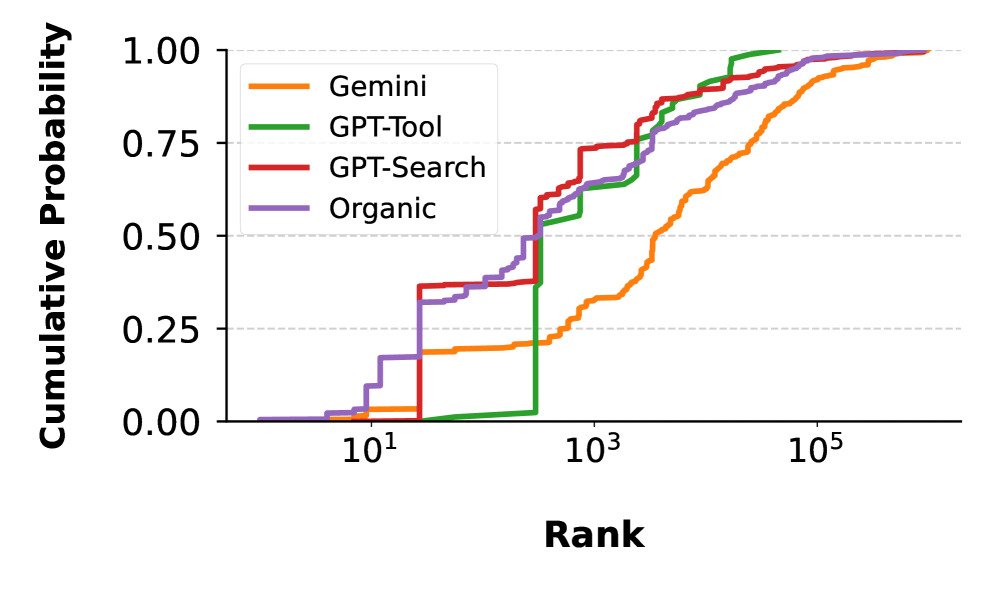
Google Gemini search in particular was more likely to cite low-popularity domains.

Google Gemini search in particular was more likely to cite low-popularity domains. Credit: Kirsten et al

The AI search engines also arguably have an advantage in being able to weave pre-trained “internal knowledge” in with data culled from cited websites. That was especially true for GPT-4o with Search Tool, which often didn’t cite any web sources and simply provided a direct response based on its training.

But this reliance on pre-trained data can become a limitation when searching for timely information. For search terms pulled from Google’s list of Trending Queries for September 15, the researchers found GPT-4o with Search Tool often responded with messages along the lines of “could you please provide more information” rather than actually searching the web for up-to-date information.

While the researchers didn’t determine whether AI-based search engines were overall “better” or “worse” than traditional search engine links, they did urge future research on “new evaluation methods that jointly consider source diversity, conceptual coverage, and synthesis behavior in generative search systems.”

AI-powered search engines rely on “less popular” sources, researchers find Read More »

the-android-powered-boox-palma-2-pro-fits-in-your-pocket,-but-it’s-not-a-phone

The Android-powered Boox Palma 2 Pro fits in your pocket, but it’s not a phone

Softly talking about the Boox Palma 2 Pro

For years, color E Ink was seen as a desirable feature, which would make it easier to read magazines and comics on low-power devices—Boox even has an E Ink monitor. However, the quality of the displays has been lacking. These screens do show colors, but they’re not as vibrant as what you get on an LCD or OLED. In the case of the Palma 2 Pro, the screen is also less sharp in color mode. The touchscreen display is 824 × 1648 in monochrome, but turning on color cuts that in half to 412 × 824.

In addition to the new screen, the second-gen Palma adds a SIM card slot. It’s not for phone calls, though. The SIM slot allows the device to get 5G mobile data in addition to Wi-Fi.

Credit: Boox

The Palma 2 Pro runs Android 15 out of the box. That’s a solid showing for Boox, which often uses much older builds of Google’s mobile OS. Upgrades aren’t guaranteed, and there’s no official support for Google services. However, Boox has a workaround for its devices so the Play Store can be installed.

The new Boox pocket reader is available for pre-order now at $400. It’s expected to ship around November 14.

The Android-powered Boox Palma 2 Pro fits in your pocket, but it’s not a phone Read More »

lawsuit:-reddit-caught-perplexity-“red-handed”-stealing-data-from-google-results

Lawsuit: Reddit caught Perplexity “red-handed” stealing data from Google results


Scraper accused of stealing Reddit content “shocked” by lawsuit.

In a lawsuit filed on Wednesday, Reddit accused an AI search engine, Perplexity, of conspiring with several companies to illegally scrape Reddit content from Google search results, allegedly dodging anti-scraping methods that require substantial investments from both Google and Reddit.

Reddit alleged that Perplexity feeds off Reddit and Google, claiming to be “the world’s first answer engine” but really doing “nothing groundbreaking.”

“Its answer engine simply uses a different company’s” large language model “to parse through a massive number of Google search results to see if it can answer a user’s question based on those results,” the lawsuit said. “But Perplexity can only run its ‘answer engine’ by wrongfully accessing and scraping Reddit content appearing in Google’s own search results from Google’s own search engine.”

Likening companies involved in the alleged conspiracy to “bank robbers,” Reddit claimed it caught Perplexity “red-handed” stealing content that its “answer engine” should not have had access to.

Baiting Perplexity with “the digital equivalent of marked bills,” Reddit tested out posting content that could only be found in Google search engine results pages (SERPs) and “within hours, queries to Perplexity’s ‘answer engine’ produced the contents of that test post.”

“The only way that Perplexity could have obtained that Reddit content and then used it in its ‘answer engine’ is if it and/or its Co-Defendants scraped Google SERPs for that Reddit content and Perplexity then quickly incorporated that data into its answer engine,” Reddit’s lawsuit said.

In a Reddit post, Perplexity denied any wrongdoing, describing its answer engine as summarizing Reddit discussions and citing Reddit threads in answers, just like anyone who shares links or posts on Reddit might do. Perplexity suggested that Reddit was attacking the open Internet by trying to extort licensing fees for Reddit content, despite knowing that Perplexity doesn’t train foundational models. Reddit’s endgame, Perplexity alleged, was to use the Perplexity lawsuit as a “show of force in Reddit’s training data negotiations with Google and OpenAI.”

“We won’t be extorted, and we won’t help Reddit extort Google, even if they’re our (huge) competitor,” Perplexity wrote. “Perplexity will play fair, but we won’t cave. And we won’t let bigger companies use us in shell games. ”

Reddit likely anticipated Perplexity’s defense of the “open Internet,” noting in its complaint that “Reddit’s current Robots Exclusion Protocol file (‘robots.txt’) says, ‘Reddit believes in an open Internet, but not the misuse of public content.’”

Google reveals how scrapers steal from search results

To block scraping, Reddit uses various measures, such as “registered user-identification limits, IP-rate limits, captcha bot protection, and anomaly-detection tools,” the complaint said.

Similarly, Google relies on “anti-scraping systems and teams dedicated to preventing unauthorized access to its products and services,” Reddit said, noting Google prohibits “unauthorized automated access” to its SERPs.

To back its claims, Reddit subpoenaed Google to find out more about how the search giant blocks AI scrapers from accessing content on SERPs. Google confirmed it relies on “a technological access control system called ‘SearchGuard,’ which is designed to prevent automated systems from accessing and obtaining wholesale search results and indexed data while allowing individual users—i.e., humans—access to Google’s search results, including results that feature Reddit data.”

“SearchGuard prevents unauthorized access to Google’s search data by imposing a barrier challenge that cannot be solved in the ordinary course by automated systems unless they take affirmative actions to circumvent the SearchGuard system,” Reddit’s complaint explained.

Bypassing these anti-scraping systems violates the Digital Millennium Copyright Act, Reddit alleged, as well as laws against unfair trade and unjust enrichment. Seemingly, Google’s SearchGuard may currently be the easiest to bypass for alleged conspirators who supposedly pivoted to looting Google SERPs after realizing they couldn’t access Reddit content directly on the platform.

Scrapers shocked by Reddit lawsuit

Reddit accused three companies of conspiring with Perplexity—”a Lithuanian data scraper” called Oxylabs UAB, “a former Russian botnet” known as AWMProxy, and SerpApi, a Texas company that sells services for scraping search engines.

Oxylabs “is explicit that its scraping service is meant to circumvent Google’s technological measures,” Reddit alleged, pointing to an Oxylabs’ website called “How to Scrape Google Search Results.”

SerpApi touts the same service, including some options to scrape SERPs at “ludicrous speeds.” To trick browsers, SerpApi’s fastest option uses “a server-swarm to hide from, avoid, or simply overwhelm by brute force effective measures Google has put in place to ward off automated access to search engine results,” Reddit alleged. SerpApi also allegedly provides users “with tips to reduce the chance of being blocked while web scraping, such as by sending ‘fake user-agent string[s],’ shifting IP addresses to avoid multiple requests from the same address, and using proxies ‘to make traffic look like regular user traffic’ and thereby ‘impersonate’ user traffic.”

According to Reddit, the three companies disguise “their web scrapers as regular people (among other techniques) to circumvent or bypass the security restrictions meant to stop them.” During a two-week span in July, they scraped “almost three billion” SERPs containing Reddit text, URLs, images, and videos, a subpoena requesting information from Google revealed.

Ars could not immediately reach AWMProxy for comment. However, the other companies were surprised by Reddit’s lawsuit, while vowing to defend their business models.

SerpApi’s spokesperson told Ars that Reddit did not notify the company before filing the lawsuit.

“We strongly disagree with Reddit’s allegations and intend to vigorously defend ourselves in court,” SerpApi’s spokesperson said. “In the eight years we’ve been in business, SerpApi has always operated on the right side of the law. As stated on our website, ‘The crawling and parsing of public data is protected by the First Amendment of the United States Constitution. We value freedom of speech tremendously.’”

Additionally, SerpAPI works “closely with our attorneys to ensure that our services comply with all applicable laws and fair use principles. SerpApi stands firmly behind its business model and conduct, and we will continue to defend our rights to the fullest extent,” the spokesperson said.

Oxylabs’ chief governance strategy officer, Denas Grybauskas, told Ars that Reddit’s complaint seemed baffling since the other companies involved in the litigation are “unrelated and unaffiliated.”

“We are shocked and disappointed by this news, as Reddit has made no attempt to speak with us directly or communicate any potential concerns,” Grybauskas said. “Oxylabs has always been and will continue to be a pioneer and an industry leader in public data collection, and it will not hesitate to defend itself against these allegations. Oxylabs’ position is that no company should claim ownership of public data that does not belong to them. It is possible that it is just an attempt to sell the same public data at an inflated price.”

Grybauskas defended Oxylabs’ business as creating “real-world value for thousands of businesses and researchers, such as those driving open-source investigations, disinformation tackling, or environmental monitoring.”

“We strongly believe that our core business principles make the Internet a better place and serve the public good,” Grybauskas said. “Oxylabs provides infrastructure for compliant access to publicly available information, and we demand every customer to use our services lawfully. ”

Reddit cited threats to licensing deals

Apparently, Reddit caught on to the alleged scheme after sending cease-and-desist letters to Perplexity to stop scraping Reddit content that its answer engine was citing. Rather than ending the scraping, Reddit claimed Perplexity’s citations increased “forty-fold.” Since Perplexity is a customer listed on SerpApi’s website, Reddit hypothesized the two were conspiring to skirt Google’s anti-circumvention tools, the complaint said, along with the other companies.

In a statement provided to Ars, Ben Lee, chief legal officer at Reddit, said that Oxylabs, AWMProxy, and SerpApi were “textbook examples” of scrapers that “bypass technological protections to steal data, then sell it to clients hungry for training material.”

“Unable to scrape Reddit directly, they mask their identities, hide their locations, and disguise their web scrapers to steal Reddit content from Google Search,” Lee said. “Perplexity is a willing customer of at least one of these scrapers, choosing to buy stolen data rather than enter into a lawful agreement with Reddit itself.”

On Reddit, Perplexity pushed back on Reddit’s claims that Perplexity ignored requests to license Reddit content.

“Untrue. Whenever anyone asks us about content licensing, we explain that Perplexity, as an application-layer company, does not train AI models on content,” Perplexity said. “Never has. So, it is impossible for us to sign a license agreement to do so.”

Reddit supposedly “insisted we pay anyway, despite lawfully accessing Reddit data,” Perplexity said. “Bowing to strong arm tactics just isn’t how we do business.”

Perplexity’s spokesperson, Jesse Dwyer, told Ars the company chose to post its statement on Reddit “to illustrate a simple point.”

“It is a public Reddit link accessible to anyone, yet by the logic of Reddit’s lawsuit, if you mention it or cite it in any way (which is your job as a reporter), they might just sue you,” Dwyer said.

But Reddit claimed that its business and reputation have been “damaged” by “misappropriation of Reddit data and circumvention of technological control measures.” Without a licensing deal ensuring that Perplexity and others are respecting Reddit policies, Reddit cannot control who has access to data, how they’re using data, and if data use conflicts with Reddit’s privacy policy and user agreement, the complaint said.

Further, Reddit’s worried that Perplexity’s workaround could catch on, potentially messing up Reddit’s other licensing deals. All the while, Reddit noted, it has to invest “significant resources” in anti-scraping technology, with Reddit ultimately suffering damages, including “lost profits and business opportunities, reputational harm, and loss of user trust.”

Reddit’s hoping the court will grant an injunction barring companies from scraping Reddit content from Google SERPs. It also wants companies blocked from both selling Reddit data and “developing or distributing any technology or product that is used for the unauthorized circumvention of technological control measures and scraping of Reddit data.”

If Reddit wins, companies could be required to pay substantial damages or to disgorge profits from the sale of Reddit content.

Advance Publications, which owns Ars Technica parent Condé Nast, is the largest shareholder in Reddit.

Photo of Ashley Belanger

Ashley is a senior policy reporter for Ars Technica, dedicated to tracking social impacts of emerging policies and new technologies. She is a Chicago-based journalist with 20 years of experience.

Lawsuit: Reddit caught Perplexity “red-handed” stealing data from Google results Read More »

google-has-a-useful-quantum-algorithm-that-outperforms-a-supercomputer

Google has a useful quantum algorithm that outperforms a supercomputer


An approach it calls “quantum echoes” takes 13,000 times longer on a supercomputer.

Image of a silvery plate labeled with

The work relied on Google’s current-generation quantum hardware, the Willow chip. Credit: Google

The work relied on Google’s current-generation quantum hardware, the Willow chip. Credit: Google

A few years back, Google made waves when it claimed that some of its hardware had achieved quantum supremacy, performing operations that would be effectively impossible to simulate on a classical computer. That claim didn’t hold up especially well, as mathematicians later developed methods to help classical computers catch up, leading the company to repeat the work on an improved processor.

While this back-and-forth was unfolding, the field became less focused on quantum supremacy and more on two additional measures of success. The first is quantum utility, in which a quantum computer performs computations that are useful in some practical way. The second is quantum advantage, in which a quantum system completes calculations in a fraction of the time it would take a typical computer. (IBM and a startup called Pasqual have published a useful discussion about what would be required to verifiably demonstrate a quantum advantage.)

Today, Google and a large collection of academic collaborators are publishing a paper describing a computational approach that demonstrates a quantum advantage compared to current algorithms—and may actually help us achieve something useful.

Out of time

Google’s latest effort centers on something it’s calling “quantum echoes.” The approach could be described as a series of operations on the hardware qubits that make up its machine. These qubits hold a single bit of quantum information in a superposition between two values, with probabilities of finding the qubit in one value or the other when it’s measured. Each qubit is entangled with its neighbors, allowing its probability to influence those of all the qubits around it. The operations that allow computation, called gates, are ways of manipulating these probabilities. Most current hardware, including Google’s, perform manipulations on one or two qubits at a time (termed one- and two-qubit gates, respectively.

For quantum echoes, the operations involved performing a set of two-qubit gates, altering the state of the system, and later performing the reverse set of gates. On its own, this would return the system to its original state. But for quantum echoes, Google inserts single-qubit gates performed with a randomized parameter. This alters the state of the system before the reverse operations take place, ensuring that the system won’t return to exactly where it started. That explains the “echoes” portion of the name: You’re sending an imperfect copy back toward where things began, much like an echo involves the imperfect reversal of sound waves.

That’s what the process looks like in terms of operations performed on the quantum hardware. But it’s probably more informative to think of it in terms of a quantum system’s behavior. As Google’s Tim O’Brien explained, “You evolve the system forward in time, then you apply a small butterfly perturbation, and then you evolve the system backward in time.” The forward evolution is the first set of two qubit gates, the small perturbation is the randomized one qubit gate, and the second set of two qubit gates is the equivalent of sending the system backward in time.

Because this is a quantum system, however, strange things happen. “On a quantum computer, these forward and backward evolutions, they interfere with each other,” O’Brien said. One way to think about that interference is in terms of probabilities. The system has multiple paths between its start point and the point of reflection—where it goes from evolving forward in time to evolving backward—and from that reflection point back to a final state. Each of those paths has a probability associated with it. And since we’re talking about quantum mechanics, those paths can interfere with each other, increasing some probabilities at the expense of others. That interference ultimately determines where the system ends up.

(Technically, these are termed “out of time order correlations,” or OTOCs. If you read the Nature paper describing this work, prepare to see that term a lot.)

Demonstrating advantage

So how do you turn quantum echoes into an algorithm? On its own, a single “echo” can’t tell you much about the system—the probabilities ensure that any two runs might show different behaviors. But if you repeat the operations multiple times, you can begin to understand the details of this quantum interference. And performing the operations on a quantum computer ensures that it’s easy to simply rerun the operations with different random one-qubit gates and get many instances of the initial and final states—and thus a sense of the probability distributions involved.

This is also where Google’s quantum advantage comes from. Everyone involved agrees that the precise behavior of a quantum echo of moderate complexity can be modeled using any leading supercomputer. But doing so is very time-consuming, so repeating those simulations a few times becomes unrealistic. The paper estimates that a measurement that took its quantum computer 2.1 hours to perform would take the Frontier supercomputer approximately 3.2 years. Unless someone devises a far better classical algorithm than what we have today, this represents a pretty solid quantum advantage.

But is it a useful algorithm? The repeated sampling can act a bit like the Monte Carlo sampling done to explore the behavior of a wide variety of physical systems. Typically, however, we don’t view algorithms as modeling the behavior of the underlying hardware they’re being run on; instead, they’re meant to model some other physical system we’re interested in. That’s where Google’s announcement stands apart from its earlier work—the company believes it has identified an interesting real-world physical system with behaviors that the quantum echoes can help us understand.

That system is a small molecule in a Nuclear Magnetic Resonance (NMR) machine. In a second draft paper being published on the arXiv later today, Google has collaborated with a large collection of NMR experts to explore that use.

From computers to molecules

NMR is based on the fact that the nucleus of every atom has a quantum property called spin. When nuclei are held near to each other, such as when they’re in the same molecule, these spins can influence one another. NMR uses magnetic fields and photons to manipulate these spins and can be used to infer structural details, like how far apart two given atoms are. But as molecules get larger, these spin networks can extend for greater distances and become increasingly complicated to model. So NMR has been limited to focusing on the interactions of relatively nearby spins.

For this work, though, the researchers figured out how to use an NMR machine to create the physical equivalent of a quantum echo in a molecule. The work involved synthesizing the molecule with a specific isotope of carbon (carbon-13) in a known location in the molecule. That isotope could be used as the source of a signal that propagates through the network of spins formed by the molecule’s atoms.

“The OTOC experiment is based on a many-body echo, in which polarization initially localized on a target spin migrates through the spin network, before a Hamiltonian-engineered time-reversal refocuses to the initial state,” the team wrote. “This refocusing is sensitive to perturbations on distant butterfly spins, which allows one to measure the extent of polarization propagation through the spin network.”

Naturally, something this complicated needed a catchy nickname. The team came up with TARDIS, or Time-Accurate Reversal of Dipolar InteractionS. While that name captures the “out of time order” aspect of OTOC, it’s simply a set of control pulses sent to the NMR sample that starts a perturbation of the molecule’s network of nuclear spins. A second set of pulses then reflects an echo back to the source.

The reflections that return are imperfect, with noise coming from two sources. The first is simply imperfections in the control sequence, a limitation of the NMR hardware. But the second is the influence of fluctuations happening in distant atoms along the spin network. These happen at a certain frequency at random, or the researchers could insert a fluctuation by targeting a specific part of the molecule with randomized control signals.

The influence of what’s going on in these distant spins could allow us to use quantum echoes to tease out structural information at greater distances than we currently do with NMR. But to do so, we need an accurate model of how the echoes will propagate through the molecule. And again, that’s difficult to do with classical computations. But it’s very much within the capabilities of quantum computing, which the paper demonstrates.

Where things stand

For now, the team stuck to demonstrations on very simple molecules, making this work mostly a proof of concept. But the researchers are optimistic that there are many ways the system could be used to extract structural information from molecules at distances that are currently unobtainable using NMR. They list a lot of potential upsides that should be explored in the discussion of the paper, and there are plenty of smart people who would love to find new ways of using their NMR machines, so the field is likely to figure out pretty quickly which of these approaches turns out to be practically useful.

The fact that the demonstrations were done with small molecules, however, means that the modeling run on the quantum computer could also have been done on classical hardware (it only required 15 hardware qubits). So Google is claiming both quantum advantage and quantum utility, but not at the same time. The sorts of complex, long-distance interactions that would be out of range of classical simulation are still a bit beyond the reach of the current quantum hardware. O’Brien estimated that the hardware’s fidelity would have to improve by a factor of three or four to model molecules that are beyond classical simulation.

The quantum advantage issue should also be seen as a work in progress. Google has collaborated with enough researchers at enough institutions that there’s unlikely to be a major improvement in algorithms that could allow classical computers to catch up. Until the community as a whole has some time to digest the announcement, though, we shouldn’t take that as a given.

The other issue is verifiability. Some quantum algorithms will produce results that can be easily verified on classical hardware—situations where it’s hard to calculate the right result but easy to confirm a correct answer. Quantum echoes isn’t one of those, so we’ll need another quantum computer to verify the behavior Google has described.

But Google told Ars nothing is up to the task yet. “No other quantum processor currently matches both the error rates and number of qubits of our system, so our quantum computer is the only one capable of doing this at present,” the company said. (For context, Google says that the algorithm was run on up to 65 qubits, but the chip has 105 qubits total.)

There’s a good chance that other companies would disagree with that contention, but it hasn’t been possible to ask them ahead of the paper’s release.

In any case, even if this claim proves controversial, Google’s Michel Devoret, a recent Nobel winner, hinted that we shouldn’t have long to wait for additional ones. “We have other algorithms in the pipeline, so we will hopefully see other interesting quantum algorithms,” Devoret said.

Nature, 2025. DOI: 10.1038/s41586-025-09526-6  (About DOIs).

Photo of John Timmer

John is Ars Technica’s science editor. He has a Bachelor of Arts in Biochemistry from Columbia University, and a Ph.D. in Molecular and Cell Biology from the University of California, Berkeley. When physically separated from his keyboard, he tends to seek out a bicycle, or a scenic location for communing with his hiking boots.

Google has a useful quantum algorithm that outperforms a supercomputer Read More »

youtube’s-likeness-detection-has-arrived-to-help-stop-ai-doppelgangers

YouTube’s likeness detection has arrived to help stop AI doppelgängers

AI content has proliferated across the Internet over the past few years, but those early confabulations with mutated hands have evolved into synthetic images and videos that can be hard to differentiate from reality. Having helped to create this problem, Google has some responsibility to keep AI video in check on YouTube. To that end, the company has started rolling out its promised likeness detection system for creators.

Google’s powerful and freely available AI models have helped fuel the rise of AI content, some of which is aimed at spreading misinformation and harassing individuals. Creators and influencers fear their brands could be tainted by a flood of AI videos that show them saying and doing things that never happened—even lawmakers are fretting about this. Google has placed a large bet on the value of AI content, so banning AI from YouTube, as many want, simply isn’t happening.

Earlier this year, YouTube promised tools that would flag face-stealing AI content on the platform. The likeness detection tool, which is similar to the site’s copyright detection system, has now expanded beyond the initial small group of testers. YouTube says the first batch of eligible creators have been notified that they can use likeness detection, but interested parties will need to hand Google even more personal information to get protection from AI fakes.

Sneak Peek: Likeness Detection on YouTube.

Currently, likeness detection is a beta feature in limited testing, so not all creators will see it as an option in YouTube Studio. When it does appear, it will be tucked into the existing “Content detection” menu. In YouTube’s demo video, the setup flow appears to assume the channel has only a single host whose likeness needs protection. That person must verify their identity, which requires a photo of a government ID and a video of their face. It’s unclear why YouTube needs this data in addition to the videos people have already posted with their oh-so stealable faces, but rules are rules.

YouTube’s likeness detection has arrived to help stop AI doppelgängers Read More »

google-fi-is-getting-enhanced-web-calls-and-messaging,-ai-bill-summaries

Google Fi is getting enhanced web calls and messaging, AI bill summaries

Google’s Fi cellular service is getting an upgrade, and since this is 2025, there’s plenty of AI involved. You’ll be able to ask Google AI questions about your bill, and a different variation of AI will improve call quality. AI haters need not despair—there are also some upgrades to connectivity and Fi web features.

As part of this update, a new Gemini-powered chatbot will soon be turned loose on your billing statements. The idea is that you can get bill summaries and ask specific questions of the robot without waiting for a real person. Google claims that testers have had positive experiences with the AI billing bot, so it’s rolling the feature out widely.

Next month, Google also plans to flip the switch on an AI audio enhancement. The new “optimized audio” will use AI to filter out background sounds like wind or crowd noise. If you’re using a Pixel, you already have a similar feature for your end of the call. However, this update will reduce background noise on the other end as well. Google’s MVNO has also added support for HD and HD+ calling on supported connections.

The AI stuff aside, Google is making a long-overdue improvement to Fi’s web interface. While Fi added support for RCS messaging fairly early on, the technology didn’t work with the service’s web-based features. If you wanted to call or text from your browser, you had to disable RCS on your account. That is thankfully changing.

Google Fi is getting enhanced web calls and messaging, AI bill summaries Read More »

oneplus-unveils-oxygenos-16-update-with-deep-gemini-integration

OnePlus unveils OxygenOS 16 update with deep Gemini integration

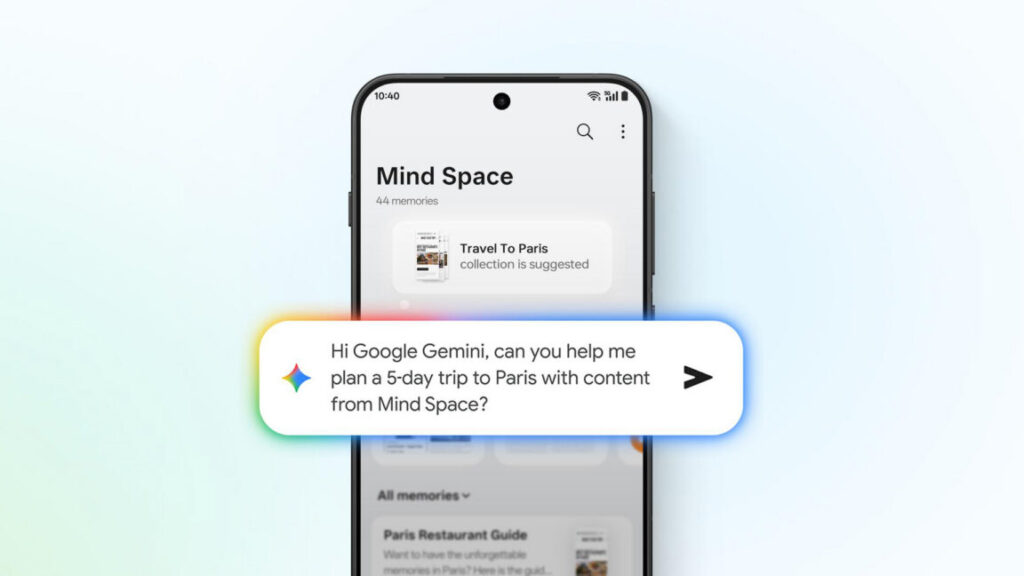
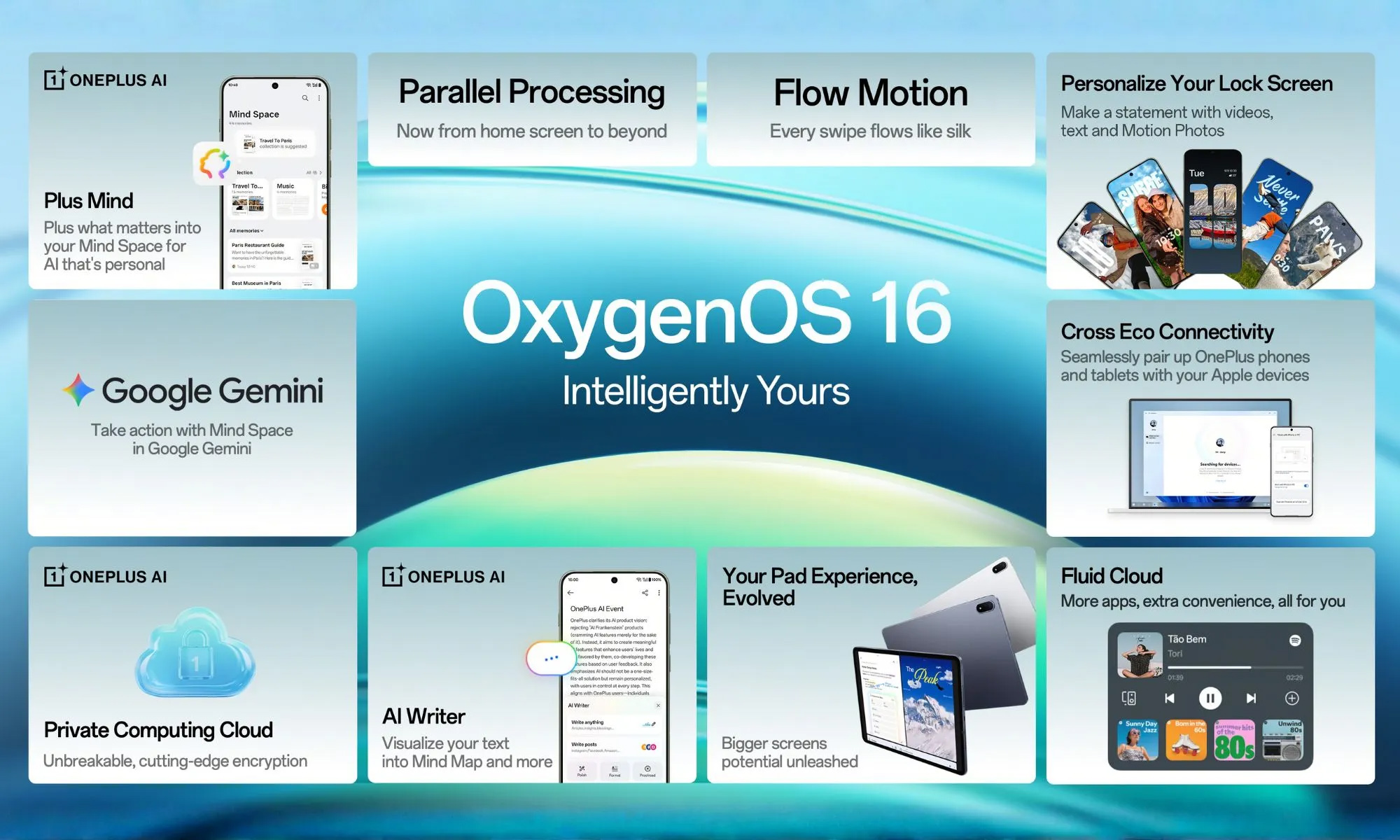
The updated Android software expands what you can add to Mind Space and uses Gemini. For starters, you can add scrolling screenshots and voice memos up to 60 seconds in length. This provides more data for the AI to generate content. For example, if you take screenshots of hotel listings and airline flights, you can tell Gemini to use your Mind Space content to create a trip itinerary. This will be fully integrated with the phone and won’t require a separate subscription to Google’s AI tools.

oneplus-oxygen-os16

Credit: OnePlus

Mind Space isn’t a totally new idea—it’s quite similar to AI features like Nothing’s Essential Space and Google’s Pixel Screenshots and Journal. The idea is that if you give an AI model enough data on your thoughts and plans, it can provide useful insights. That’s still hypothetical based on what we’ve seen from other smartphone OEMs, but that’s not stopping OnePlus from fully embracing AI in Android 16.

In addition to beefing up Mind Space, OxygenOS 16 will also add system-wide AI writing tools, which is another common AI add-on. Like the systems from Apple, Google, and Samsung, you will be able to use the OnePlus writing tools to adjust text, proofread, and generate summaries.

OnePlus will make OxygenOS 16 available starting October 17 as an open beta. You’ll need a OnePlus device from the past three years to run the software, both in the beta phase and when it’s finally released. As for that, OnePlus hasn’t offered a specific date. The initial OxygenOS 16 release will be with the OnePlus 15 devices, with releases for other supported phones and tablets coming later.

OnePlus unveils OxygenOS 16 update with deep Gemini integration Read More »

inside-the-web-infrastructure-revolt-over-google’s-ai-overviews

Inside the web infrastructure revolt over Google’s AI Overviews


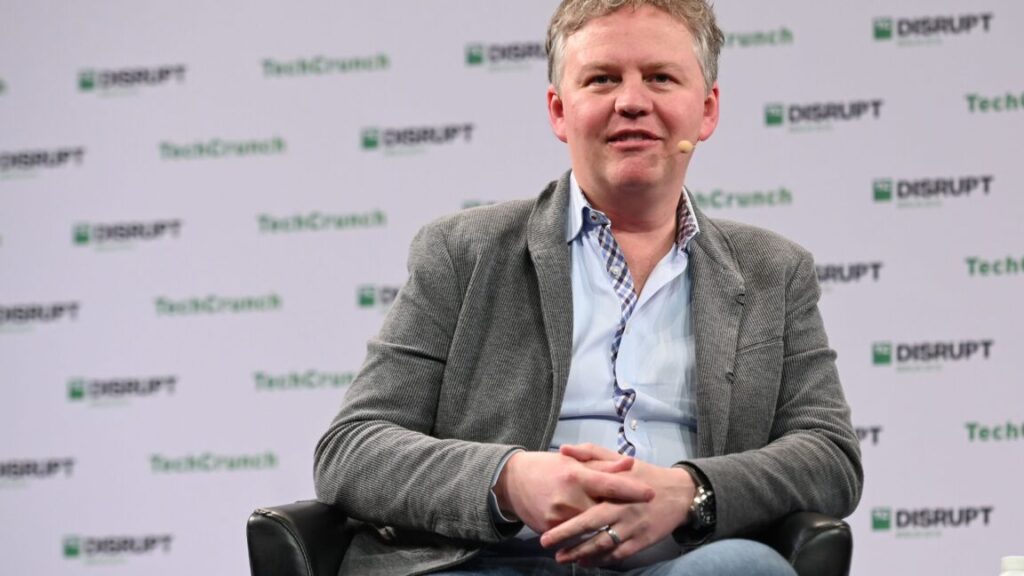
Cloudflare CEO Matthew Prince is making sweeping changes to force Google’s hand.

It could be a consequential act of quiet regulation. Cloudflare, a web infrastructure company, has updated millions of websites’ robots.txt files in an effort to force Google to change how it crawls them to fuel its AI products and initiatives.

We spoke with Cloudflare CEO Matthew Prince about what exactly is going on here, why it matters, and what the web might soon look like. But to get into that, we need to cover a little background first.

The new change, which Cloudflare calls its Content Signals Policy, happened after publishers and other companies that depend on web traffic have cried foul over Google’s AI Overviews and similar AI answer engines, saying they are sharply cutting those companies’ path to revenue because they don’t send traffic back to the source of the information.

There have been lawsuits, efforts to kick-start new marketplaces to ensure compensation, and more—but few companies have the kind of leverage Cloudflare does. Its products and services back something close to 20 percent of the web, and thus a significant slice of the websites that show up on search results pages or that fuel large language models.

“Almost every reasonable AI company that’s out there is saying, listen, if it’s a fair playing field, then we’re happy to pay for content,” Prince said. “The problem is that all of them are terrified of Google because if Google gets content for free but they all have to pay for it, they are always going to be at an inherent disadvantage.”

This is happening because Google is using its dominant position in search to ensure that web publishers allow their content to be used in ways that they might not otherwise want it to.

The changing norms of the web

Since 2023, Google has offered a way for website administrators to opt their content out of use for training Google’s large language models, such as Gemini.

However, allowing pages to be indexed by Google’s search crawlers and shown in results requires accepting that they’ll also be used to generate AI Overviews at the top of results pages through a process called retrieval-augmented generation (RAG).

That’s not so for many other crawlers, making Google an outlier among major players.

This is a sore point for a wide range of website administrators, from news websites that publish journalism to investment banks that produce research reports.

A July study from the Pew Research Center analyzed data from 900 adults in the US and found that AI Overviews cut referrals nearly in half. Specifically, users clicked a link on a page with AI Overviews at the top just 8 percent of the time, compared to 15 percent for search engine results pages without those summaries.

And a report in The Wall Street Journal cited a wide range of sources—including internal traffic metrics from numerous major publications like The New York Times and Business Insider—to describe industry-wide plummets in website traffic that those publishers said were tied to AI summaries, leading to layoffs and strategic shifts.

In August, Google’s head of search, Liz Reid, disputed the validity and applicability of studies and publisher reports of reduced link clicks in search. “Overall, total organic click volume from Google Search to websites has been relatively stable year-over-year,” she wrote, going on to say that reports of big declines were “often based on flawed methodologies, isolated examples, or traffic changes that occurred prior to the rollout of AI features in Search.”

Publishers aren’t convinced. Penske Media Corporation, which owns brands like The Hollywood Reporter and Rolling Stone, sued Google over AI Overviews in September. The suit claims that affiliate link revenue has dropped by more than a third in the past year, due in large part to Google’s overviews—a threatening shortfall in a business that already has difficult margins.

Penske’s suit specifically noted that because Google bundles traditional search engine indexing and RAG use together, the company has no choice but to allow Google to keep summarizing its articles, as cutting off Google search referrals entirely would be financially fatal.

Since the earliest days of digital publishing, referrals have in one way or another acted as the backbone of the web’s economy. Content could be made available freely to both human readers and crawlers, and norms were applied across the web to allow information to be tracked back to its source and give that source an opportunity to monetize its content to sustain itself.

Today, there’s a panic that the old system isn’t working anymore as content summaries via RAG have become more common, and along with other players, Cloudflare is trying to update those norms to reflect the current reality.

A mass-scale update to robots.txt

Announced on September 24, Cloudflare’s Content Signals Policy is an effort to use the company’s influential market position to change how content is used by web crawlers. It involves updating millions of websites’ robots.txt files.

Starting in 1994, websites began placing a file called “robots.txt” at the domain root to indicate to automated web crawlers which parts of the domain should be crawled and indexed and which should be ignored. The standard became near-universal over the years; honoring it has been a key part of how Google’s web crawlers operate.

Historically, robots.txt simply includes a list of paths on the domain that were flagged as either “allow” or “disallow.” It was technically not enforceable, but it became an effective honor system because there are advantages to it for the owners of both the website and the crawler: Website owners could dictate access for various business reasons, and it helped crawlers avoid working through data that wouldn’t be relevant.

But robots.txt only tells crawlers whether they can access something at all; it doesn’t tell them what they can use it for. For example, Google supports disallowing the agent “Google-Extended” as a path to blocking crawlers that are looking for content with which to train future versions of its Gemini large language model—though introducing that rule doesn’t do anything about the training Google did before it rolled out Google-Extended in 2023, and it doesn’t stop crawling for RAG and AI Overviews.

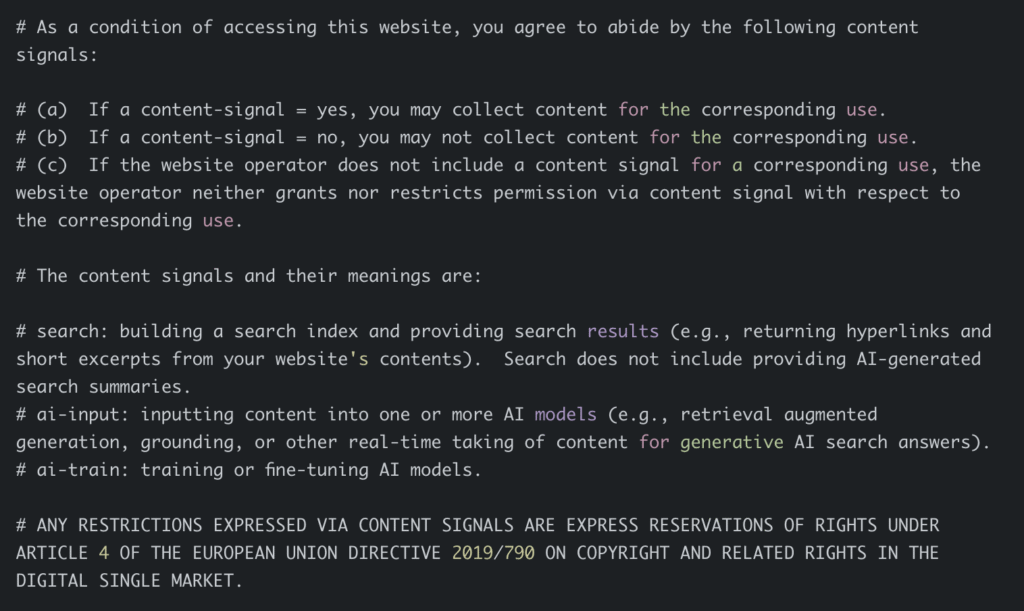
The Content Signals Policy initiative is a newly proposed format for robots.txt that intends to do that. It allows website operators to opt in or out of consenting to the following use cases, as worded in the policy:

  • search: Building a search index and providing search results (e.g., returning hyperlinks and short excerpts from your website’s contents). Search does not include providing AI-generated search summaries.
  • ai-input: Inputting content into one or more AI models (e.g., retrieval augmented generation, grounding, or other real-time taking of content for generative AI search answers).
  • ai-train: Training or fine-tuning AI models.

Cloudflare has given all of its customers quick paths for setting those values on a case-by-case basis. Further, it has automatically updated robots.txt on the 3.8 million domains that already use Cloudflare’s managed robots.txt feature, with search defaulting to yes, ai-train to no, and ai-input blank, indicating a neutral position.

The threat of potential litigation

In making this look a bit like a terms of service agreement, Cloudflare’s goal is explicitly to put legal pressure on Google to change its policy of bundling traditional search crawlers and AI Overviews.

“Make no mistake, the legal team at Google is looking at this saying, ‘Huh, that’s now something that we have to actively choose to ignore across a significant portion of the web,'” Prince told me.

Cloudflare specifically made this look like a license agreement. Credit: Cloudflare

He further characterized this as an effort to get a company that he says has historically been “largely a good actor” and a “patron of the web” to go back to doing the right thing.

“Inside of Google, there is a fight where there are people who are saying we should change how we’re doing this,” he explained. “And there are other people saying, no, that gives up our inherent advantage, we have a God-given right to all the content on the Internet.”

Amid that debate, lawyers have sway at Google, so Cloudflare tried to design tools “that made it very clear that if they were going to follow any of these sites, there was a clear license which was in place for them. And that will create risk for them if they don’t follow it,” Prince said.

The next web paradigm

It takes a company with Cloudflare’s scale to do something like this with any hope that it will have an impact. If just a few websites made this change, Google would have an easier time ignoring it, or worse yet, it could simply stop crawling them to avoid the problem. Since Cloudflare is entangled with millions of websites, Google couldn’t do that without materially impacting the quality of the search experience.

Cloudflare has a vested interest in the general health of the web, but there are other strategic considerations at play, too. The company has been working on tools to assist with RAG on customers’ websites in partnership with Microsoft-owned Google competitor Bing and has experimented with a marketplace that provides a way for websites to charge crawlers for scraping the sites for AI, though what final form that might take is still unclear.

I asked Prince directly if this comes from a place of conviction. “There are very few times that opportunities come along where you get to help think through what a future better business model of an organization or institution as large as the Internet and as important as the Internet is,” he said. “As we do that, I think that we should all be thinking about what have we learned that was good about the Internet in the past and what have we learned that was bad about the Internet in the past.”

It’s important to acknowledge that we don’t yet know what the future business model of the web will look like. Cloudflare itself has ideas. Others have proposed new standards, marketplaces, and strategies, too. There will be winners and losers, and those won’t always be the same winners and losers we saw in the previous paradigm.

What most people seem to agree on, whatever their individual incentives, is that Google shouldn’t get to come out on top in a future answer-engine-driven web paradigm just because it previously established dominance in the search-engine-driven one.

For this new standard for robots.txt, success looks like Google allowing content to be available in search but not in AI Overviews. Whatever the long-term vision, and whether it happens because of Cloudflare’s pressure with the Content Signals Policy or some other driving force, most agree that it would be a good start.

Photo of Samuel Axon

Samuel Axon is the editorial lead for tech and gaming coverage at Ars Technica. He covers AI, software development, gaming, entertainment, and mixed reality. He has been writing about gaming and technology for nearly two decades at Engadget, PC World, Mashable, Vice, Polygon, Wired, and others. He previously ran a marketing and PR agency in the gaming industry, led editorial for the TV network CBS, and worked on social media marketing strategy for Samsung Mobile at the creative agency SPCSHP. He also is an independent software and game developer for iOS, Windows, and other platforms, and he is a graduate of DePaul University, where he studied interactive media and software development.

Inside the web infrastructure revolt over Google’s AI Overviews Read More »

google’s-ai-videos-get-a-big-upgrade-with-veo-3.1

Google’s AI videos get a big upgrade with Veo 3.1

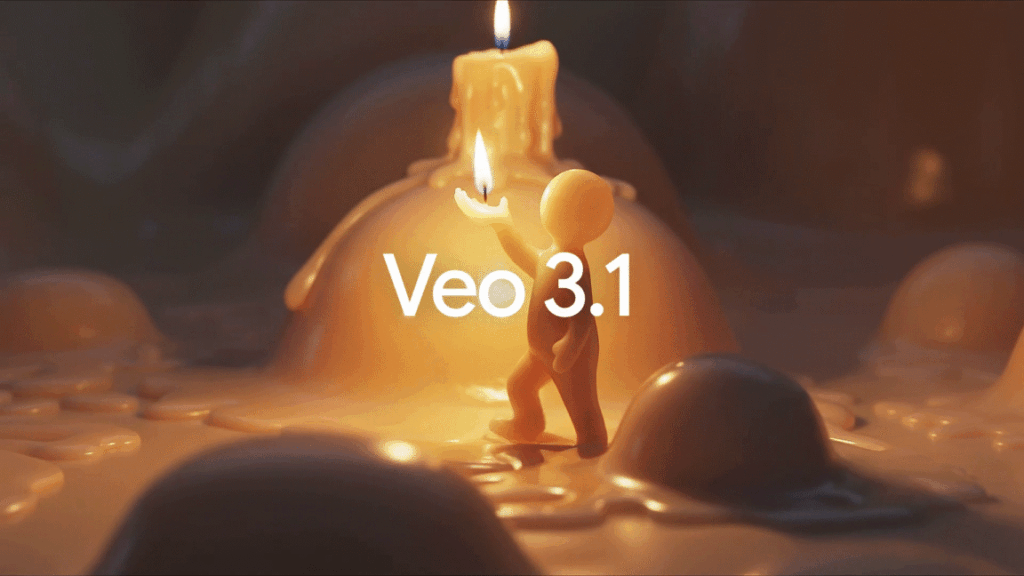
It’s getting harder to know what’s real on the Internet, and Google is not helping one bit with the announcement of Veo 3.1. The company’s new video model supposedly offers better audio and realism, along with greater prompt accuracy. The updated video AI will be available throughout the Google ecosystem, including the Flow filmmaking tool, where the new model will unlock additional features. And if you’re worried about the cost of conjuring all these AI videos, Google is also adding a “Fast” variant of Veo.

Veo made waves when it debuted earlier this year, demonstrating a staggering improvement in AI video quality just a few months after Veo 2’s release. It turns out that having all that video on YouTube is very useful for training AI models, so Google is already moving on to Veo 3.1 with a raft of new features.

Google says Veo 3.1 offers stronger prompt adherence, which results in better video outputs and fewer wasted compute cycles. Audio, which was a hallmark feature of the Veo 3 release, has reportedly improved, too. Veo 3’s text-to-video was limited to 720p landscape output, but there’s an ever-increasing volume of vertical video on the Internet. So Veo 3.1 can produce both landscape and portrait 16:9 video.

Google previously said it would bring Veo video tools to YouTube Shorts, which use a vertical video format like TikTok. The release of Veo 3.1 probably opens the door to fulfilling that promise. You can bet Veo videos will show up more frequently on TikTok as well now that it fits the format. This release also keeps Google in its race with OpenAI, which recently released a Sora iPhone app with an impressive new version of its video-generating AI.

Google’s AI videos get a big upgrade with Veo 3.1 Read More »