NIH grants

at-nih,-a-power-struggle-over-institute-directorships-deepens

At NIH, a power struggle over institute directorships deepens


The research agency has 27 institute and center directors. Will those roles become politicized?

When a new presidential administration comes in, it is responsible for filling around 4,000 jobs sprinkled across the federal government’s vast bureaucracy. These political appointees help carry out the president’s agenda, and, at least in theory, make government agencies responsive to elected officials.

Some of these roles—the secretary of state, for example—are well-known. Others, such as the deputy assistant secretary for textiles, consumer goods, materials, critical minerals & metals industry & analysis, are more obscure.

Historically, science agencies like NASA or the National Institutes of Health tend to have fewer political appointees than many other parts of the federal government. Sometimes, very senior roles—with authority over billions of dollars of spending, and the power to shape entire fields of research—are filled without any direct input from the White House or Congress. The arrangement reflects a long-running argument that scientists should oversee the work of funding and conducting research with very little interference from political leaders.

Since the early 2000s, according to federal employment records, NIH, the country’s premier biomedical research agency, has usually had just a few political appointees within its workforce. (As of November 2025, that workforce numbered around 17,500 people, after significant cuts.) Staff scientists and external experts played a key role in selecting the directors of the 27 institutes and centers that make up NIH. That left the selection of people for powerful positions largely outside of direct White House oversight.

What is the future of that status quo under the Trump administration?

Those questions have recently swirled at NIH. The arrival of political appointees in the kinds of positions previously held by civil servants, and apparent changes to hiring practices for other key positions, have raised concerns among current and former officials about a new era of politicization.

For decades, NIH has enjoyed strong bipartisan support. But conservative lawmakers have periodically raised questions about some of the agency’s spending, and according to one 2014 survey, the agency is perceived by federal executives as being a progressive place. (Since the early 2000s, some data suggests, US scientists as a whole have grown considerably more liberal relative to the general population.)

Since the COVID-19 pandemic, many conservatives have criticized NIH for funding the kind of controversial virology experiments that some experts believe may have started the pandemic, and for promoting public health strategies that many on the right viewed as unscientific and authoritarian. One of the NIH institute directors, Anthony Fauci, who led the National Institute of Allergy and Infectious Diseases from 1984 until his retirement in 2022, came to be a highly polarizing figure, described on the right as an unelected official wielding considerable power.

Over the years, some biomedical researchers have argued for changes to the way NIH hires and retains people in leadership positions. In 2019, the agency announced plans to impose term limits on some midlevel roles, in a bid to diversify its management. More recently, Johns Hopkins University physician and researcher Joseph Marine argued in an essay for The Free Press that NIH should set five to 10-year term limits on the directors of individual NIH institutes. “Regular turnover of leadership,” he wrote, “brings fresh ideas and a healthy reassessment of priorities.”

Shortly after winning the 2024 presidential election, Donald Trump tapped Jay Bhattacharya, a prominent critic of NIH, to lead the agency. It may not be entirely surprising that an administration advocating for reforms to NIH would seek to flip key management positions that often experience little turnover.

Former official Mike Lauer, who until early 2025 oversaw NIH’s vast external grants program, said there were signs before Trump’s second inauguration that institute directors might be subject to fresh political scrutiny.

“There was a frustration that so much of the agency’s direction, as well as financial decision-making, was being made by people who are outside of the political sphere,” Lauer told Undark. He pointed to a line in Project 2025, a proposed roadmap for the Trump administration that was produced by the Heritage Foundation, a conservative think tank. “Funding for scientific research,” the report argues, “should not be controlled by a small group of highly paid and unaccountable insiders at the NIH, many of whom stay in power for decades.”

Soon after Trump’s inauguration, some senior officials at NIH were put on administrative leave or abruptly departed, including Lawrence Tabak, who had spent more than a decade as principal deputy director and served as NIH’s interim leader for almost two years during the COVID-19 pandemic.

At the same time, the administration grew the number of political appointees at NIH. As of late June, according to federal records, the Trump administration had placed nine political appointees at the agency, up from four the year before—itself higher than in most previous years. One of them, Seana Cranston, is a former Republican Congressional staffer who serves as chief of staff to the NIH Director; her predecessor was a career civil servant who had spent nearly 40 years in the NIH, the last four as chief of staff. Another is Michael Allen, who took the role of chief operating officer for the $6.5 billion NIAID, Fauci’s former institute. (Allen was appointed with no official announcement, and appears to have no official biography or background information posted on NIH websites.)

Those numbers still left NIH with fewer political appointees than many other agencies, including NASA, a comparably sized science agency.

The administration has departed from the traditional process for hiring NIH’s 27 institute and center directors, who are responsible for overseeing most of the funding decisions and day-to-day operations of NIH.

In the spring of 2025, five of those directors—including the head of NIAID—were fired or placed on administrative leave. (They have all since been removed from their positions.)

Then, in September, part of the search committee for the National Institute of Mental Health was abruptly disbanded, and then just as suddenly reconvened, according to Joshua Gordon, the former head of that institute, and one other source close to NIH.

In October, the directorship of another agency, the National Institute of Environmental Health Sciences, was filled by a close personal friend of Vice President JD Vance, without any apparent search process — a move that multiple former NIH officials told Undark may be unprecedented.

By then, 13 other NIH institutes and centers had vacant leadership posts. Other roles have opened up more recently: In an email to NIH staff on Dec. 30, Bhattacharya announced the departure of Walter Koroshetz, leader of the agency’s main neuroscience research institute. In the email, Bhattacharya seemed to suggest he had opposed the decision: “Dr. Koroshetz’s performance as Director has been exceptional,” Bhattacharya wrote, but “the Department of Health and Human Services has elected to pursue a leadership transition.”

In early January, the Director of the National Heart, Lung, and Blood Institute announced his retirement, bringing the total number of open posts to 15.

The searches, NIH insiders say, appear to be happening on a compressed timeline. And while the NIH director has typically relied on search committees consisting of both NIH career scientists and external experts, multiple sources close to NIH say the agency has not formed those kinds of committees to make the latest round of hires.

In response to questions from Undark in early January, the Department of Health and Human Services sent a brief emailed statement, signed “NIH Press Team,” explaining that “an NIH leadership team with experience in scientific agency management will consider the applicant pool and make recommendations to the NIH Director.” The press representative declined to respond to follow-up questions about who would be on that team, or why the hiring process had changed.

Those changes have prompted speculation among some NIH insiders that the Trump administration is seeking to exert more political control over the hiring of directorships.

“Having external members on the search committee is vitally important for preventing politicization,” said Mark Histed, an NIH scientist who has recently been a critic — on his personal time, he stresses — of Trump’s approach to the agency. “Because, as you can imagine, if you’ve got a bunch of external scientists, it’s a lot harder to ram down what the White House wants, because people are not part of the political system.”

That kind of open and non-politicized search process, Histed said in a follow-up interview, isn’t unique to NIH: It’s one widely used by scientific institutions around the world. And it has worked, he argued, to help make NIH a scientific juggernaut: “That process,” he said, “led to 80 years of staggering scientific success.”

Members of Congress have taken notice. In language attached to the current appropriations bill moving through Congress, lawmakers direct NIH “to maintain its longstanding practice of including external scientists and stakeholders” in the search process. (Agencies are supposed to follow these Congressional instructions, but they are not binding.) In late January, Diana DeGette, a Democratic representative from Colorado, sponsored a bill that, according to a press release, would “Protect NIH From Political Interference” by, among other steps, capping the number of political appointees at the agency.

Lauer, the former NIH grants chief, took a broader historical view of the changes. There has long been a tug-of-war, he said, between presidential administrations that seek more political control over an agency, and civil servants and other bureaucratic experts who may resist that perceived incursion. From the point of view of politicians and their staff, Lauer said, “what they’ll say—I understand where they’re coming from—what they’ll say is, is that more political control means that the agency is going to be responsive to the will of the electorate, that there’s a greater degree of transparency and public accountability.”

Those upsides can be significant, Lauer said, but there are also downsides, including more short-term thinking, unstable budgets, and the potential loss of expertise and competence.

Mark Richardson, a political scientist at Georgetown University, is an expert on politicization and the federal bureaucracy. In his work, he said, he has observed a correlation between how much political parties disagree over the role of a specific agency, and the degree to which presidential administrations seek to exert control there through appointees and other personnel choices. NIH has historically fallen alongside agencies like the Bureau of Labor Statistics and the U.S. Patent and Trademark Office that are subject to broad alignment across the parties.

“I think what you’re seeing more with the Trump administration is kind of an expansion of political conflict to these types of agencies,” Richardson said.

This article was originally published on Undark. Read the original article.

At NIH, a power struggle over institute directorships deepens Read More »
via-the-false-claims-act,-nih-puts-universities-on-edge

Via the False Claims Act, NIH puts universities on edge


Funding pause at U. Michigan illustrates uncertainty around new language in NIH grants.

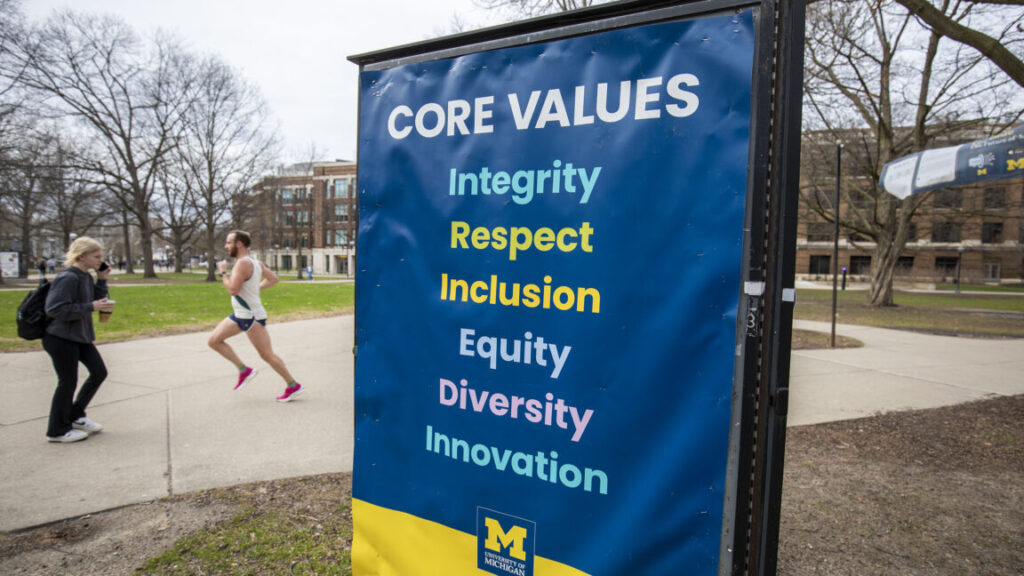
University of Michigan students walk on the UM campus next to signage displaying the University’s “Core Values” on April 3, 2025 in Ann Arbor, Michigan. Credit: Bill Pugliano/Getty Images

Earlier this year, a biomedical researcher at the University of Michigan received an update from the National Institutes of Health. The federal agency, which funds a large swath of the country’s medical science, had given the green light to begin releasing funding for the upcoming year on the researcher’s multi-year grant.

Not long after, the researcher learned that the university had placed the grant on hold. The school’s lawyers, it turned out, were wrestling with a difficult question: whether to accept new terms in the Notice of Award, a legal document that outlines the grant’s terms and conditions.

Other researchers at the university were having the same experience. Indeed, Undark’s reporting suggests that the University of Michigan—among the top three university recipients of NIH funding in 2024, with more than $750 million in grants—had quietly frozen some, perhaps all, of its incoming NIH funding dating back to at least the second half of April.

The university’s director of public affairs, Kay Jarvis, declined to comment for this article or answer a list of questions from Undark, instead pointing to the institution’s research website.

In conversations with Michigan scientists, and in internal communications obtained by Undark, administrators explained the reason for the delays: University officials were concerned about new language in NIH grant notices. That language said that universities will be subject to liability under a Civil War-era statute called the False Claims Act if they fail to abide by civil rights laws and a January 20 executive order related to gender.

For the most part, public attention to NIH funding has focused on what the new Trump administration is doing on its end, including freezing and terminating grants at elite institutions for alleged Title VI and IX violations, and slashing funding for newly disfavored areas of research. The events in Ann Arbor show how universities themselves are struggling to cope with a wave of recent directives from the federal government.

The new terms may expose universities to significant legal risk, according to several experts. “The Trump administration is using the False Claims Act as a massive threat to the bottom lines of research institutions,” said Samuel Bagenstos, a law professor at the University of Michigan, who served as general counsel for the Department of Health and Human Services during the Biden administration. (Bagenstos said he has not advised the university’s lawyers on this issue.) That law entitles the government to collect up to three times the financial damage. “So potentially you could imagine the Trump administration seeking all the federal funds times three that an institution has received if they find a violation of the False Claims Act.”

Such an action, Bagenstos and another legal expert said, would be unlikely to hold up in court. But the possibility, he said, is enough to cause concern for risk-averse institutions.

The grant pauses unsettled the affected researchers. One of them noted that the university had put a hold on a grant that supported a large chunk of their research program. “I don’t have a lot of money left,” they said.

The researcher worried that if funds weren’t released soon, personnel would have to be fired and medical research halted. “There’s a feeling in the air that somebody’s out to get scientists,” said the researcher, reflecting on the impact of all the changes at the federal level. “And it could be your turn tomorrow for no clear reason.” (The researcher, like other Michigan scientists interviewed for this story, spoke on condition of anonymity for fear of retaliation.)

Bagenstos said some other universities had also halted funding—a claim Undark was unable to confirm. At Michigan, at least, money is now flowing: On Wednesday, June 11, just hours after Undark sent a list of questions to the university’s public affairs office, some researchers began receiving emails saying their funding would be released. And research administrators received a message stating that the university would begin releasing the more than 270 awards that it had placed on hold.

The federal government distributes tens of billions of dollars each year to universities through NIH funding. In the past, the terms of those grants have required universities to comply with civil rights laws. More recently, though, the scope of those expectations has expanded. Multiple recent award notices viewed by Undark now contain language referring to a January 20 executive order that states the administration “will defend women’s rights and protect freedom of conscience by using clear and accurate language and policies that recognize women are biologically female, and men are biologically male.” The notices also contain four bullet points, one of which asks the grant recipient—meaning the researcher’s institution—to acknowledge that “a knowing false statement” regarding compliance is subject to liability under the False Claims Act.

Read an NIH Notice of Award

Alongside this change, on April 21, the agency issued a policy requiring universities to certify that they will not participate in discriminatory DEI activities or boycotts of Israel, noting that false statements would be subject to penalties under the False Claims Act. (That measure was rescinded in early June, reinstated, and then rescinded again while the agency awaits further White House guidance.) Additionally, in May, an announcement from the Department of Justice encouraged use of the False Claims Act in civil rights enforcement.

Some experts said that signing onto FCA terms could put universities in a vulnerable position, not because they aren’t following civil rights laws, but because the new grant language is vague and seemingly ripe for abuse.

The False Claims Act says someone who knowingly submits a false claim to the government can be held liable for triple damages. In the case of a major research institution like the University of Michigan, worst-case scenarios could range into the billions of dollars.

It’s not just the dollar amount that may cause schools to act in a risk-averse way, said Bagenstos. The False Claims Act also contains what’s known as a “qui tam” provision, which allows private entities to file a lawsuit on behalf of the United States and then potentially take a piece of the recovery money. “The government does not have the resources to identify and pursue all cases of legitimate fraud” in the country, said Bagenstos, so generally the provision is a useful one. But it can be weaponized when “yoked to a pernicious agenda of trying to suppress speech by institutions of higher learning, or simply to try to intimidate them.”

Avoiding the worst-case scenario might seem straightforward enough: Just follow civil rights laws. But in reality, it’s not entirely clear where a university’s responsibility starts and stops. For example, an institution might officially adopt policies that align with the new executive orders. But if, say, a student group, or a sociology department, steps out of bounds, then the university might be understood to not be in compliance—particularly by a less-than-friendly federal administration.

University attorneys may also balk at the ambiguity and vagueness of terms like “gender ideology” and “DEI,” said Andrew Twinamatsiko, a director of the Center for Health Policy and the Law at the O’Neill Institute at Georgetown Law. Litigation-averse universities may end up rolling back their programming, he said, because they don’t want to run afoul of the government’s overly broad directives.

“I think this is a time that calls for some courage,” said Bagenstos. If every university decides the risks are too great, then the current policies will prevail without challenge, he said, even though some are legally unsound. And the bar for False Claims Act liability is actually quite high, he pointed out: There’s a requirement that the person knowingly made a false statement or deliberately ignored facts. Universities are actually well-positioned to prevail in court, said Bagenstos and other legal experts. The issue is that they don’t want to engage in drawn-out and potentially costly litigation.

One possibility might be for a trade group, such as the Association of American Universities, to mount the legal challenge, said Richard Epstein, a libertarian legal scholar. In his view, the new NIH terms are unconstitutional because such conditions on spending, which he characterized as “unrelated to scientific endeavors,” need to be authorized by Congress.

The NIH did not respond to repeated requests for comment.

Some people expressed surprise at the insertion of the False Claims Act language.

Michael Yassa, a professor of neurobiology and behavior at the University of California, Irvine, said that he wasn’t aware of the new terms until Undark contacted him. The NIH-supported researcher and study-section chair started reading from a recent Notice of Award during the interview. “I can’t give you a straight answer on this one,” he said, and after further consideration, added, “Let me run this by a legal team.”

Andrew Miltenberg, an attorney in New York City who’s nationally known for his work on Title IX litigation, was more pointed. “I don’t actually understand why it’s in there,” he said, referring to the new grant language. “I don’t think it belongs in there. I don’t think it’s legal, and I think it’s going to take some lawsuits to have courts interpret the fact that there’s no real place for it.

This article was originally published on Undark. Read the original article.

Via the False Claims Act, NIH puts universities on edge Read More »

“have-we-no-shame?”:-trump’s-nih-grant-cuts-appallingly-illegal,-judge-rules

“Have we no shame?”: Trump’s NIH grant cuts appallingly illegal, judge rules

“Where’s the support for that?” Young asked. “I see no evidence of that.”

Meanwhile, a lawyer representing one of the plaintiffs suing to block the grants, Kenneth Parreno, seemingly successfully argued that canceling grants related to race or transgender health were part of “a slapdash, harried effort to rubber stamp an ideological purge.” At the trial, Young noted that much of the information about the grant cancellations was only available due to the independent efforts of academics behind a project called Grant Watch, which was launched to crowdsource the monumental task of tracking the cuts.

According to Young, he felt “hesitant to draw this conclusion” but ultimately had “an unflinching obligation to draw it.”

Rebuking the cuts and ordering hundreds of grants restored, Young said “it is palpably clear that these directives and the set of terminated grants here also are designed to frustrate, to stop, research that may bear on the health—we’re talking about health here, the health of Americans, of our LGBTQ community. That’s appalling.

“You are bearing down on people of color because of their color,” Young said. “The Constitution will not permit that… Have we fallen so low? Have we no shame?”

Young also signaled that he may restore even more grants, noting that the DOJ “made virtually no effort to push back on claims that the cuts were discriminatory,” Politico reported.

White House attacks judge

Andrew Nixon, a spokesperson for the Department of Health and Human Services, told NYT that in spite of the ruling, the agency “stands by its decision to end funding for research that prioritized ideological agendas.” He claimed HHS is exploring a potential appeal, which seems likely given the White House’s immediate attacks on Young’s ruling. Politico noted that Trump considers his executive orders to be “unreviewable by the courts” due to his supposedly “broad latitude to set priorities and pause funding for programs that no longer align.”

“Have we no shame?”: Trump’s NIH grant cuts appallingly illegal, judge rules Read More »