Pluto

astronomers-are-filling-in-the-blanks-of-the-kuiper-belt

Astronomers are filling in the blanks of the Kuiper Belt


Are you out there, Planet X?

Next-generation telescopes are mapping this outer frontier.

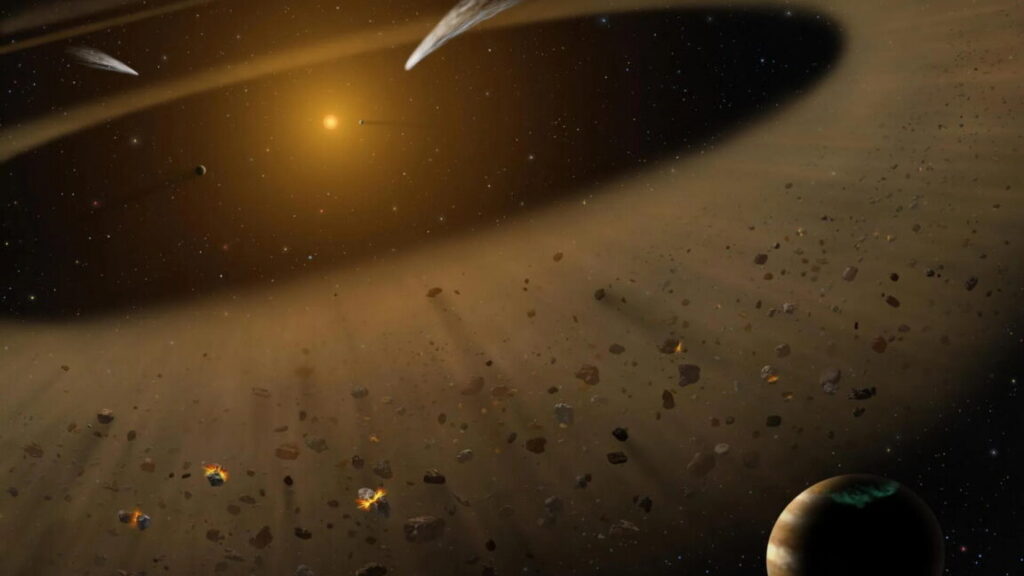
Credit: NASA/SOFIA/Lynette Cook

Out beyond the orbit of Neptune lies an expansive ring of ancient relics, dynamical enigmas, and possibly a hidden planet—or two.

The Kuiper Belt, a region of frozen debris about 30 to 50 times farther from the sun than the Earth is—and perhaps farther, though nobody knows—has been shrouded in mystery since it first came into view in the 1990s.

Over the past 30 years, astronomers have cataloged about 4,000 Kuiper Belt objects (KBOs), including a smattering of dwarf worlds, icy comets, and leftover planet parts. But that number is expected to increase tenfold in the coming years as observations from more advanced telescopes pour in. In particular, the Vera C. Rubin Observatory in Chile will illuminate this murky region with its flagship project, the Legacy Survey of Space and Time (LSST), which began operating last year. Other next-generation observatories, such as the James Webb Space Telescope (JWST), will also help to bring the belt into focus.

“Beyond Neptune, we have a census of what’s out there in the solar system, but it’s a patchwork of surveys, and it leaves a lot of room for things that might be there that have been missed,” says Renu Malhotra, who serves as Louise Foucar Marshall Science Research Professor and Regents Professor of Planetary Sciences at the University of Arizona.

“I think that’s the big thing that Rubin is going to do—fill out the gaps in our knowledge of the contents of the solar system,” she adds. “It’s going to greatly advance our census and our knowledge of the contents of the solar system.”

As a consequence, astronomers are preparing for a flood of discoveries from this new frontier, which could shed light on a host of outstanding questions. Are there new planets hidden in the belt, or lurking beyond it? How far does this region extend? And are there traces of cataclysmic past encounters between worlds—both homegrown or from interstellar space—imprinted in this largely pristine collection of objects from the deep past?

“I think this will become a very hot field very soon, because of LSST,” says Amir Siraj, a graduate student at Princeton University who studies the Kuiper Belt.

The Kuiper Belt is a graveyard of planetary odds and ends that were scattered far from the sun during the messy birth of the solar system some 4.6 billion years ago. Pluto was the first KBO ever spotted, more than a half-century before the belt itself was discovered.

Since the 1990s, astronomers have found a handful of other dwarf planets in the belt, such as Eris and Sedna, along with thousands of smaller objects. While the Kuiper Belt is not completely static, it is, for the most part, an intact time capsule of the early solar system that can be mined for clues about planet formation.

For example, the belt contains weird structures that may be signatures of past encounters between giant planets, including one particular cluster of objects, known as a “kernel,” located at about 44 astronomical units (AU), where one AU is the distance between Earth and the sun (about 93 million miles).

While the origin of this kernel is still unexplained, one popular hypothesis is that its constituent objects—which are known as cold classicals—were pulled along by Neptune’s outward migration through the solar system more than 4 billion years ago, which may have been a bumpy ride.

The idea is that “Neptune got jiggled by the rest of the gas giants and did a bit of a jump; it’s called the ‘jumping Neptune’ scenario,” says Wes Fraser, an astronomer at the Dominion Astrophysical Observatory, National Research Council of Canada, who studies the Kuiper Belt, noting that astronomer David Nesvorný came up with the idea.

“Imagine a snowplow driving along a highway, and lifting up the plow. It leaves a clump of snow behind,” he adds. “That same sort of idea is what left the clump of cold classicals behind. That is the kernel.”

In other words, Neptune tugged these objects along with it as it migrated outward, but then broke its gravitational hold over them when it “jumped,” leaving them to settle into the Kuiper Belt in the distinctive Neptune-sculpted kernel pattern that remains intact to this day.

Last year, Siraj and his advisers at Princeton set out to look for other hidden structures in the Kuiper Belt with a new algorithm that analyzed 1,650 KBOs—about 10 times as many objects as the 2011 study, led by Jean-Robert Petit, that first identified the kernel.

The results consistently confirmed the presence of the original kernel, while also revealing a possibly new “inner kernel” located at about 43 AU, though more research is needed to confirm this finding, according to the team’s 2025 study.

“You have these two clumps, basically, at 43 and 44 AU,” Siraj explains. “It’s unclear whether they’re part of the same structure,” but “either way, it’s another clue about, perhaps, Neptune’s migration, or some other process that formed these clumps.”

As Rubin and other telescopes discover thousands more KBOs in the coming years, the nature and possible origin of these mysterious structures in the belt may become clearer, potentially opening new windows into the tumultuous origins of our solar system.

In addition to reconstructing the early lives of the known planets, astronomers who study the Kuiper Belt are racing to spot unknown planets. The most famous example is the hypothetical giant world known as Planet Nine or Planet X, first proposed in 2016. Some scientists have suggested that the gravitational influence of this planet, if it exists, might explain strangely clustered orbits within the Kuiper Belt, though this speculative world would be located well beyond the belt, at several hundred AU.

Siraj and his colleagues have also speculated about the possibility of a Mercury- or Mars-sized world, dubbed Planet Y, that may be closer to the belt, at around 80 to 200 AU, according to their 2025 study. Rubin is capable of spotting these hypothetical worlds, though it may be challenging to anticipate the properties of planets that lurk this far from the sun.

“We know nothing about the atmospheres and surfaces of gas giant or ice giant type planets at 200, 300, or 400 AU,” Fraser says. “We know nothing about their chemistry. Every single time we look at an exoplanet, it behaves differently than what our models predict.”

“I think Planet Nine might very well just be a tar ball that is so dark that we can’t see it, and that’s why it hasn’t been discovered yet,” he adds. “If we found that, I wouldn’t be too surprised. And who knows what an Earth [in the belt] would look like? Certainly the compositional makeup will be different than a Mars, or an Earth, or a Venus, in the inner solar system.”

Observatories like Rubin and JWST may fill in these tantalizing gaps in our knowledge of the Kuiper Belt, and perhaps pinpoint hidden planets. But even if these telescopes reveal an absence of planets, it would be a breakthrough.

“There’s a lot of room for discovery of large bodies,” says Malhotra. “That would be awesome, but if we don’t find any, that would tell us something as well.”

“Not finding them up to some distance would give us estimates of how efficient or inefficient the planet formation process was,” she adds. “It would fill in some of the uncertainties that we have in our models.”

One other major open question about the Kuiper Belt is the extent of its boundaries. The belt suddenly tapers off at about 50 AU, an edge called the Kuiper cliff. This is a puzzling feature, because it suggests that our solar system has an anomalously small debris belt compared with other systems.

“The solar system looks kind of weird,” Fraser says. “The Kuiper cliff is a somewhat sharp delineation. Beyond that, we have no evidence that there was a disk of material. And yet, if you look at other stellar systems that have debris disks, the vast majority of those are significantly larger.”

“If we were to find a debris disk at, say, 100 AU, that would immediately make the solar system not weird, and quite average at that point,” he notes.

In 2024, Fraser and his colleagues presented hints of a possible undiscovered population of objects that may exist at about 100 AU—though he emphasizes that these are candidate detections, and are not yet confirmed to be a hidden outer ring.

However, even Rubin may not be able to resolve the presence of the tiny and distant objects that could represent a new outer limit of the Kuiper Belt. Time will tell.

As astronomers gear up for this major step change in our understanding of the Kuiper Belt, answers to some of our most fundamental questions hang in the balance. With its immaculate record of the early solar system, this region preserves secrets from the deep past. Here there are probably not dragons, but there may well be hidden planets, otherworldly structures, and discoveries that haven’t yet been imagined.

“I’d say the big question is, what’s out there?” Malhotra says. “What are we missing?”

This story originally appeared on wired.com.

Photo of WIRED

Wired.com is your essential daily guide to what’s next, delivering the most original and complete take you’ll find anywhere on innovation’s impact on technology, science, business and culture.

Astronomers are filling in the blanks of the Kuiper Belt Read More »
we-saw-the-heart-of-pluto-10-years-ago—it’ll-be-a-long-wait-to-see-the-rest

We saw the heart of Pluto 10 years ago—it’ll be a long wait to see the rest


A 50-year wait for a second mission wouldn’t be surprising. Just ask Uranus and Neptune.

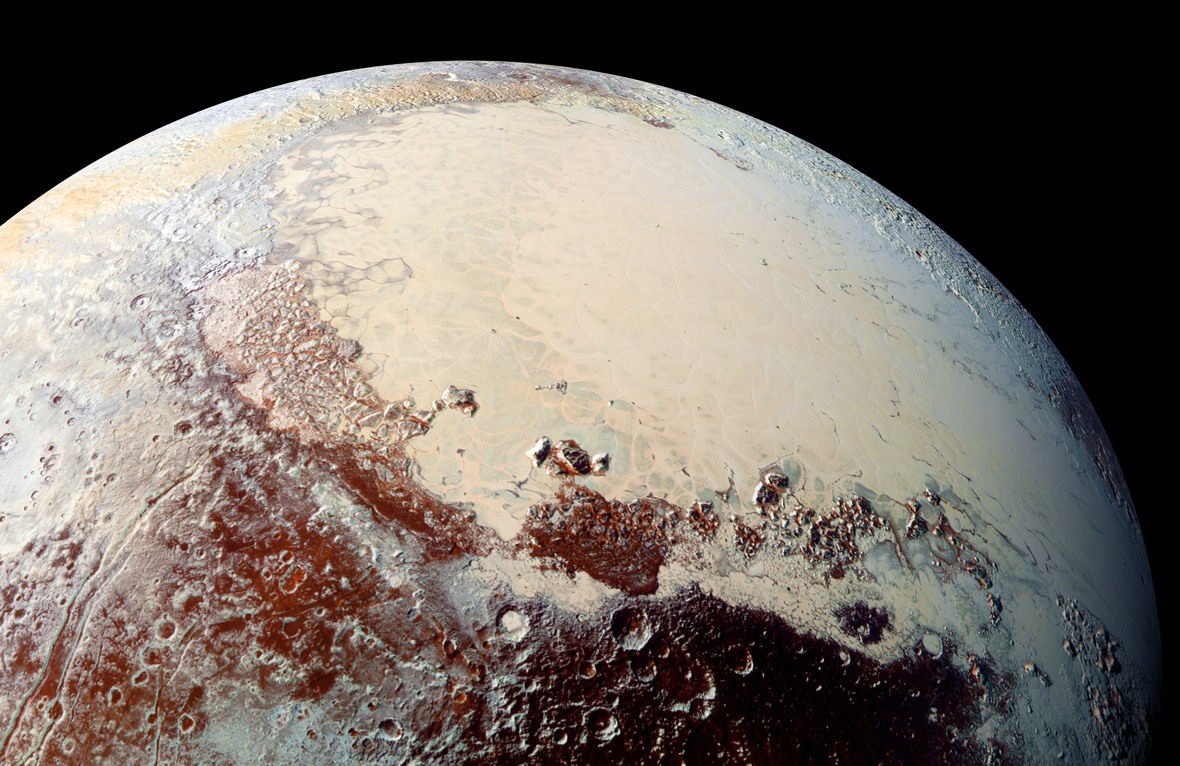
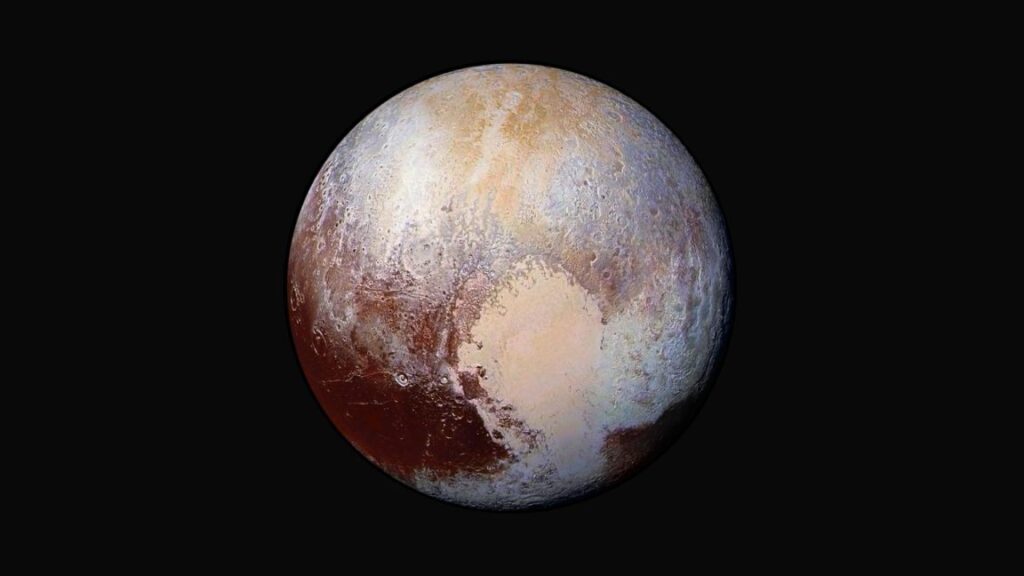
Four images from New Horizons’ Long Range Reconnaissance Imager (LORRI) were combined with color data from the spacecraft’s Ralph instrument to create this enhanced color global view of Pluto. Credit: NASA/Johns Hopkins University/SWRI

NASA’s New Horizons spacecraft got a fleeting glimpse of Pluto 10 years ago, revealing a distant world with a picturesque landscape that, paradoxically, appears to be refreshing itself in the cold depths of our Solar System.

The mission answered numerous questions about Pluto that have lingered since its discovery by astronomer Clyde Tombaugh in 1930. As is often the case with planetary exploration, the results from New Horizons’ flyby of Pluto on July 14, 2015, posed countless more questions. First and foremost, how did such a dynamic world come to be so far from the Sun?

For at least the next few decades, the only resources available for scientists to try to answer these questions will be either the New Horizons mission’s archive of more than 50 gigabits of data recorded during the flyby, or observations from billions of miles away with powerful telescopes on the ground or space-based observatories like Hubble and James Webb.

That fact is becoming abundantly clear. Ten years after the New Horizons encounter, there are no missions on the books to go back to Pluto and no real prospects for one.

A mission spanning generations

In normal times, with a stable NASA budget, scientists might get a chance to start developing another Pluto mission in perhaps 10 or 20 years, after higher-priority missions like Mars Sample Return, a spacecraft to orbit Uranus, and a probe to orbit and land on Saturn’s icy moon Enceladus. In that scenario, perhaps a new mission could reach Pluto and enter orbit before the end of the 2050s.

But these aren’t normal times. The Trump administration has proposed cutting NASA’s science budget in half, jeopardizing not only future missions to explore the Solar System but also threatening to shut down numerous operating spacecraft, including New Horizons itself as it speeds through an uncharted section of the Kuiper Belt toward interstellar space.

The proposed cuts are sapping morale within NASA and the broader space science community. If implemented, the budget reductions would affect more than NASA’s actual missions. They would also slash NASA’s funding available for research, eliminating grants that could pay for scientists to analyze existing data stored in the New Horizons archive or telescopic observations to peer at Pluto from afar.

The White House maintains funding for newly launched missions like Europa Clipper and an exciting mission called Dragonfly to soar through the skies of Saturn’s moon Titan. Instead, the Trump administration’s proposed budget, which still must be approved by Congress, suggests a reluctance to fund new missions exploring anything beyond the Moon or Mars, where NASA would focus efforts on human exploration and bankroll an assortment of commercial projects.

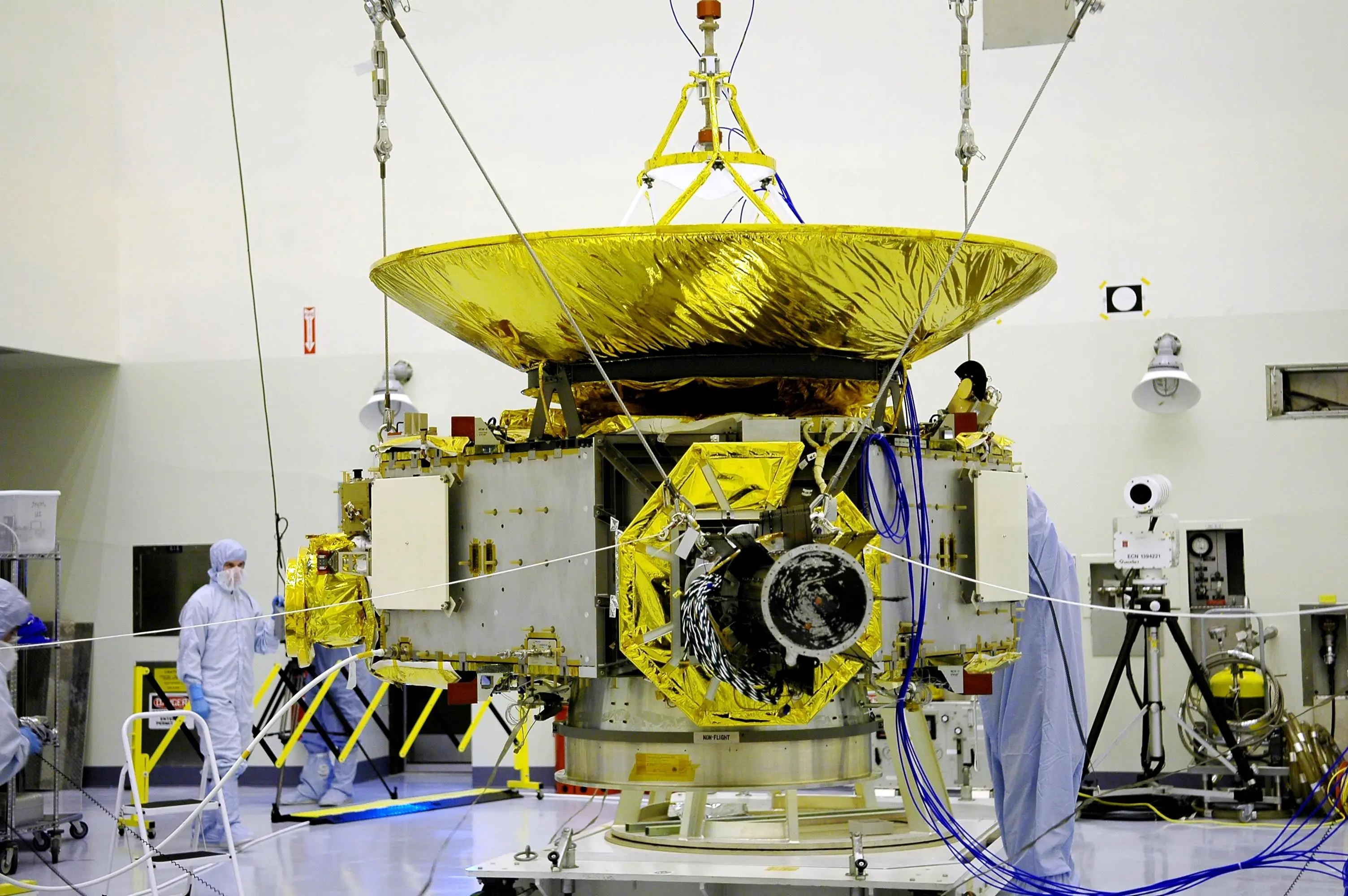
NASA’s New Horizons spacecraft undergoing launch preparations at Kennedy Space Center, Florida, in September 2005. Credit: NASA

In this environment, it’s difficult to imagine the development of a new Pluto mission to begin any time in the next 20 years. Even if Congress or a future presidential administration restores NASA’s planetary science budget, a Pluto mission wouldn’t be near the top of the agency’s to-do list.

The National Academies’ most recent decadal survey prioritized Mars Sample Return, a Uranus orbiter, and an Enceladus “Orbilander” mission in their recommendations to NASA’s planetary science program through 2032. None of these missions has a realistic chance to launch by 2032, and it seems more likely than not that none of them will be in any kind of advanced stage of development by then.

The panel of scientists participating in the latest decadal survey—released in 2022—determined that a second mission to Pluto did not merit a technical risk and cost evaluation report, meaning it wasn’t even shortlisted for consideration as a science priority for NASA.

There’s a broad consensus in the scientific community that a follow-up mission to Pluto should be an orbiter, and not a second flyby. New Horizons zipped by Pluto at a relative velocity of nearly 31,000 mph (14 kilometers per second), flying as close as 7,750 miles (12,500 kilometers).

At that range and velocity, the spacecraft’s best camera was close enough to resolve something the size of a football field for less than an hour. Pluto was there, then it was gone. New Horizons only glimpsed half of Pluto at decent resolution, but what it saw revealed a heart-shaped sheet of frozen nitrogen and methane with scattered mountains of water ice, all floating on what scientists believe is likely a buried ocean of liquid water.

Pluto must harbor a wellspring of internal heat to keep from freezing solid, something researchers didn’t anticipate before the arrival of New Horizons.

New Horizons revealed Pluto as a mysterious world with icy mountains and very smooth plains. Credit: NASA

So, what is Pluto’s ocean like? How thick are Pluto’s ice sheets? Are any of Pluto’s suspected cryovolcanoes still active today? And, what secrets are hidden on the other half of Pluto?

These questions, and more, could be answered by an orbiter. Some of the scientists who worked on New Horizons have developed an outline for a conceptual mission to orbit Pluto. This mission, named Persephone for the wife of Pluto in classical mythology, hasn’t been submitted to NASA as a real proposal, but it’s worth illustrating the difficulties in not just reaching Pluto, but maneuvering into orbit around a dwarf planet so far from the Earth.

Nuclear is the answer

The initial outline for Persephone released in 2020 called for a launch in 2031 on NASA’s Space Launch System Block 2 rocket with an added Centaur kick stage. Again, this isn’t a realistic timeline for such an ambitious mission, and the rocket selected for this concept doesn’t exist. But if you assume Persephone could launch on a souped-up super heavy-lift SLS rocket in 2031, it would take more than 27 years for the spacecraft to reach Pluto before sliding into orbit in 2058.

Another concept study led by Alan Stern, also the principal investigator on the New Horizons mission, shows how a future Pluto orbiter could reach its destination by the late 2050s, assuming a launch on an SLS rocket around 2030. Stern’s concept, called the Gold Standard, would reserve enough propellant to leave Pluto and go on to fly by another more distant object.

Persephone and Gold Standard both assume a Pluto-bound spacecraft can get a gravitational boost from Jupiter. But Jupiter moves out of alignment from 2032 until the early 2040s, adding a decade or more to the travel time for any mission leaving Earth in those years.

It took nine years for New Horizons to make the trip from Earth to Pluto, but the spacecraft was significantly smaller than an orbiter would need to be. That’s because an orbiter has to carry enough power and fuel to slow down on approach to Pluto, allowing the dwarf planet’s weak gravity to capture it into orbit. A spacecraft traveling too fast, without enough fuel, would zoom past Pluto just like New Horizons.

The Persephone concept would use five nuclear radioisotope power generators and conventional electric thrusters, putting it within reach of existing technology. A 2020 white paper authored by John Casani, a longtime project manager at the Jet Propulsion Laboratory who died last month, showed the long-term promise of next-generation nuclear electric propulsion.

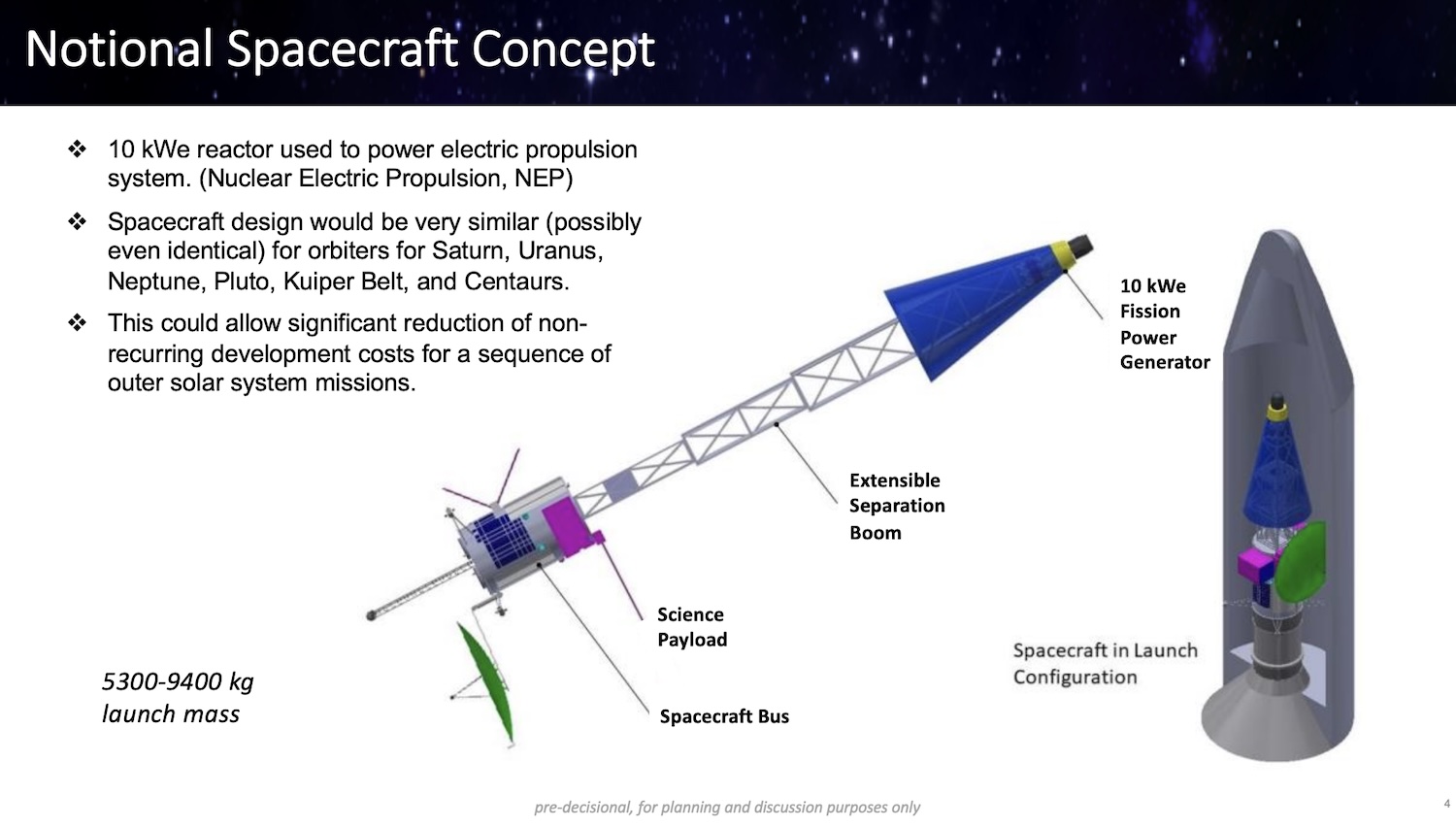
A relatively modest 10-kilowatt nuclear reactor to power electric thrusters would reduce the flight time to Pluto by 25 to 30 percent, while also providing enough electricity to power a radio transmitter to send science data back to Earth at a rate four times faster, according to the mission study report on the Persephone concept.

However, nuclear electric propulsion technologies are still early in the development phase, and Trump’s budget proposal also eliminates any funding for nuclear rocket research.

A concept for a nuclear electric propulsion system to power a spacecraft toward the outer Solar System. Credit: NASA/JPL-Caltech

A rocket like SpaceX’s Starship might eventually be capable of accelerating a probe into the outer Solar System, but detailed studies of Starship’s potential for a Pluto mission haven’t been published yet. A Starship-launched Pluto probe would have its own unique challenges, and it’s unclear whether it would have any advantages over nuclear electric propulsion.

How much would all of this cost? It’s anyone’s guess at this point. Scientists estimated the Persephone concept would cost $3 billion, excluding launch costs, which might cost $1 billion or more if a Pluto mission requires a bespoke launch solution. Development of a nuclear electric propulsion system would almost certainly cost billions of dollars, too.

All of this suggests 50 years or more might elapse between the first and second explorations of Pluto. That is in line with the span of time between the first flybys of Uranus and Neptune by NASA’s Voyager spacecraft in 1986 and 1989, and the earliest possible timeline for a mission to revisit those two ice giants.

So, it’s no surprise scientists are girding for a long wait—and perhaps taking a renewed interest in their own life expectancies—until they get a second look at one of the most seductive worlds in our Solar System.

Photo of Stephen Clark

Stephen Clark is a space reporter at Ars Technica, covering private space companies and the world’s space agencies. Stephen writes about the nexus of technology, science, policy, and business on and off the planet.

We saw the heart of Pluto 10 years ago—it’ll be a long wait to see the rest Read More »