Space

nasa’s-oldest-active-astronaut-is-also-one-of-the-most-curious-humans

NASA’s oldest active astronaut is also one of the most curious humans

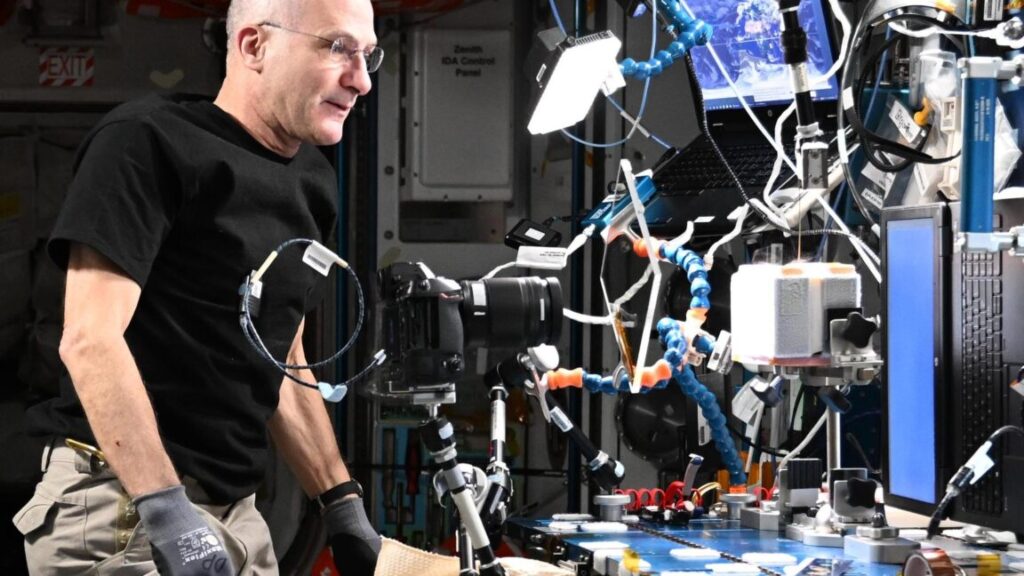
For his most recent trip to the International Space Station, in lieu of bringing coffee or some other beverage in his “personal drink bag” allotment for the stay, NASA astronaut Don Pettit asked instead for a couple of bags of unflavored gelatin.

This was not for cooking purposes but rather to perform scientific experiments. How many of us would give up coffee for science?

Well, Donald Roy Pettit is not like most of us.

At the age of 69, Pettit is NASA’s oldest active astronaut and began his third long-duration stay on the space station last month. A lifelong tinkerer and gifted science communicator, he already is performing wonders up there, and we’ll get to his current activities in a moment. But just so you understand who we’re dealing with, the thing to know about Pettit is that he is insatiably curious, and wants to share the wonder of science and the natural world with others.

Here’s just one small example. During his last six-month increment in orbit, from late 2011 to the middle of 2012, Pettit had some Lego blocks he’d been using for student demonstrations. After the final one, he asked if he could use the Legos for a science experiment. He turned them into a belts-and-rollers-type Van de Graaff generator and produced groundbreaking work in electric fluids. This research was published in Physical Review Letters after Pettit returned to Earth. Most of us probably could not even spell Van de Graaff generator, and this dude is up there, in space, building them out of toys.

The way Pettit, a chemical engineer by training, explains things is that he has the “programmatic” scientific research he does for NASA, and then there’s everything else, often done during his limited free time.

“This is well-planned, well thought out, peer-reviewed, and uplinked to station with the supplies needed,” he said of programmatic research. “And then you have what I call science of opportunity. This is science which comes to mind while you are there, simply because you are there, and you can do it because you can. The scientific disciplines that I’ve dabbled in on the International Space Station include fluid physics, classic physics, chemistry, biology, plant growth, and Earth observations.”

Wafers of water ice. Credit: Don Pettit/NASA

NASA’s oldest active astronaut is also one of the most curious humans Read More »
if-you-thought-astra-was-going-to-go-away-quietly,-you-were-wrong

If you thought Astra was going to go away quietly, you were wrong

On Wednesday morning, a surprising email popped into my inbox with the following subject line: “Astra announces Department of Defense contract valued up to $44 Million.”

I had to read it a second time to make sure I got it right. Astra, the launch company? Astra, whose valuation went from $2.6 billion to $25 million after a series of launch failures? Astra, the company that was taken private in July at 50 cents a share?

Yes, it was that Astra.

This was curious, indeed. To get some answers, I spoke with the cofounder of Astra, Chris Kemp, who remains the company’s chief executive.

“If I have learned anything, it’s that you just don’t give up,” Kemp said. “You know, if you give up easily, this is not the place to be. Fortunately, I am surrounded by a team that has chosen not to give up.”

Rocket 4 becomes more real

I’ll be frank: When Kemp and his co-founder, Adam London, took Astra private this summer, I never expected to hear from the company again. Astra certainly was not the first launch company to fail, and it won’t be the last. But it is the first to seemingly resurrect itself in such a dramatic way.

To be clear, Astra is not back yet. The company remains in the phase of building and testing rocket stages and engines and does not have a launch vehicle ready to go. Its new booster, Rocket 4, will launch no earlier than the fourth quarter of 2025, Kemp said. (That date should probably be viewed with some skepticism).

The company has previously discussed Rocket 4, which is intended to carry 600 kg to low-Earth orbit, as far back as August 2022. But at the time, most of the launch industry, including this reporter, shrugged and moved along. After all, the company’s smaller vehicle, Rocket 3, failed on five of its seven orbital launch attempts. The general sentiment was that the new rocket would never fly.

However, even as Astra’s finances worsened and the company had to stave off bankruptcy by being taken private, not everyone dismissed the vision. In April 2023, the US Space Force awarded a task order for Rocket 4 to launch the STP-S29B mission. That was interesting, but it was just a single data point. Then came this week’s announcement that the US Department of Defense’s “Defense Innovation Unit” had awarded a grant worth up to $44 million to Astra for a “tactically responsive launch system.”

If you thought Astra was going to go away quietly, you were wrong Read More »

rocket-report:-sneak-peek-at-the-business-end-of-new-glenn;-france-to-fly-frog

Rocket Report: Sneak peek at the business end of New Glenn; France to fly FROG


“The vehicle’s max design gimbal condition is during ascent when it has to fight high-altitude winds.”

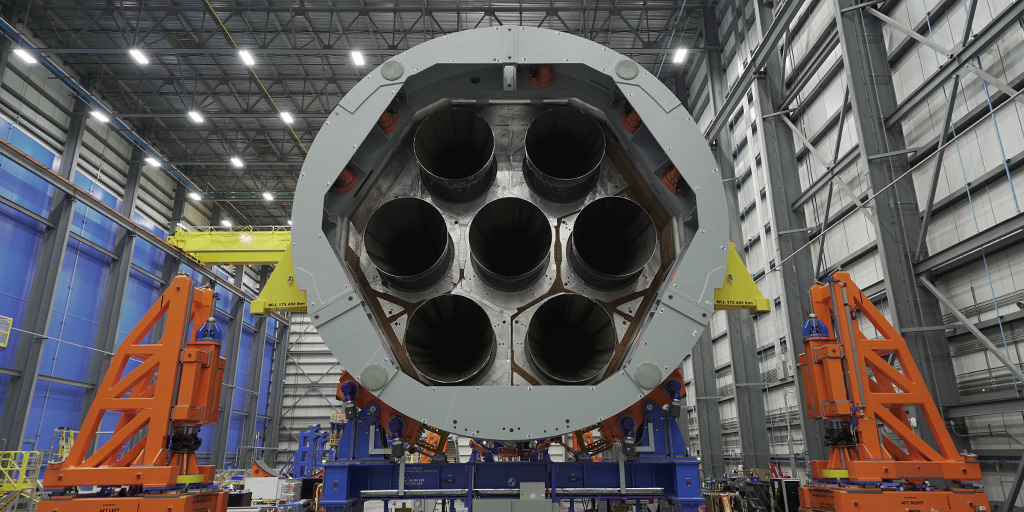
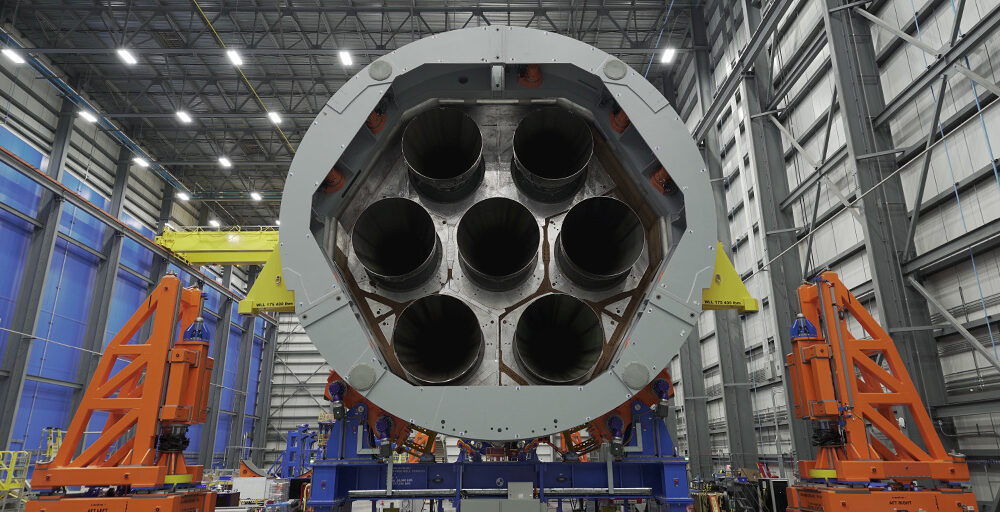
Blue Origin’s first New Glenn rocket, with seven BE-4 engines installed inside the company’s production facility near NASA’s Kennedy Space Center in Florida. Credit: Blue Origin

Welcome to Edition 7.17 of the Rocket Report! Next week marks 10 years since one of the more spectacular launch failures of this century. On October 28, 2014, an Antares rocket, then operated by Orbital Sciences, suffered an engine failure six seconds after liftoff from Virginia and crashed back onto the pad in a fiery twilight explosion. I was there and won’t forget seeing the rocket falter just above the pad, being shaken by the deafening blast, and then running for cover. The Antares rocket is often an afterthought in the space industry, but it has an interesting backstory touching on international geopolitics, space history, and novel engineering. Now, Northrop Grumman and Firefly Aerospace are developing a new version of Antares.

As always, we welcome reader submissions. If you don’t want to miss an issue, please subscribe using the box below (the form will not appear on AMP-enabled versions of the site). Each report will include information on small-, medium-, and heavy-lift rockets as well as a quick look ahead at the next three launches on the calendar.

Astra gets a lifeline from DOD. Astra, the launch startup that was taken private again earlier this year for a sliver of its former value, has landed a new contract with the Defense Innovation Unit (DIU) to support the development of a next-gen launch system for time-sensitive space missions, TechCrunch reports. The contract, which the DIU awarded under its Novel Responsive Space Delivery (NRSD) program, has a maximum value of $44 million. The money will go toward the continued development of Astra’s Launch System 2, designed to perform rapid, ultra-low-cost launches.

Guarantees? … It wasn’t clear from the initial reporting how much money DIU is actually committing to Astra, which said the contract will fund continued development of Launch System 2. Launch System 2 includes a small-class launch vehicle with a similarly basic name, Rocket 4, and mobile ground infrastructure designed to be rapidly set up at austere spaceports. Adam London, founder and chief technology officer at Astra, said the contract award is a “major vote of confidence” in the company. If Astra can capitalize on the opportunity, this would be quite a remarkable turnaround. After going public at an initial valuation of $2.1 billion, or $12.90 per share, Astra endured multiple launch failures with its previous rocket and risked bankruptcy before the company’s co-founders, Chris Kemp and Adam London, took the company private again this year at a price of just $0.50 per share. (submitted by Ken the Bin and EllPeaTea)

Blue Origin debuts a new New Shepard. Jeff Bezos’ Blue Origin space venture successfully sent a brand-new New Shepard rocket ship on an uncrewed shakedown cruise Wednesday, with the aim of increasing the company’s capacity to take people on suborbital space trips, GeekWire reports. The capsule, dubbed RSS Karman Line, carried payloads instead of people when it lifted off from Blue Origin’s Launch Site One in West Texas. But if all the data collected during the 10-minute certification flight checks out, it won’t be long before crews climb aboard for similar flights.

Now there are two … With this week’s flight, Blue Origin now has two human-rated suborbital capsules in its fleet, along with two boosters. This should allow the company to ramp up the pace of its human missions, which have historically flown at a cadence of about one flight every two to three months. The new capsule, named for the internationally recognized boundary of space 62 miles (100 kilometers) above Earth, features upgrades to improve performance and ease reusability. (submitted by Ken the Bin and EllPeaTea)

The easiest way to keep up with Eric Berger’s and Stephen Clark’s reporting on all things space is to sign up for our newsletter. We’ll collect their stories and deliver them straight to your inbox.

Sign Me Up!

China has a new space tourism company. Chinese launch startup Deep Blue Aerospace targets providing suborbital tourism flights starting in 2027, Space News reports. The company was already developing a partially reusable orbital rocket named Nebula-1 for satellite launches and recently lost a reusable booster test vehicle during a low-altitude test flight. While Deep Blue moves forward with more Nebula-1 testing before its first orbital launch, the firm is now selling tickets for rides to suborbital space on a six-person capsule. The first two tickets were expected to be sold Thursday in a promotional livestream event.

Architectural considerations … Deep Blue has a shot at becoming China’s first space tourism company and one of only a handful in the world, joining US-based Blue Origin and Virgin Galactic in the market for suborbital flights. Deep Blue’s design will be a single-stage reusable rocket and crew capsule, similar to Blue Origin’s New Shepard, capable of flying above the Kármán line and providing up to 10 minutes of microgravity experience for its passengers before returning to the ground. A ticket, presumably for a round trip, will cost about $210,000. (submitted by Ken the Bin)

France’s space agency aims to launch a FROG. French space agency CNES will begin flight testing a small reusable rocket demonstrator called FROG-H in 2025, European Spaceflight reports. FROG is a French acronym that translates to Rocket for GNC demonstration, and its purpose is to test landing algorithms for reusable launch vehicles. CNES manages the program in partnership with French nonprofits and universities. At 11.8 feet (3.6 meters) tall, FROG is the smallest launch vehicle prototype at CNES, which says it will test concepts and technologies at small scale before incorporating them into Europe’s larger vertical takeoff/vertical landing test rockets like Callisto and Themis. Eventually, the idea is for all this work to lead to a reusable European orbital-class rocket.

Building on experience … CNES flew a jet-powered demonstrator named FROG-T on five test flights beginning in May 2019, reaching a maximum altitude of about 100 feet (30 meters). FROG-H will be powered by a hydrogen peroxide rocket engine developed by the Łukasiewicz Institute of Aviation in Poland under a European Space Agency contract. The first flights of FROG-H are scheduled for early 2025. The structure of the FROG project seeks to “break free from traditional development methods” by turning to “teams of enthusiasts” to rapidly develop and test solutions through an experimental approach, CNES says on its website. (submitted by EllPeaTea and Ken the Bin)

Falcon 9 sweeps NSSL awards. The US Space Force’s Space Systems Command announced on October 18 it has ordered nine launches from SpaceX in the first batch of dozens of missions the military will buy in a new phase of competition for lucrative national security launch contracts, Ars reports. The parameters of the competition limited the bidders to SpaceX and United Launch Alliance (ULA). SpaceX won both task orders for a combined value of $733.5 million, or roughly $81.5 million per mission. Six of the nine missions will launch from Vandenberg Space Force Base, California, beginning as soon as late 2025. The other three will launch from Cape Canaveral Space Force Station, Florida.

Head-to-head … This was the first set of contract awards by the Space Force’s National Security Space Launch (NSSL) Phase 3 procurement round and represents one of the first head-to-head competitions between SpaceX’s Falcon 9 and ULA’s Vulcan rocket. The nine launches were divided into two separate orders, and SpaceX won both. The missions will deploy payloads for the National Reconnaissance Office and the Space Development Agency. (submitted by Ken the Bin)

SpaceX continues deploying NRO megaconstellation. SpaceX launched more surveillance satellites for the National Reconnaissance Office Thursday aboard a Falcon 9 rocket, Spaceflight Now reports. While the secretive spy satellite agency did not identify the number or exact purpose of the satellites, the Falcon 9 likely deployed around 20 spacecraft believed to be based on SpaceX’s Starshield satellite bus, a derivative of the Starlink spacecraft platform, with participation from Northrop Grumman. These satellites host classified sensors for the NRO.  This is the fourth SpaceX launch for the NRO’s new satellite fleet, which seeks to augment the agency’s bespoke multibillion-dollar spy satellites with a network of smaller, cheaper, more agile platforms in low-Earth orbit.

The century mark … This mission, officially designated NROL-167, was the 100th flight of a Falcon 9 rocket this year and the 105th SpaceX launch overall in 2024. The NRO has not said how many satellites will make up its fleet when completed, but the intelligence agency says it will be the US government’s largest satellite constellation in history. By the end of the year, the NRO expects to have 100 or more of these satellites in orbit, allowing the agency to transition from a demonstration mode to an operational mode to deliver intelligence data to military and government users. Many more launches are expected through 2028. (submitted by Ken the Bin)

ULA is stacking its third Vulcan rocket. United Launch Alliance has started assembling its next Vulcan rocket—the first destined to launch a US military payload—as the Space Force prepares to certify it to loft the Pentagon’s most precious national security satellites, Ars reports. Space Force officials expect to approve ULA’s Vulcan rocket for military missions without requiring another test flight, despite an unusual problem on the rocket’s second demonstration flight earlier this month, when one of Vulcan’s two strap-on solid-fueled boosters lost its nozzle shortly after liftoff.

Pending certification … Despite the nozzle failure, the Vulcan rocket continued climbing into space and eventually reached its planned injection orbit, and the Space Force and ULA declared the test flight a success. Still, engineers want to understand what caused the nozzle to break apart and decide on corrective actions before the Space Force clears the Vulcan rocket to launch a critical national security payload. This could take a little longer than expected due to the booster problem, but Space Force officials still hope to certify the Vulcan rocket in time to support a national security launch by the end of the year.

Blue Origin’s first New Glenn has all its engines. Blue Origin published a photo Thursday on X showing all seven first-stage BE-4 engines installed on the base of the company’s first New Glenn rocket. This is a notable milestone as Blue Origin proceeds toward the first launch of the heavy-lifter, possibly before the end of the year. But there’s a lot of work for Blue Origin to accomplish before then. These steps include rolling the rocket to the launch pad, running through propellant loading tests and practice countdowns, and then test-firing all seven BE-4 engines on the pad at Cape Canaveral Space Force Station, Florida.

Seven for seven … The BE-4 engines will consume methane fuel mixed with liquid oxygen for the first few minutes of the New Glenn flight, generating more than 3.8 million pounds of combined thrust. The seven BE-4s on New Glenn are similar to the BE-4 engines that fly two at a time on ULA’s Vulcan rocket. Dave Limp, Blue Origin’s CEO, said three of the seven engines on the New Glenn first stage have thrust vector control capability to provide steering during launch, reentry, and landing on the company’s offshore recovery vessel. “That gimbal capability, along with the landing gear and Reaction Control System thrusters, are key to making our booster fully reusable,” Limp wrote on X. “Fun fact: The vehicle’s max design gimbal condition is during ascent when it has to fight high-altitude winds.”

Next Super Heavy booster test-fired in Texas. SpaceX fired up the Raptor engines on its next Super Heavy booster, numbered Booster 13, Thursday evening at the company’s launch site in South Texas. This happened just 11 days after SpaceX launched and caught the Super Heavy booster on the previous Starship test flight and signals SpaceX could be ready for the next Starship test flight sometime in November. SpaceX has already test-fired the Starship upper stage for the next flight.

Great expectations … We expect the next Starship flight, which will be program’s sixth full-scale demo mission, will include another booster catch back at the launch tower at Starbase, Texas. SpaceX may also attempt to reignite a Raptor engine on the Starship upper stage while it is in space, demonstrating the capability to steer itself back into the atmosphere on future flights. So far, SpaceX has only launched Starships on long, arcing suborbital trajectories that carry the vehicle halfway around the world before reentry. In order to actually launch a Starship into a stable orbit around Earth, SpaceX will want to show it can bring the vehicle back so it doesn’t reenter the atmosphere in an uncontrolled manner. An uncontrolled reentry of a large spacecraft like Starship could pose a public safety risk.

Next three launches

Oct. 26: Falcon 9 | Starlink 10-8 | Cape Canaveral Space Force Station, Florida | 21: 47 UTC

Oct. 29: Falcon 9 | Starlink 9-9 | Vandenberg Space Force Base, California | 11: 30 UTC

Oct. 30: H3 | Kirameki 3 | Tanegashima Space Center, Japan | 06: 46 UTC

Photo of Stephen Clark

Stephen Clark is a space reporter at Ars Technica, covering private space companies and the world’s space agencies. Stephen writes about the nexus of technology, science, policy, and business on and off the planet.

Rocket Report: Sneak peek at the business end of New Glenn; France to fly FROG Read More »

astronaut-hospitalized-after-returning-from-235-day-space-mission

Astronaut hospitalized after returning from 235-day space mission

NASA said Friday one its astronauts is in a hospital in Florida for medical observation after a “normal” predawn splashdown in the Gulf of Mexico inside a SpaceX capsule.

The mission’s other three crew members were cleared to return to their home base at Johnson Space Center in Houston after their own medical evaluations, NASA said.

The hospitalized astronaut “is in stable condition and under observation as a precautionary measure,” a NASA spokesperson said in a statement. The agency did not identify the astronaut or provide any more details about their condition, citing medical privacy protections.

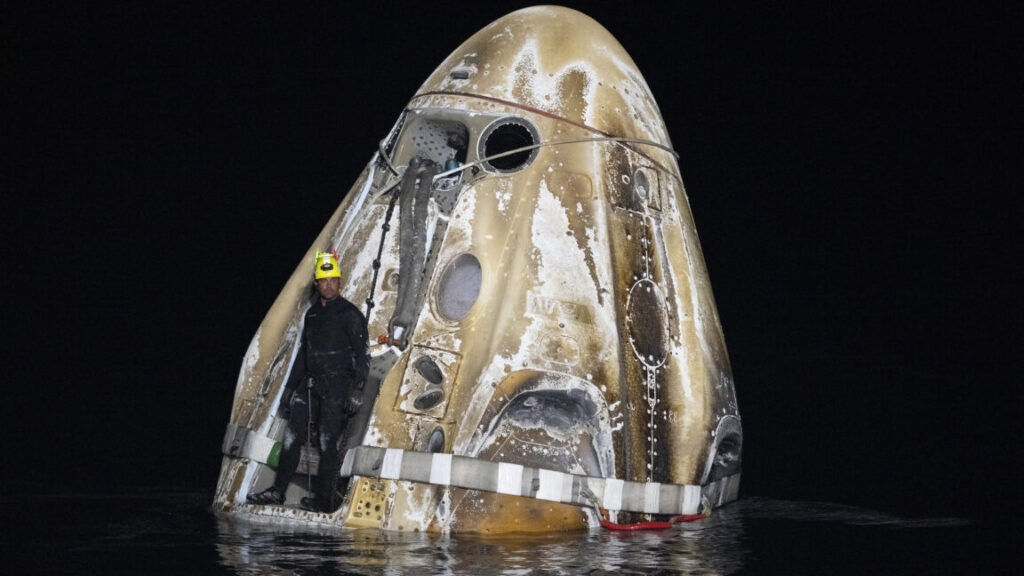
Strapped into their seats onside SpaceX’s Crew Dragon Endeavour spacecraft, the four-person crew splashed down just south of Pensacola, Florida, at 3: 29 am EDT (07: 29 UTC) Friday, wrapping up a 235-day mission in low-Earth orbit.

NASA extended their stay at the International Space Station earlier this year to accommodate schedule changes caused by the troubled test flight of Boeing’s Starliner spacecraft, then to wait for better weather conditions in SpaceX’s recovery zones near Florida.

Commander Matthew Dominick, pilot Michael Barratt, mission specialist Jeanette Epps, and Russian cosmonaut Alexander Grebenkin were inside SpaceX’s Dragon spacecraft for reentry and splashdown. NASA said one of its astronauts “experienced a medical issue” after the splashdown, and all four crew members were flown to Ascension Sacred Heart Pensacola for medical evaluation.

Three of the crew members were later released and departed Pensacola on a NASA business jet to fly back to Houston, according to NASA. The unidentified astronaut remains at Ascension.

“We’re grateful to Ascension Sacred Heart for its support during this time, and we are proud of our team for its quick action to ensure the safety of our crew members,” the NASA spokesperson said. “NASA will provide additional information as it becomes available.”

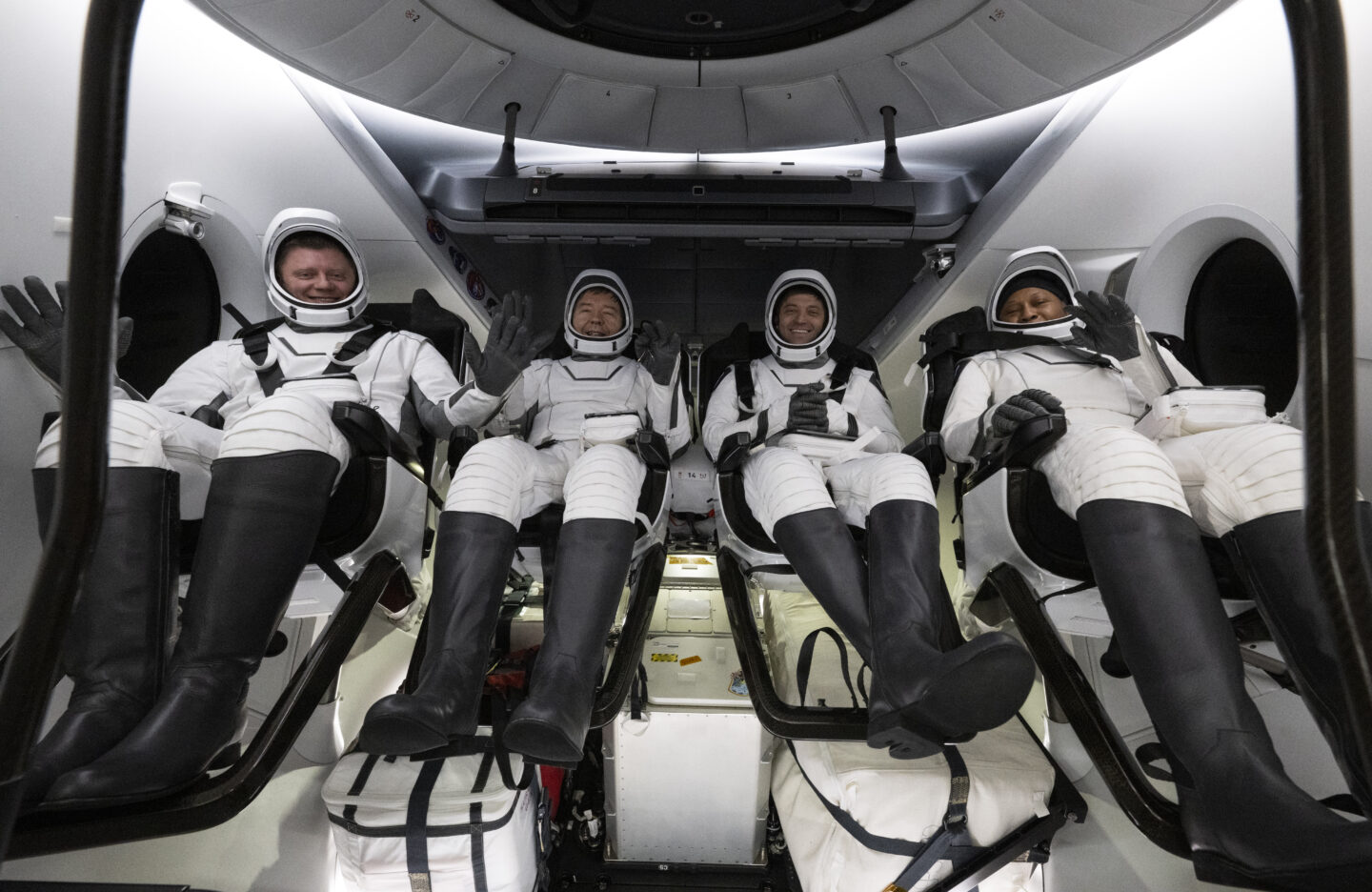
Roscosmos cosmonaut Alexander Grebenkin, left, NASA astronauts Michael Barratt, second from left, Matthew Dominick, second from right, and Jeanette Epps, right are seen inside the SpaceX Dragon Endeavour spacecraft shortly after splashdown Friday morning.

Credit: NASA/Joel Kowsky

Roscosmos cosmonaut Alexander Grebenkin, left, NASA astronauts Michael Barratt, second from left, Matthew Dominick, second from right, and Jeanette Epps, right are seen inside the SpaceX Dragon Endeavour spacecraft shortly after splashdown Friday morning. Credit: NASA/Joel Kowsky

This mission, named Crew-8, was SpaceX’s eighth operational crew rotation flight to the space station under a multibillion-dollar commercial crew contract with NASA. This was the first flight to space for Dominick, Epps, and Grebenkin, and the third space mission for Barratt.

Roscosmos, the Russian space agency, released a photo of Grebenkin standing in Pensacola a few hours after splashdown. “After the space mission and splashdown, cosmonaut Alexander Grebenkin feels great!” Roscosmos posted on its Telegram channel.

Adapting to Earth

This is not the first time an astronaut has been hospitalized after returning to Earth, but it is uncommon. South Korean astronaut Yi So-yeon was hospitalized for back pain after experiencing higher-than-expected g-forces during reentry in a Russian Soyuz spacecraft in 2008.

Three NASA astronauts were hospitalized in Hawaii after splashing down at the end of the Apollo-Soyuz Test Project mission in 1975. The astronauts suffered lung irritation after breathing in toxic vapors from the Apollo spacecraft’s thrusters in the final moments before splashdown.

Astronaut hospitalized after returning from 235-day space mission Read More »

why-is-elon-musk-talking-to-vladimir-putin,-and-what-does-it-mean-for-spacex?

Why is Elon Musk talking to Vladimir Putin, and what does it mean for SpaceX?


NASA chief says ties between SpaceX CEO and Putin should be investigated.

Elon Musk wears a black “Make America Great Again” ball cap while attending a campaign rally with Republican presidential nominee, former President Donald Trump, in October. Credit: Anna Moneymaker/Getty Images

In a blockbuster story published Friday morning, The Wall Street Journal reports that Elon Musk has been in regular contact with Russian President Vladimir Putin for about two years, with the discussions covering a range of issues from geopolitics to business to personal matters.

There are no on-the-record sources confirming the regular conversations between Musk and Putin, and Musk did not comment to the news organization. A Putin spokesperson said the Russian leader and Musk have had just one telephone call. However, the report is plausibly true, and the Journal cites “several current and former US, European, and Russian officials.” This is also not the first time there have been reports of contact between Musk and Putin.

The new story about Musk’s direct links to an avowed enemy of the United States immediately raised concerns among some prominent US officials who work with the billionaire entrepreneur, including NASA Administrator Bill Nelson.

“I don’t know if that story is true,” Nelson said in a conversation with Semafor on Friday morning. “If it’s true there have been multiple conversations with Elon Musk and the president of Russia, then that would be concerning, particularly for NASA and the Department of Defense.” Nelson added that the report should be investigated.

To Russia, with love

Musk’s motivations for speaking directly with Putin are not immediately clear. His largest companies, SpaceX and Tesla, do not do business directly with the Russian government. In fact, the rise of SpaceX as a dominant player has substantially harmed Russia’s space business in multiple ways: it helped force US rival United Launch Alliance to stop buying Russian rocket engines, it reduced demand for Russian commercial launch services, and SpaceX’s Crew Dragon vehicle allowed NASA to stop spending hundreds of millions of dollars a year for Russian transportation to the International Space Station.

Unlike Tesla’s complicated interactions with China, which give that country some leverage over Musk’s finances, Russia has no such levers. The most plausible answer for why Musk is conversing with Putin is that he sees himself as a global power broker and wants to do bold things like solve the Ukraine crisis. Musk has ideas and views for how the world should be, and developing relationships with world leaders will help advance those ideas. Musk is also opportunistic and must believe that he can manage Putin in a way that is advantageous to his personal and business aims.

One concern for US policymakers is that this could represent a break in a long-running symbiotic relationship between Musk and America. For a couple of decades the United States’ and Musk’s ambitions—to build electric cars, reusable rockets, and solve the world’s big problems with technology—have moved forward more or less harmoniously. Musk thrived amid America’s ethos of freedom and capitalism. The nation benefited from world-leading technology and economic development.

Nowhere has this relationship borne more fruit than at SpaceX, which has almost singlehandedly assured US preeminence in space for at least the next decade and probably beyond. Musk builds the best rockets, operates the only proven US human spacecraft, and flies more than half of the active satellites in Earth orbit. In the wake of Russia’s invasion of Ukraine, Europe turned to SpaceX to get its most valuable satellites into space, and Starlink provided essential communications in Ukraine. NASA’s lunar program only succeeds if SpaceX’s Starship vehicle succeeds.

But in the last two years, the same time frame in which Musk has reportedly been in contact with Putin, the once symbiotic relationship between Musk and the United States has begun to fray. This has also coincided with Musk’s purchase of Twitter and increasing alignment with conservative politics.

Musk goes MAGA

Many Americans are celebrating Musk’s bromance with Republican presidential nominee former President Donald Trump. They appreciate his embrace of Republican politics and the more than $100 million he has invested in Trump winning the presidency. In characteristic Musk fashion, he has gone all-in on a cause he deems essential to the future of his interests and those of humanity, even temporarily living in Pennsylvania.

But for many other Americans, the response to Musk’s activities has been revulsion. He has used social network X (formerly Twitter) to push an increasingly partisan viewpoint and peddled a stream of ideas and theories that can accurately be described as misinformation. These people are increasingly uncomfortable with Musk’s power over the US space program and the country’s electric vehicle industry, and ability to influence geopolitical affairs through the Starlink constellation for which there is no viable competitor at present. The idea that Musk is regularly conversing with Putin, an avowed foe of the United States and Western democracies, is deeply uncomfortable.

After nursing a libertarian streak for decades, Musk has become ultra-political. He is loved. He is hated. Because he is so personally embodied by the brands of his biggest companies—much of Tesla’s stock value is predicated on Musk’s perceived ability to steer into the future, and for all intents and purposes, Musk is SpaceX—there are bound to be consequences not just for the man, but for his brands.

Musk’s increasingly partisan positions have already affected Tesla, potentially reducing sales to Democratic-leaning voters. But until recently, SpaceX has largely flown above the fray. However, that could change. During Musk’s recent showdown with Brazil, for example, the Starlink Internet service was caught in the crosshairs.

Implications for SpaceX

At a minimum, in the wake of Friday’s report, Musk will likely face increased calls for the revocation of his national security clearance. As the launch provider for sensitive Department of Defense missions, Musk has access to privileged information about the capabilities of spy satellites and other national security assets. He also has critical contracts with the US military for Starlink communication services under the Starshield business unit.

In addition, Musk’s political activities are playing out as the US Space Force is beginning to award contracts as part of the latest round of national security launch missions, known as NSSL Phase 3. It is possible the US military could lean more into the Vulcan rocket and United Launch Alliance.

Some of the more ardent critics of Musk’s behavior have called for the US government to force Musk to divest his interest in SpaceX. Musk founded SpaceX more than 22 years ago and remains the dominant shareholder, with total autonomy to make decisions. This would be a nuclear option and, in reality, probably would do more harm than good to SpaceX, which for years has thrived on Musk’s audacious goals and relentless pressure to achieve remarkable feats. It seems unlikely to occur at this time.

What seems clear is that the publication of Friday’s article reflects the concerns of some people within the US intelligence community about Musk’s behavior, his ability to conduct Cowboy diplomacy, and the power his money and technologies give him as an individual.

What happens next will, undoubtedly, depend to some extent on the results of the US presidential election next month. A Trump victory would likely give Musk carte blanche to continue pursuing his interests, with the clear message to US agencies to enable his businesses rather than to restrict them for regulatory reasons. Musk would likely enjoy increased power to pursue his aims until the end of the Trump presidency or until falling out with Trump. Such a scenario certainly cannot be ruled out among two people who are accustomed to calling the shots and not being told no.

Should Kamala Harris win the presidency, a lot would hinge on how Musk responds to the election. He could say some mea culpas and probably move on, but if he goes the election-denier route, he and his businesses probably would face heightened scrutiny. US regulatory agencies could act with more zeal, and Musk’s activities could be more closely investigated for violation of US laws. And NASA and the US Space Force could do more to ensure that other US companies can emerge to challenge SpaceX’s dominance.

Photo of Eric Berger

Eric Berger is the senior space editor at Ars Technica, covering everything from astronomy to private space to NASA policy, and author of two books: Liftoff, about the rise of SpaceX; and Reentry, on the development of the Falcon 9 rocket and Dragon. A certified meteorologist, Eric lives in Houston.

Why is Elon Musk talking to Vladimir Putin, and what does it mean for SpaceX? Read More »

boeing-is-still-bleeding-money-on-the-starliner-commercial-crew-program

Boeing is still bleeding money on the Starliner commercial crew program


“We signed up to some things that are problematic.”

Boeing’s Starliner spacecraft backs away from the International Space Station on September 6 without its crew. Credit: NASA

Sometimes, it’s worth noting when something goes unsaid.

On Wednesday, Boeing’s new CEO, Kelly Ortberg, participated in his first quarterly conference call with investment analysts. Under fire from labor groups and regulators, Boeing logged a nearly $6.2 billion loss for the last three months, while the new boss pledged a turnaround for the troubled aerospace company.

What Ortberg didn’t mention in the call was the Starliner program. Starliner is a relatively small portion of Boeing’s overall business, but it’s a high-profile and unprofitable one.

Mounting losses

Boeing has reported recurring financial losses on the program and added $250 million to the tally with Wednesday’s quarterly report filed with the Securities and Exchange Commission. This brings the company’s total losses on Starliner to $1.85 billion, recorded in increments over the last few years as the program has faced technical problems and delays.

In its SEC filing, Boeing wrote: “Risk remains that we may record additional losses in future periods.”

Boeing runs the Starliner program under a fixed-price contract with NASA, meaning the government pays the contractor a set amount of money, and the company is on the hook for any cost overruns. These are favorable terms for the government because they divert financial risk to the contractor, usually resulting in lower costs if the program is successful.

Since the last Starliner test flight ended in a disappointing fashion, Boeing has released no updates on its plans for the future of the spacecraft. The company released a short written statement after Starliner landed in early September, saying managers would review data and “determine the next steps for the program.”

A week after Starliner landed, Boeing’s chief financial officer, Brian West, echoed that line. “There is important work to determine any next steps for the Starliner program, and we’ll evaluate that,” he said at a conference sponsored by Morgan Stanley.

A member of the Starliner recovery team removes cargo from the spacecraft after landing in New Mexico on September 6, without its two-person crew.

Credit: NASA/Aubrey Gemignani

A member of the Starliner recovery team removes cargo from the spacecraft after landing in New Mexico on September 6, without its two-person crew. Credit: NASA/Aubrey Gemignani

Starliner concluded its third test flight a little more than six weeks ago, leaving behind the two astronauts the craft ferried to the International Space Station earlier in the year. This was the first time people flew into orbit on a Starliner spacecraft.

NASA, which partnered with Boeing to develop the Starliner spacecraft, decided the Boeing capsule should return to Earth without its crew after the test flight encountered problems with overheating thrusters and helium leaks. The spacecraft safely reached the space station with NASA astronauts Butch Wilmore and Suni Williams in June, but agency officials were not comfortable with risking the crew’s safety on Starliner for the trip home. Instead, the duo will return to Earth on a SpaceX Dragon spacecraft early next year.

Boeing managers had a different opinion and lobbied for Starliner to return to Earth with Wilmore and Williams. Ultimately, the Starliner spacecraft parachuted to a successful landing at White Sands Space Harbor, New Mexico, on September 6, but there’s a lot of work ahead for Boeing to fix the thruster problems and helium leaks before the capsule can fly with people again. This will take many months—potentially a year or more—and will cost Boeing hundreds of millions of dollars, as shown in Wednesday’s SEC filing.

Doing less

In response to questions Wednesday from Wall Street investment firms, Ortberg, who took the CEO job in August, suggested it’s time for Boeing to look at cutting some of its losses and recalibrate how it pursues new business opportunities. Boeing’s previous CEO, Dave Calhoun, said last year the company would no longer enter into fixed-price development contracts.

“I think that that we’re better off being doing less and doing it better than doing more and not doing it well,” Ortberg said. “So we’re in the process of taking an evaluation of the portfolio. It’s something a new CEO always does when you come into a business.”

Most of Boeing’s financial loss in the third quarter of this year came from the company’s commercial airplane business. Beset by safety concerns with its 737 Max aircraft and a labor strike that has halted production at many of its airplane factories, Boeing posted its worst quarterly performance since the height of the COVID pandemic in 2020.

Even before the strike, the Federal Aviation Administration capped Boeing’s production rate for the 737 Max, limiting revenue for the commercial airplane business.

Ortberg didn’t specify any programs that Boeing might consider trimming or canceling, but said the company’s “core” business of commercial airplanes and military systems will stay.

“There are probably some things on the fringe there that we can be more efficient with, or that just distract us from our main goal here. So, more to come on that,” Ortberg said. “I don’t have a specific list of things that we’re going to keep and we’re not going to keep. That’s something for us to evaluate, and the process is underway.”

Kelly Ortberg, Boeing’s new CEO, is pictured in 2016 during his tenure as chief executive of Rockwell Collins.

Kelly Ortberg, Boeing’s new CEO, is pictured in 2016 during his tenure as chief executive of Rockwell Collins. Credit: Daniel Acker/Bloomberg via Getty Images

Apart from technical execution, Ortberg identified Boeing’s errors in cost and risk estimation as other reasons for the company’s poor performance on several fixed-price government contracts, including Starliner.

“We’re not going to be able to just wave the wand and clean up these troubled contracts,” he said. “We signed up to some things that are problematic.”

Ortberg said he is reluctant to ditch all of Boeing’s troubled contracts. “Even if we wanted to, I don’t think we can walk away from these contracts,” he said. “These are our core customers that need this capability. We’ve got long-term commitments to them. So walking away isn’t an answer to this.”

However, Orberg added that Boeing could reassess programs as they shift from one contract phase to the next. NASA’s commercial crew contract with Boeing has a maximum value of $4.6 billion, but that assumes the agency gives Boeing the green light to fly six operational Starliner missions.

So far, NASA has only authorized Boeing to begin detailed preparations for three. The latter half of the commercial crew contract remains a question mark, and could be an opportunity for Boeing to reevaluate the Starliner program without breaking its obligations to NASA. This is especially salient because NASA plans to decommission the International Space Station in 2030, and it’s not clear Boeing could fly all six of its Starliner missions before then while still alternating with SpaceX for crew transportation duties.

“We do have to get into a position where we’ve got a portfolio much more balanced with less risky programs and more profitable programs, and we’re going to be working that,” Ortberg said. “But I don’t think a wholesale walkaway is in the cards.”

This statement makes it sound like Boeing isn’t going to pull the plug on Starliner immediately. Still, Boeing hasn’t laid out its specific plans for Starliner, or even confirmed its intention to keep working on the program. This is puzzling.

Saying nothing

Ortberg was not asked about Starliner in Wednesday’s investor call. After the call, Ars asked a Boeing spokesperson if the company still has a long-term commitment to the Starliner program. The spokesperson replied that the company has nothing to share on the topic.

The Starliner test flight this year was supposed to pave the way for NASA to officially certify the Boeing crew capsule to begin flying in a slate of up to six operational crew rotation flights to the space station. Once certified, Boeing will become NASA’s second crew transportation provider alongside SpaceX, which has now launched nine operational crew missions for NASA, plus a handful more all-private astronaut missions.

NASA still wants to certify Boeing’s Starliner spacecraft to provide the agency with a second commercial option for getting astronauts into orbit. A fundamental goal set out for NASA’s commercial crew program more than a decade ago was to develop two dissimilar human-rated transportation systems for access to low-Earth orbit. The idea here is competition will drive down costs, and NASA will have a backup option if one of the commercial crew providers runs into difficulties.

However, NASA has not announced whether it will require Boeing to complete another test flight to achieve the certification milestone with Starliner. NASA is looking at slots to fly an unpiloted Starliner spacecraft on a cargo mission to the space station next year, perhaps to verify modifications to the ship’s propulsion system really fix the problems discovered on the test flight this year.

NASA is making moves while assuming Boeing will stay in the game. Astronauts are still assigned to train for the first operational Starliner mission, although it’s not likely to happen until the end of next year or in 2026. Earlier this month, NASA announced SpaceX will launch a four-person crew to the International Space Station no earlier than July of next year, taking a slot that the agency once hoped Boeing would use.

Bill Nelson, NASA’s administrator, told reporters in late August that he received assurances from Ortberg that Boeing intends to “move forward and fly Starliner in the future.” At the time, Ortberg was just a couple of weeks into his tenure at Boeing.

Two months later, Nelson’s secondhand assertion is still all we have.

Photo of Stephen Clark

Stephen Clark is a space reporter at Ars Technica, covering private space companies and the world’s space agencies. Stephen writes about the nexus of technology, science, policy, and business on and off the planet.

Boeing is still bleeding money on the Starliner commercial crew program Read More »

after-seeing-hundreds-of-launches,-spacex’s-rocket-catch-was-a-new-thrill

After seeing hundreds of launches, SpaceX’s rocket catch was a new thrill


For a few moments, my viewing angle made it look like the rocket was coming right at me.

Coming in for the catch. Credit: Stephen Clark/Ars Technica

BOCA CHICA BEACH, Texas—I’ve taken some time to process what happened on the mudflats of South Texas a little more than a week ago and relived the scene in my mind countless times.

With each replay, it’s still as astonishing as it was when I saw it on October 13, standing on an elevated platform less than 4 miles away. It was surreal watching SpaceX’s enormous 20-story-tall Super Heavy rocket booster plummeting through the sky before being caught back at its launch pad by giant mechanical arms.

This is the way, according to SpaceX, to enable a future where it’s possible to rapidly reuse rockets, not too different from the way airlines turn around their planes between flights. This is required for SpaceX to accomplish the company’s mission, set out by Elon Musk two decades ago, of building a settlement on Mars.

Of course, SpaceX’s cameras got much better views of the catch than mine. This is one of my favorite video clips.

The final phase of Super Heavy’s landing burn used the three center Raptor engines to precisely steer into catch position pic.twitter.com/BxQbOmT4yk

— SpaceX (@SpaceX) October 14, 2024

In the near-term future, regularly launching and landing Super Heavy boosters, and eventually the Starship upper stage that goes into orbit, will make it possible for SpaceX to achieve the rapid-fire launch cadence the company needs to fulfill its contracts with NASA. The space agency is paying SpaceX roughly $4 billion to develop a human-rated version of Starship to land astronauts on the Moon under the umbrella of the Artemis program.

To make that happen, SpaceX must launch numerous Starship tankers over the course of a few weeks to a few months to refuel the Moon-bound Starship lander in low-Earth orbit. Rapid reuse is fundamental to the lunar lander architecture NASA chose for the first two Artemis landing missions.

SpaceX, which is funding most of Starship’s development costs, says upgraded versions will be capable of hauling 200 metric tons of payload to low-Earth orbit while flying often at a relatively low cost. This would unlock innumerable other potential applications for the US military and commercial industry.

Here’s a sampling of the photos I captured of SpaceX’s launch and catch, followed by the story of how I got them.

The fifth full-scale test flight of SpaceX’s new-generation Starship rocket lifted off from South Texas at sunrise Sunday morning. Stephen Clark/Ars Technica

Some context

I probably spent too much time watching last week’s flight through my camera’s viewfinder, but I suspect I’ll see it many more times. After all, SpaceX wants to make this a routine occurrence, more common than the landings of the smaller Falcon 9 booster now happening several times per week.

Nine years ago, I watched from 7 miles away as SpaceX landed a Falcon 9 for the first time. This was the closest anyone not directly involved in the mission could watch as the Falcon 9’s first stage returned to Cape Canaveral Space Force Station in Florida, a few minutes after lifting off with a batch of commercial communications satellites.

Citing safety concerns, NASA and the US Air Force closed large swaths of the spaceport for the flight. Journalists and VIPs were kept far away, and the locations on the base where employees or special guests typically watch a launch were off-limits. The landing happened at night and played out like a launch in reverse, with the Falcon 9 booster settling to a smooth touchdown on a concrete landing pad a few miles from the launch site.

The Falcon 9 landing on December 21, 2015, came after several missed landings on SpaceX’s floating offshore drone ship. With the Super Heavy booster, SpaceX nailed the catch on the first try.

The catch method means the rocket doesn’t need to carry landing legs, as the Falcon 9 does. This reduces the rocket’s weight and complexity, and theoretically reduces the amount of time and money needed to prepare the rocket to fly again.

I witnessed the first catch of SpaceX’s Super Heavy booster last week from just outside the restricted zone around the company’s sprawling Starbase launch site in South Texas. Deputies from the local sheriff’s office patrolled the area to ensure no one strayed inside the keep-out area and set up roadblocks to turn away anyone who wasn’t supposed to be there.

The launch was early in the morning, so I arrived late the night before at a viewing site run by Rocket Ranch, a campground that caters to SpaceX fans seeking a front-row seat to the goings-on at Starbase. Some SpaceX employees, several other reporters, and media photographers were there, too.

There are other places to view a Starship launch. Condominium and hotel towers on South Padre Island roughly 6 miles from the launch pad, a little farther than my post, offer commanding aerial views of Starbase, which is situated on Boca Chica Beach a few miles north of the US-Mexico border. The closest publicly accessible place to watch a Starship launch is on the south shore of the mouth of the Rio Grande River, but if you’re coming from the United States, getting there requires crossing the border and driving off-road.

People gather at the Rocket Ranch viewing site near Boca Chica Beach, Texas, before the third Starship test flight in March.

People gather at the Rocket Ranch viewing site near Boca Chica Beach, Texas, before the third Starship test flight in March. Credit: Brandon Bell/Getty Images

I chose a location with an ambiance somewhere in between the hustle and bustle of South Padre Island and the isolated beach just across the border in Mexico. The vibe on the eve of the launch had the mix of a rave and a pilgrimage of SpaceX true believers.

A laser light show projected the outline of a Starship against a tree as uptempo EDM tracks blared from speakers. Meanwhile, dark skies above revealed cosmic wonders invisible to most city dwellers, and behind us, the Rio Grande inexorably flowed toward the sea. Those of us who were there to work got a few hours of sleep, but I’m not sure I can say the same for everyone.

At first light, a few scattered yucca plants sticking up from the chaparral were the only things between us and SpaceX’s sky-scraping Starship rocket on the horizon. We got word the launch time would slip 25 minutes. SpaceX chose the perfect time to fly, with a crystal-clear sky hued by the rising Sun.

First, you see it

I was at Starbase for all four previous Starship test flights and have covered more than 300 rocket launches in person. I’ve been privileged to witness a lot of history, but after hundreds of launches, some of the novelty has worn off. Don’t get me wrong—I still feel a lump in my throat every time I see a rocket leave the planet. Prelaunch jitters are a real thing. But I no longer view every launch as a newsworthy event.

October 13 was different.

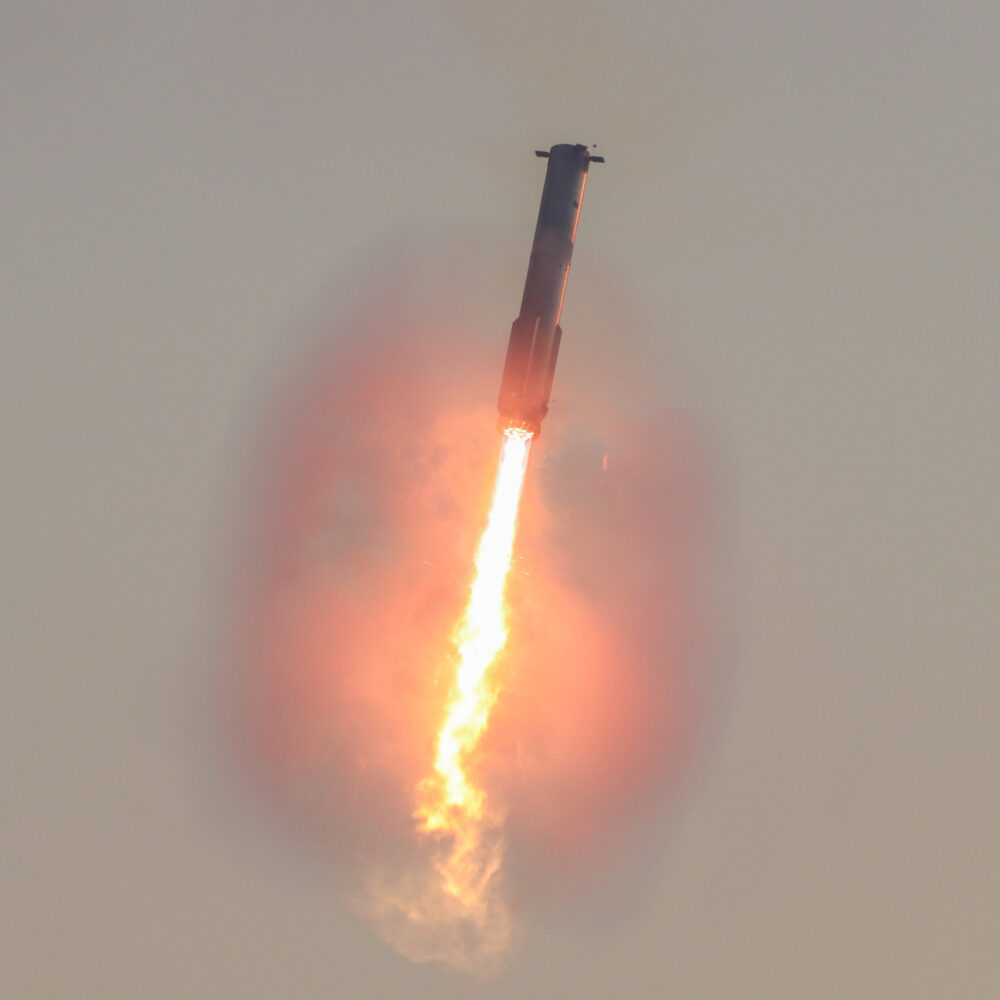
Those prelaunch anxieties were present as SpaceX counted off the final seconds to liftoff. First, you see it. A blast of orange flashed from the bottom of the gleaming, frosty rocket filled with super-cold propellants. Then, the 11 million-pound vehicle began a glacial climb from the launch pad. About 20 seconds later, the rumble from the rocket’s 33 methane-fueled engines reached our location.

Our viewing platform shook from the vibrations for over a minute as Starship and the Super Heavy booster soared into the stratosphere. Two-and-a-half minutes into the flight, the rocket was just a point of bluish-white light as it accelerated east over the Gulf of Mexico.

Another burst of orange encircled the rocket during the so-called hot-staging maneuver, when the Starship upper stage lit its engines at the moment the Super Heavy booster detached to begin the return to Starbase. Flying at the edge of space more than 300,000 feet over the Gulf, the booster flipped around and fired its engines to cancel out its downrange velocity and propel itself back toward the coastline.

The engines shut down, and the booster plunged deeper into the atmosphere. Eventually, the booster transformed from a dot in the sky back into the shape of a rocket as it approached Starbase at supersonic speed. The rocket’s velocity became more evident as it got closer. For a few moments, my viewing angle made it look like the rocket—bigger than the fuselage of a 747 jumbo jet—was coming right at me.

The descending booster zoomed through the contrail cloud it left behind during launch, then reappeared into clear air. With the naked eye, I could see a glow inside the rocket’s engine bay as it dived toward the launch pad, presumably from heat generated as the vehicle slammed into ever-denser air on the way back to Earth. This phenomenon made the rocket resemble a lit cigar.

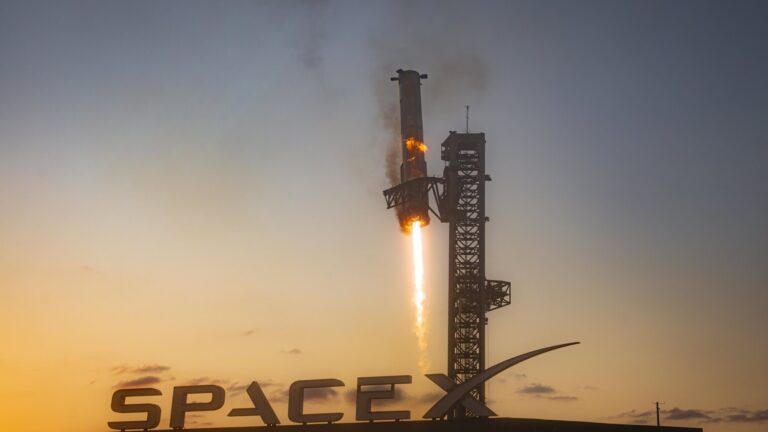
Finally, the rocket hit the brakes by igniting 13 of its 33 engines, then downshifted to three engines for the final maneuver to slide in between the launch tower’s two catch arms. Like balancing a pencil on the tip of your finger, the Raptor engines vectored their thrust to steady the booster, which, for a moment, appeared to be floating next to the tower.

The Super Heavy booster, more than 20 stories tall, rights itself over the launch pad in Texas, moments before two mechanical arms grabbed it in mid-air.

Credit: Stephen Clark/Ars Technica

The Super Heavy booster, more than 20 stories tall, rights itself over the launch pad in Texas, moments before two mechanical arms grabbed it in mid-air. Credit: Stephen Clark/Ars Technica

A double-clap sonic boom jolted spectators from their slack-jawed awe. Only then could we hear the roar from the start of the Super Heavy booster’s landing burn. This sound reached us just as the rocket settled into the grasp of the launch tower, with its so-called catch fittings coming into contact with the metallic beams of the catch arms.

The engines switched off, and there it was. Many of the spectators lucky enough to be there jumped up and down with joy, hugged their friends, or let out an ecstatic yell. I snapped a few final photos and returned to his laptop, grinning, speechless, and started wondering how I could put this all into words.

Once the smoke cleared, at first glance, the rocket looked as good as new. There was no soot on the outside of the booster, as it is on the Falcon 9 rocket after returning from space. This is because the Super Heavy booster and Starship use cleaner-burning methane fuel instead of kerosene.

Elon Musk, SpaceX’s founder and CEO, later said the outer ring of engine nozzles on the bottom of the rocket showed signs of heating damage. This, he said, would be “easily addressed.”

What’s not so easy to address is how SpaceX can top this. A landing on the Moon or Mars? Sure, but realistically, those milestones are years off. There’s something that’ll happen before then.

Sometime soon, SpaceX will try to catch a Starship back at the launch pad at the end of an orbital flight. This will be an extraordinarily difficult feat, far exceeding the challenge of catching the Super Heavy booster.

Super Heavy only reaches a fraction of the altitude and speed of the Starship upper stage, and while the booster’s size and the catch method add degrees of difficulty, the rocket follows much the same up-and-down flight profile pioneered by the Falcon 9. Starship, on the other hand, will reenter the atmosphere from orbital velocity, streak through the sky surrounded by super-heated plasma, then shift itself into a horizontal orientation for a final descent SpaceX likes to call the “belly flop.”

In the last few seconds, Starship will reignite three of its engines, flip itself vertical, and come down for a precision landing. SpaceX demonstrated the ship could do this on the test flight last week, when the vehicle made a controlled on-target splashdown in the Indian Ocean after traveling halfway around the world from Texas.

If everything goes according to plan, SpaceX could be ready to try to catch a Starship for real next year. Stay tuned.

Photo of Stephen Clark

Stephen Clark is a space reporter at Ars Technica, covering private space companies and the world’s space agencies. Stephen writes about the nexus of technology, science, policy, and business on and off the planet.

After seeing hundreds of launches, SpaceX’s rocket catch was a new thrill Read More »

solar-power-from-space?-actually,-it-might-happen-in-a-couple-of-years.

Solar power from space? Actually, it might happen in a couple of years.

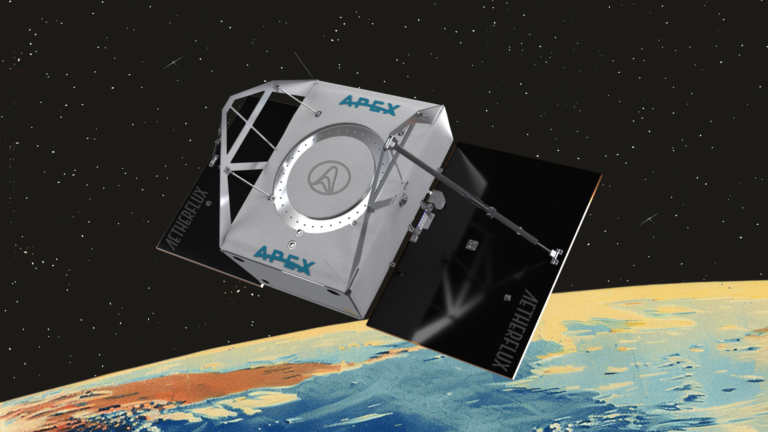
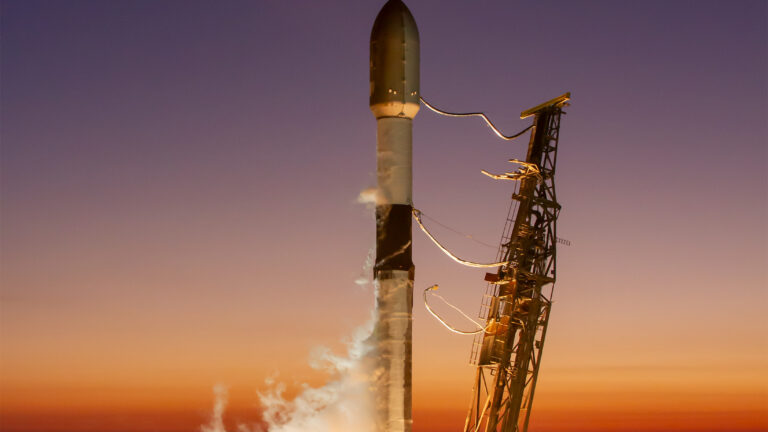
That approach starts in low-Earth orbit rather than 36,000 km away from the surface of the Earth. Aetherflux plans to begin with a single satellite, launching into an orbit about 500 km above the planet on a SpaceX transporter mission about 12 to 15 months from now.

This initial satellite will be based on a commercially available bus from Apex, which will produce, on average, about 1 kilowatt of power. It’s a modest amount, enough electricity to power a dishwasher. This satellite will also include a high-powered infrared laser to transmit this power back to Earth. A mobile ground station, about 10 meters across, will receive the energy.

With a single satellite in low-Earth orbit, power beaming will only be available for any location on Earth for a few minutes as the spacecraft passes from horizon to horizon.

“We’ve spent a lot of time over the last year with folks within Department of Defense, and with some of the folks within DARPA,” Bhatt said. “The idea is like do a demonstration mission which kind of establishes the core functionality.”

Where is all this headed?

One of the key aspects of the test is to determine both the safety and efficiency of collecting the solar energy in space, transmitting it through the atmosphere, and then producing a usable source of power on the ground.

If the demo mission works, Aetherflux plans to develop a constellation of satellites in low-Earth orbit that could provide power continuously and at greater amounts. Initially, the company seeks to deliver power in remote locations, such as disaster relief areas, off-the-grid mining operations, or forward operating bases for the military.

“If we can make that business model work, that’s kind of the jumping-off point to being able to say, hey, could we put this on things like freight shipping?” Bhatt said. “Could we meaningfully address the ability to do freight shipping across large bodies of water with renewable energy?”

Long term, there’s the potential to provide a base load of power to augment the intermittent availability of terrestrial wind and solar energy—a key need if the world is to de-carbonize its electricity generation.

But that’s probably putting the cart before the horse. One of the biggest challenges of space-based solar power is that it has always been theoretical. It should work. But will it work? Trying out a low-cost demonstrator mission in the next couple of years is a fine way of finally putting that question to rest.

Solar power from space? Actually, it might happen in a couple of years. Read More »

spacex-prevails-over-ula,-wins-military-launch-contracts-worth-$733-million

SpaceX prevails over ULA, wins military launch contracts worth $733 million

These missions require medium-lift rockets, or smaller rockets capable of a high-rate launch cadence to match the capability of a larger launch vehicle. In June, the Space Force selected SpaceX, ULA, and Blue Origin, Jeff Bezos’s space company, to compete for Lane 1 launch task orders.

Military officials will add more companies to the pool of available Lane 1 launch providers as they mature their rockets. These companies may include Rocket Lab, Firefly Aerospace, Relativity Space, Stoke Space, and others.

While Blue Origin is on the Space Force’s list of available launch providers, the company’s New Glenn rocket was not eligible for the contracts announced Friday. That’s because military officials require a rocket to complete at least one successful orbital launch to become qualified for a Lane 1 task order. New Glenn’s first test flight is scheduled some time later this year.

This rule left SpaceX’s Falcon 9 and ULA’s Vulcan rockets as the only launch vehicles eligible for the task orders, setting up a head-to-head competition between the rival rocket companies. SpaceX prevailed, winning all nine Lane 1 missions up for competition this year.

Lane 2 of the Space Force’s National Security Space Launch program covers more challenging military missions, typically larger, more expensive payloads destined for higher orbits. The Space Force is expected to soon select launch providers for Lane 2 missions. These launches will require the Space Force to certify the rockets, whereas the military is comfortable accepting a little more risk for the Lane 1 missions.

SpaceX’s Falcon 9 and Falcon Heavy are currently certified for national security launches, and the Space Force is in the process of certifying ULA’s Vulcan launcher after two successful test flights. The Space Force and Blue Origin also have a certification plan for the New Glenn rocket, but it must first complete multiple successful test flights.

Updated October 19 with additional information about the launch task orders.

SpaceX prevails over ULA, wins military launch contracts worth $733 million Read More »

rocket-report:-bloomberg-calls-for-sls-cancellation;-spacex-hits-century-mark

Rocket Report: Bloomberg calls for SLS cancellation; SpaceX hits century mark


All the news that’s fit to lift

“For the first time, Canada will host its own homegrown rocket technology.”

SpaceX’s fifth flight test ended in success. Credit: SpaceX

Welcome to Edition 7.16 of the Rocket Report! Even several days later, it remains difficult to process the significance of what SpaceX achieved in South Texas last Sunday. The moment of seeing a rocket fall out of the sky and be captured by two arms felt historic to me, as historic as the company’s first drone ship landing in April 2016. What a time to be alive.

As always, we welcome reader submissions, and if you don’t want to miss an issue, please subscribe using the box below (the form will not appear on AMP-enabled versions of the site). Each report will include information on small-, medium-, and heavy-lift rockets as well as a quick look ahead at the next three launches on the calendar.

Surprise! Rocket Lab adds a last-minute mission. After signing a launch contract less than two months ago, Rocket Lab says it will launch a customer as early as Saturday from New Zealand on board its Electron launch vehicle. Rocket Lab added that the customer for the expedited mission, to be named “Changes In Latitudes, Changes In Attitudes,” is confidential. This is an impressive turnaround in launch times and will allow Rocket Lab to burnish its credentials for the US Space Force, which has prioritized “responsive” launch in recent years.

Rapid turnaround down under … The basic idea is that if an adversary were to take out assets in space, the military would like to be able to rapidly replace them. “This quick turnaround from contract to launch is not only a showcase of Electron’s capability, but also of the relentless and fast-paced execution by the experienced team behind it that continues to deliver trusted and reliable access to space for our customers,” Rocket Lab Chief Executive Peter Beck said in a statement. (submitted by EllPeaTea and Ken the Bin)

Canadian spaceport and rocket firm link up. A Canadian spaceport developer, Maritime Launch Services, says it has partnered with a Canadian rocket firm, Reaction Dynamics. Initially, Reaction Dynamics will attempt a suborbital launch from the Nova Scotia-based spaceport. This first mission will serve as a significant step toward enabling Canada’s first-ever orbital launch of a domestically developed rocket, Space Daily reports.

A homegrown effort … “For the first time, Canada will host its own homegrown rocket technology, launched from a Canadian-built commercial spaceport, offering launch vehicle and satellite customers the opportunity to reach space without leaving Canadian soil,” said Stephen Matier, president and CEO of Maritime Launch. Reaction Dynamics is developing the Aurora rocket, which uses hybrid-propulsion technology and is projected to have a payload capacity of 200 kg to low-Earth orbit. (submitted by Joey Schwartz and brianrhurley)

The easiest way to keep up with Eric Berger’s and Stephen Clark’s reporting on all things space is to sign up for our newsletter. We’ll collect their stories and deliver them straight to your inbox.

Sign Me Up!

Sirius completes engine test campaign. French launch startup Sirius Space Services said Thursday that it had completed a hot fire test campaign of the thrust chamber for its STAR-1 rocket engine, European Spaceflight reports. During the campaign, the prototype completed two 60-second hot fire tests powered by liquid methane and liquid oxygen. The successful completion of the testing validates the design of the STAR-1 thrust chamber. Full-scale engine testing may begin during the second quarter of next year.

A lot of engines needed … Sirius Space Services is developing a range of three rockets that all use a modular booster system. Sirius 1 will be a two-stage single-stick rocket capable of delivering 175 kilograms to low-Earth orbit. Sirius 13 will feature two strap-on boosters and will have the capacity to deliver 600 kilograms. Finally, the Sirius 15 rocket will feature four boosters and will be capable of carrying payloads of up to 1,000 kilograms. (submitted by Ken the Bin)

SpaceX, California commission lock horns over launch rates. Last week the California Coastal Commission rejected a plan agreed to between SpaceX and the US Space Force to increase the number of launches from Vandenberg Space Force Base to as many as 50 annually, the Los Angeles Times reports. The commission voted 6–4 to block the request to increase from a maximum of 36 launches. In rejecting the plan, some members of the commission cited their concerns about Elon Musk, the owner of SpaceX. “We’re dealing with a company, the head of which has aggressively injected himself into the presidential race,” commission Chair Caryl Hart said.

Is this a free speech issue? … SpaceX responded to the dispute quickly, suing the California commission in federal court on Tuesday, Reuters reports. The company seeks an order that would bar the agency from regulating the company’s workhorse Falcon 9 rocket launch program at Vandenberg. The lawsuit claims the commission, which oversees use of land and water within the state’s more than 1,000 miles of coastline, unfairly asserted regulatory powers. Musk’s lawsuit called any consideration of his public statements improper, violating speech rights protected by the US Constitution. (submitted by brianrhurley)

SpaceX launches 100th rocket of the year. SpaceX launched its 100th rocket of the year early Tuesday morning and followed it up with another liftoff just hours later, Space.com reports. SpaceX’s centenary mission of the year lifted off from Florida with a Falcon 9 rocket carrying 23 of the company’s Starlink Internet satellites aloft.

Mostly Falcon 9s … The company followed that milestone with another launch two hours later from the opposite US coast. SpaceX’s 101st liftoff of 2024 saw 20 more Starlinks soar to space from Vandenberg Space Force Base in California. The company has already exceeded its previous record for annual launches, 98, set last year. The company’s tally in 2023 included 91 Falcon 9s, five Falcon Heavies, and two Starships. This year the mix is similar. (submitted by Ken the Bin)

Fifth launch of Starship a massive success. SpaceX accomplished a groundbreaking engineering feat Sunday when it launched the fifth test flight of its gigantic Starship rocket and then caught the booster back at the launch pad in Texas with mechanical arms seven minutes later, Ars reports. This achievement is the first of its kind, and it’s crucial for SpaceX’s vision of rapidly reusing the Starship rocket, enabling human expeditions to the Moon and Mars, routine access to space for mind-bogglingly massive payloads, and novel capabilities that no other company—or country—seems close to attaining.

Catching a rocket by its tail … High over the Gulf of Mexico, the first stage of the Starship rocket used its engines to reverse course and head back toward the Texas coastline. After reaching a peak altitude of 59 miles (96 kilometers), the Super Heavy booster began a supersonic descent before reigniting 13 engines for a final braking burn. The rocket then shifted down to just three engines for the fine maneuvering required to position the rocket in a hover over the launch pad. That’s when the launch pad’s tower, dubbed Mechazilla, ensnared the rocket in its two weight-bearing mechanical arms, colloquially known as “chopsticks.” The engines switched off, leaving the booster suspended perhaps 200 feet above the ground. The upper stage of the rocket, Starship, executed what appeared to be a nominal vertical landing into the Indian Ocean as part of its test flight.

Clipper launches on Falcon Heavy. NASA’s Europa Clipper spacecraft lifted off Monday from Kennedy Space Center in Florida aboard a SpaceX Falcon Heavy rocket, Ars reports, kicking off a $5.2 billion robotic mission to explore one of the most promising locations in the Solar System for finding extraterrestrial life. Delayed several days due to Hurricane Milton, which passed through Central Florida late last week, the launch of Europa Clipper signaled the start of a five-and-a-half- year journey to Jupiter, where the spacecraft will settle into an orbit taking it repeatedly by one of the giant planet’s numerous moons.

Exploring oceans, saving money … There’s strong evidence of a global ocean of liquid water below Europa’s frozen crust, and Europa Clipper is going there to determine if it has the ingredients for life. “This is an epic mission,” said Curt Niebur, Europa Clipper’s program scientist at NASA Headquarters. “It’s a chance for us not to explore a world that might have been habitable billions of years ago, but a world that might be habitable today, right now.” The Clipper mission was originally supposed to launch on NASA’s Space Launch System rocket, but it had to be moved off that vehicle because vibrations from the solid rocket motors could have damaged the spacecraft. The change to Falcon Heavy also saved the agency $2 billion.

ULA recovers pieces of shattered booster nozzle. When the exhaust nozzle on one of the Vulcan rocket’s strap-on boosters failed shortly after liftoff earlier this month, it scattered debris across the beachfront landscape just east of the launch pad on Florida’s Space Coast, Ars reports. United Launch Alliance, the company that builds and launches the Vulcan rocket, is investigating the cause of the booster anomaly before resuming Vulcan flights. Despite the nozzle failure, the rocket continued its climb and ended up reaching its planned trajectory heading into deep space.

Not clear what the schedule impacts will be … The nozzle fell off one of Vulcan’s two solid rocket boosters around 37 seconds after taking off from Cape Canaveral Space Force Station on October 4. A shower of sparks and debris fell away from the Vulcan rocket when the nozzle failed. Julie Arnold, a ULA spokesperson, confirmed to Ars that the company has retrieved some of the debris. “We recovered some small pieces of the GEM 63XL SRB nozzle that were liberated in the vicinity of the launch pad,” Arnold said. “The team is inspecting the hardware to aid in the investigation.” ULA has not publicly said what impacts there might be on the timeline for the next Vulcan launch, USSF-106, which had been due to occur before the end of this year.

Bloomberg calls for cancellation of the SLS rocket. In an op-ed that is critical of NASA’s Artemis Program, billionaire Michael Bloomberg—the founder of Bloomberg News and a former US Presidential candidate—called for cancellation of the Space Launch System rocket. “Each launch will likely cost at least $4 billion, quadruple initial estimates,” Bloomberg wrote. “This exceeds private-sector costs many times over, yet it can launch only about once every two years and—unlike SpaceX’s rockets—can’t be reused.”

NASA is falling behind … Bloomberg essentially is calling for the next administration to scrap all elements of the Artemis Program that are not essential to establishing and maintaining a presence on the surface of the Moon. “A celestial irony is that none of this is necessary,” he wrote. “A reusable SpaceX Starship will very likely be able to carry cargo and robots directly to the moon—no SLS, Orion, Gateway, Block 1B or ML-2 required—at a small fraction of the cost. Its successful landing of the Starship booster was a breakthrough that demonstrated how far beyond NASA it is moving.” None of the arguments that Bloomberg is advancing are new, but it is noteworthy to hear them from such a prominent person who is outside the usual orbit of space policy commentators.

Artemis II likely to be delayed. A new report from the US Government Accountability Office found that NASA’s Exploration Ground Systems program—this is, essentially, the office at Kennedy Space Center in Florida responsible for building ground infrastructure to support the Space Launch System rocket and Orion—is in danger of missing its schedule for Artemis II, according to Ars Technica. The new report, published Thursday, finds that the Exploration Ground Systems program had several months of schedule margin in its work toward a September 2025 launch date at the beginning of the year. But now, the program has allocated all of that margin to technical issues experienced during work on the rocket’s mobile launcher and pad testing.

Heat shield issue also a concern … NASA also has yet to provide any additional information on the status of its review of the Orion spacecraft’s heat shield. During the Artemis I mission that sent Orion beyond the Moon in late 2022, chunks of charred material cracked and chipped away from Orion’s heat shield during reentry into Earth’s atmosphere. Once the spacecraft landed, engineers found more than 100 locations where the stresses of reentry damaged the heat shield. To prepare for the Artemis II launch next September, Artemis officials had previously said they planned to begin stacking operations of the rocket in September of this year. But so far, this activity remains on hold pending a decision on the heat shield issue.

Next three launches

Oct. 18: Falcon 9 | Starlink 8-19 | Cape Canaveral Space Force Station, Fla. | 19: 31 UTC

Oct. 19: Electron | Changes In Latitudes, Changes In Attitudes | Māhia Peninsula, New Zealand | 10: 30 UTC

Oct. 20: Falcon 9 | OneWeb no. 20 | Vandenberg Space Force Base, Calif. | 05: 09 UTC

Photo of Eric Berger

Eric Berger is the senior space editor at Ars Technica, covering everything from astronomy to private space to NASA policy, and author of two books: Liftoff, about the rise of SpaceX; and Reentry, on the development of the Falcon 9 rocket and Dragon. A certified meteorologist, Eric lives in Houston.

Rocket Report: Bloomberg calls for SLS cancellation; SpaceX hits century mark Read More »

biden-administration-curtails-controls-on-some-space-related-exports

Biden administration curtails controls on some space-related exports

The US Commerce Department announced Thursday it is easing restrictions on exports of space-related technology, answering a yearslong call from space companies to reform regulations governing international trade.

This is the most significant update to space-related export regulations in a decade and opens more opportunities for US companies to sell their satellite hardware abroad.

“We are very excited about this rollout,” a senior Commerce official said during a background call with reporters. “It’s been a long time coming, and I think it’s going to be very meaningful for our national security and foreign policy interests and certainly facilitate secure trade with our partners.”

Overdue reform

One of the changes will allow US companies to export more products related to electro-optical and radar remote sensing, as well as space-based logistics, assembly, or servicing spacecraft destined for Australia, Canada, and the United Kingdom.

“They’re easing restrictions on some of the less sensitive space-related technologies and on spacecraft-related items going to our closest allies, like Australia, Canada, and the UK,” the senior Commerce official said. “These changes will offer relief to US companies and they’ll increase innovation without comprising the critical technologies that keep our nation safe.”

Another update to the Commerce Department’s regulations will remove license requirements for exports of “certain spacecraft components” to more than 40 allied nations, including NATO and European Union member states, Argentina, Australia, Canada, India, Israel, Japan, Mexico, New Zealand, Singapore, South Africa, South Korea, and Taiwan. This will also create more license exceptions to support NASA’s cooperative programs with other nations, officials said.

A third change, which hasn’t been finalized and must go through a public comment period, proposes to transfer some space-related item—spacecraft capable of in-space docking, grappling, and refueling, autonomous collision avoidance, and autonomous detection of ground vehicles and aircraft—from the highly restrictive State Department’s US Munitions List to the more flexible Commerce Control List.

Biden administration curtails controls on some space-related exports Read More »
it’s-increasingly-unlikely-that-humans-will-fly-around-the-moon-next-year

It’s increasingly unlikely that humans will fly around the Moon next year

Don’t book your tickets for the launch of NASA’s Artemis II mission next year just yet.

We have had reason to doubt the official September 2025 launch date for the mission, the first crewed flight into deep space in more than five decades, for a while now. This is principally because NASA is continuing to mull the implications of damage to the Orion spacecraft’s heat shield from the Artemis I mission nearly two years ago.

However, it turns out that there are now other problems with holding to this date as well.

No schedule margin

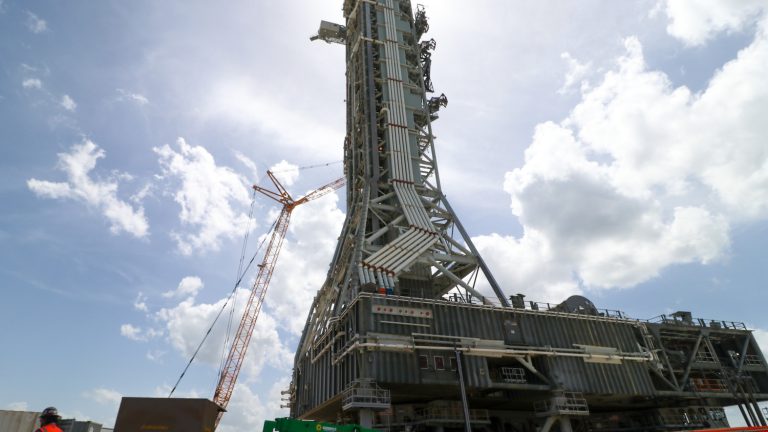
A new report from the US Government Accountability Office found that NASA’s Exploration Ground Systems program—this is, essentially, the office at Kennedy Space Center in Florida responsible for building ground infrastructure to support the Space Launch System rocket and Orion—is in danger of missing its schedule for Artemis II.

During this flight a crew of four astronauts, commanded by NASA’s Reid Wiseman, will launch inside Orion on a 10-day mission out to the Moon and back. The spacecraft will follow a free-return trajectory, which is important, because if there is a significant problem with Orion spacecraft’s propulsion system, the trajectory of the vehicle will still carry it back to Earth. At their closest approach, the crew will come within about 6,500 miles (10,400 km) of the surface of the far side of the Moon.

The new report, published Thursday, finds that the Exploration Ground Systems program had several months of schedule margin in its work toward a September 2025 launch date at the beginning of the year. But now, the program has allocated all of that margin to technical issues experienced during work on the rocket’s mobile launcher and pad testing.

“Earlier in 2024, the program was reserving that time for technical issues that may arise during testing of the integrated SLS and Orion vehicle or if weather interferes with planned activities, among other things,” the report states. “Officials said it is likely that issues will arise because this is the first time testing many of these systems. Given the lack of margin, if further issues arise during testing or integration, there will likely be delays to the September 2025 Artemis II launch date.”

It’s increasingly unlikely that humans will fly around the Moon next year Read More »