The first 250 renewals for each drug class will be reviewed by real doctors, but after that, the AI chatbot will be on its own. Adam Oskowitz, Doctronic co-founder and a professor at the University of California, San Francisco, told Politico that the AI chatbot is designed to err on the side of safety and escalate any case with uncertainty to a real doctor.
“Utah’s approach to regulatory mitigation strikes a vital balance between fostering innovation and ensuring consumer safety,” Margaret Woolley Busse, executive director of the Utah Department of Commerce, said in a statement.
For now, it’s unclear if the Food and Drug Administration will step in to regulate AI prescribing. On the one hand, prescription renewals are a matter of practicing medicine, which falls under state governance. However, Politico notes that the FDA has said that it has the authority to regulate medical devices used to diagnose, treat, or prevent disease.
In a statement, Robert Steinbrook, health research group director at watchdog Public Citizen, blasted Doctronic’s program and the lack of oversight. “AI should not be autonomously refilling prescriptions, nor identifying itself as an ‘AI doctor,’” Steinbrook said.
“Although the thoughtful application of AI can help to improve aspects of medical care, the Utah pilot program is a dangerous first step toward more autonomous medical practice,” he said.”The FDA and other federal regulatory agencies cannot look the other way when AI applications undermine the essential human clinician role in prescribing and renewing medications.”
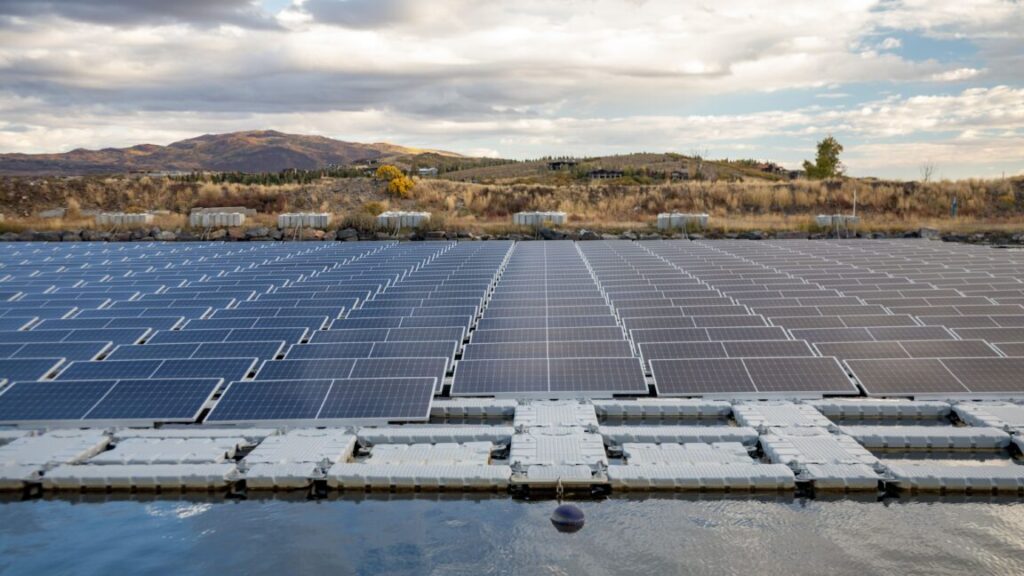
Solar power accounts for two-thirds of the new projects waiting to connect to the state’s power grid.
Utah Gov. Spencer Cox believes his state needs more power—a lot more. By some estimates, Utah will require as much electricity in the next five years as it generated all last century to meet the demands of a growing population as well as chase data centers and AI developers to fuel its economy.
To that end, Cox announced Operation Gigawatt last year, declaring the state would double energy production in the next decade. Although the announcement was short on details, Cox, a Republican, promised his administration would take an “any of the above” approach, which aims to expand all sources of energy production.
Despite that goal, the Utah Legislature’s Republican supermajority, with Cox’s acquiescence, has taken a hard turn against solar power—which has been coming online faster than any other source in Utah and accounts for two-thirds of the new projects waiting to connect to the state’s power grid.
Cox signed a pair of bills passed this year that will make it more difficult and expensive to develop and produce solar energy in Utah by ending solar development tax credits and imposing a hefty new tax on solar generation. A third bill aimed at limiting solar development on farmland narrowly missed the deadline for passage but is expected to return next year.
While Operation Gigawatt emphasizes nuclear and geothermal as Cox’s preferred sources, the legislative broadside, and Cox’s willingness to go along with it, caught many in the solar industry off guard. The three bills, in their original form, could have brought solar development to a halt if not for solar industry lobbyists negotiating a lower tax rate and protecting existing projects as well as those under construction from the brunt of the impact.
“It took every dollar of political capital from all the major solar developers just to get to something tolerable, so that anything they have under development will get built and they can move on to greener pastures,” said one industry insider, indicating that solar developers will likely pursue projects in more politically friendly states. ProPublica spoke with three industry insiders—energy developers and lobbyists—all of whom asked to remain anonymous for fear of antagonizing lawmakers who, next month, will again consider legislation affecting the industry.
The Utah Legislature’s pivot away from solar mirrors President Donald Trump taking a more hostile approach to the industry than his predecessor. Trump has ordered the phaseout of lucrative federal tax incentives for solar and other renewable energy, which expanded under the Biden administration. The loss of federal incentives is a bigger hit to solar companies than the reductions to Utah’s tax incentives, industry insiders acknowledged. The administration has also canceled large wind and solar projects, which Trump has lamented as “the scam of the century.” He described solar as “farmer killing.”
Yet Cox criticized the Trump administration’s decision to kill a massive solar project in neighboring Nevada. Known as a governor who advocates for a return to more civil political discourse, Cox doesn’t often pick fights. But he didn’t pull punches with the decision to halt the Esmeralda 7 project planned on 62,300 acres of federal land. The central Nevada project was expected to produce 6.2 gigawatts of power—enough to supply nearly eight times the number of households in Las Vegas. (Although the Trump administration canceled the environmental review of the joint project proposed by multiple developers, it has the potential to move forward as individual projects.)
“This is how we lose the AI/energy arms race with China,” Cox wrote on X when news surfaced of the project’s cancellation. “Our country needs an all-of-the-above approach to energy (like Utah).”
But he didn’t take on his own Legislature, at least publicly.
Many of Utah’s Republican legislators have been skeptical of solar for years, criticizing its footprint on the landscape and viewing it as an unreliable energy source, while lamenting the retirement of coal-generated power plants. The economies of several rural counties rely on mining coal. But lawmakers’ skepticism hadn’t coalesced into successful anti-solar legislation—until this year. When Utah lawmakers convened at the start of 2025, they took advantage of the political moment to go after solar.
“This is a sentiment sweeping through red states, and it’s very disconcerting and very disturbing,” said Steve Handy, Utah director of The Western Way, which describes itself as a conservative organization advocating for an all-of-the-above approach to energy development.
The shift in sentiment against solar energy has created a difficult climate for an all-of-the-above approach. Solar projects can be built quickly on Utah’s vast, sun-drenched land, while nuclear is a long game with projects expected to take a decade or more to come online under optimistic scenarios.
Cox generally supports solar, “in the right places,” especially when the captured energy can be stored in large batteries for distribution on cloudy days and after the sun goes down.
Cox said that instead of vetoing the anti-solar bills, he spent his political capital to moderate the legislation’s impact. “I think you’ll see where our fingerprints were,” he told ProPublica. He didn’t detail specific changes for which he advocated but said the bills’ earlier iterations would have “been a lot worse.”
“We will continue to see solar in Utah.”
Cox’s any-of-the-above approach to energy generation draws from a decades-old Republican push similarly titled “all of the above.” The GOP policy’s aim was as much about preserving and expanding reliance on fossil fuels (indeed, the phrase may have been coined by petroleum lobbyists) as it was turning to cleaner energy sources such as solar, wind, and geothermal.
As governor of a coal-producing state, Cox hasn’t shown interest in reducing reliance on such legacy fuels. But as he slowly rolls out Operation Gigawatt, his focus has been on geothermal and nuclear power. Last month, he announced plans for a manufacturing hub for small modular reactors in the northern Utah community of Brigham City, which he hopes will become a nuclear supply chain for Utah and beyond. And on a recent trade mission to New Zealand, he signed an agreement to collaborate with the country on geothermal energy development.
Meanwhile, the bills Cox signed into law already appear to be slowing solar development in Utah. Since May, when the laws took effect, 51 planned solar projects withdrew their applications to connect to the state’s grid—representing more than a quarter of all projects in Utah’s transmission connection queue. Although projects drop out for many reasons, some industry insiders theorize the anti-solar legislation could be at play.
Caught in the political squeeze over power are Utah customers, who are footing higher electricity bills. Earlier this year, the state’s utility, Rocky Mountain Power, asked regulators to approve a 30 percent hike to fund increased fuel and wholesale energy costs, as well as upgrades to the grid. In response to outrage from lawmakers, the utility knocked the request down to 18 percent. Regulators eventually awarded the utility a 4.7 percent increase—a decision the utility promptly appealed to the state Supreme Court.
Juliet Carlisle, a University of Utah political science professor focusing on environmental policy, said the new solar tax could signal to large solar developers that Utah energy policy is “becoming more unpredictable,” prompting them to build elsewhere. This, in turn, could undermine Cox’s efforts to quickly double Utah’s electricity supply.
Operation Gigawatt “relies on rapid deployment across multiple energy sources, including renewables,” she said. “If renewable growth slows—especially utility-scale solar, which is currently the fastest-deploying resource—the state may face challenges meeting demand growth timelines.”
Rep. Kay Christofferson, R-Lehi, had sponsored legislation to end the solar industry’s state tax credits for several legislative sessions, but this was the first time the proposal succeeded.
Christofferson agrees Utah is facing unprecedented demand for power, and he supports Cox’s any-of-the-above approach. But he doesn’t think solar deserves the advantages of tax credits. Despite improving battery technology, he still considers it an intermittent source and thinks overreliance on it would work against Utah’s energy goals.
In testimony on his bill, Christofferson said he believed the tax incentives had served their purpose of getting a new industry off the ground—16 percent of Utah’s power generation now comes from solar, ranking it 16th in the nation for solar capacity.
Christofferson’s bill was the least concerning to the industry, largely because it negotiated a lengthy wind-down of the subsidies. Initially it would have ended the tax credit after Jan. 1, 2032. But after negotiations with the solar industry, he extended the deadline to 2035.
The bill passed the House, but when it reached the Senate floor, Sen. Brady Brammer, R-Pleasant Grove, moved the end of the incentives to 2028. He told ProPublica he believes solar is already established and no longer needs the subsidy. Christofferson tried to defend his compromise but ultimately voted with the legislative majority.
Unlike Christofferson’s bill, which wasn’t born of an antipathy for renewable energy, Rep. Casey Snider, R-Paradise, made it clear in public statements and behind closed doors to industry lobbyists that the goal of his bill was to make solar pay.
The bill imposes a tax on all solar production. The proceeds will substantially increase the state’s endangered species fund, which Utah paradoxically uses to fight federal efforts to list threatened animals for protection. Snider cast his bill as pro-environment, arguing the money could also go to habitat protection.
As initially written, the bill would have taxed not only future projects, but also those already producing power and, more worrisome for the industry, projects under construction or in development with financing in place. The margins on such projects are thin, and the unanticipated tax could kill projects already in the works, one solar industry executive testified.
“Companies like ours are being effectively punished for investing in the state,” testified another.
The pushback drew attacks from Snider, who accused solar companies of hypocrisy on the environment.
Industry lobbyists who spoke to ProPublica said Snider wasn’t as willing to negotiate as Christofferson. However, they succeeded in reducing the tax rate on future developments and negotiated a smaller, flat fee for existing projects.
“Everyone sort of decided collectively to save the existing projects and let it go for future projects,” said one lobbyist.
Snider told ProPublica, “My goal was never to run anybody out of business. If we wanted to make it more heavy-handed, we could have. Utah is a conservative state, and I would have had all the support.”
Snider said, like the governor, he favors an any-of-the-above approach to energy generation and doesn’t “want to take down any particular industry or source.” But he believes utility-scale solar farms need to pay to mitigate their impact on the environment. He likened his bill to federal law that requires royalties from oil and gas companies to be used for conservation. He hopes federal lawmakers will use his bill as a model for federal legislation that would apply to solar projects nationwide.
“This industry needs to give back to the environment that they claim very heavily they are going to protect,” he said. “I do believe there’s a tinge of hypocrisy to this whole movement. You can’t say you’re good for the environment and not offset your impacts.”
One of the more emotional debates over solar is set to return next year, after a bill that would end tax incentives for solar development on agricultural land failed to get a vote in the final minutes of this year’s session. Sponsored by Rep. Colin Jack, R-St. George, the bill has been fast-tracked in the next session, which begins in January.
Jack said he was driven to act by ranchers who were concerned that solar companies were outbidding them for land they had been leasing to graze cows. Solar companies pay substantially higher rates than ranchers can. His bill initially had a slew of land use restrictions—such as mandating the distance between projects and residential property and creeks, minimum lot sizes and 4-mile “green zones” between projects—that solar lobbyists said would have strangled their industry. After negotiating with solar developers, Jack eliminated the land use restrictions while preserving provisions to prohibit tax incentives for solar farms on private agricultural land and to create standards for decommissioning projects.
Many in rural Utah recoil at rows of black panels disrupting the landscape and fear solar farms will displace the ranching and farming way of life. Indeed, some wondered whether Cox, who grew up on a farm in central Utah, would have been as critical of Trump scuttling a 62,300-acre solar farm in his own state as he was of the Nevada project’s cancellation.
Peter Greathouse, a rancher in western Utah’s Millard County, said he is worried about solar farms taking up grazing land in his county. “Twelve and a half percent is privately owned, and a lot of that is not farmable. So if you bring in these solar places that start to eat up the farmland, it can’t be replaced,” he said.
Utah is losing about 500,000 acres of agricultural land every 10 years, most of it to housing. A report by The Western Way estimated solar farms use 0.1 percent of the United States’ total land mass. That number is expected to grow to 0.46 percent by 2050—a tiny fraction of what is used by agriculture. Of the land managed by the Utah Trust Lands Administration, less than 3,000 of the 2.9 million acres devoted to grazing have been converted to solar farms.
Other ranchers told ProPublica they’ve been able to stay on their land and preserve their way of life by leasing to solar. Landon Kesler’s family, which raises cattle for team roping competitions, has leased land to solar for more than a decade. The revenue has allowed the family to almost double its land holdings, providing more room to ranch, Kesler said.
“I’m going to be quite honest, it’s absurd,” Kesler said of efforts to limit solar on agricultural land. “Solar very directly helped us tie up other property to be used for cattle and ranching. It didn’t run us out; it actually helped our agricultural business thrive.”
Solar lobbyists and executives have been working to bolster the industry’s image with lawmakers ahead of the next legislative session. They’re arguing solar is a good neighbor.
“We don’t use water, we don’t need sidewalks, we don’t create noise, and we don’t create light,” said Amanda Smith, vice president of external affairs for AES, which has one solar project operating in Utah and a second in development. “So we just sort of sit out there and produce energy.”
Solar pays private landowners in Utah $17 million a year to lease their land. And, more important, solar developers argue, it’s critical to powering data centers the state is working to attract.
“We are eager to be part of a diversified electricity portfolio, and we think we bring a lot of values that will benefit communities, keep rates low and stable, and help keep the lights on,” Rikki Seguin, executive director of Interwest Energy Alliance, a western trade organization that advocates for utility-scale renewable energy projects, told an interim committee of lawmakers this summer.
The message didn’t get a positive reception from some lawmakers on the committee. Rep. Carl Albrecht, R-Richfield, who represents three rural Utah counties and was among solar’s critics last session, said the biggest complaint he hears from constituents is about “that ugly solar facility” in his district.
“Why, Rep. Albrecht, did you allow that solar field to be built? It’s black. It looks like the Dead Sea when you drive by it,” Albrecht said.
This story was originally published by ProPublica.
This 9171 subtype “continues, unfortunately uninterrupted, across multiple jurisdictions,” David Sugerman, who leads the CDC measles response, said on the call.
According to the Times, local health officials are pessimistic that they’ll be able to stamp out the virus’s spread, saying that vaccination efforts have had “limited” impact. As Ars reported previously, vaccination rates are dangerously low in two measles hotspots: northwestern Mohave County, Arizona, and the southwest health district of Utah. Vaccination rates among kindergartners in the 2024–2025 school year were 78.4 percent and 80.7 percent, respectively. That’s well below the 95 percent target needed to keep the virus from spreading onward in the communities.
In addition, public health officials in Arizona and Utah have reported barriers to responding to the outbreak. Around a quarter of cases don’t know how they were exposed, suggesting cases and exposures are being missed. In late October, health officials in Salt Lake County, Utah, said that a person likely infected with measles refused to cooperate with their investigation, leaving them unable to confirm the probable case.
David Kimberlin, who sits on a panel of experts that analyzes measles data for the United States’ elimination status review, told the Times, “It would not surprise me in the least if there’s continued spread across these next several months.”
To date, the CDC has tallied 1,723 measles cases across 42 states. Most (87 percent) of those cases were linked to outbreaks, of which there have been 45 this year. For context, there were 16 outbreaks and a total of 285 measles cases in the US last year. This year’s measles cases mark a 33-year high.
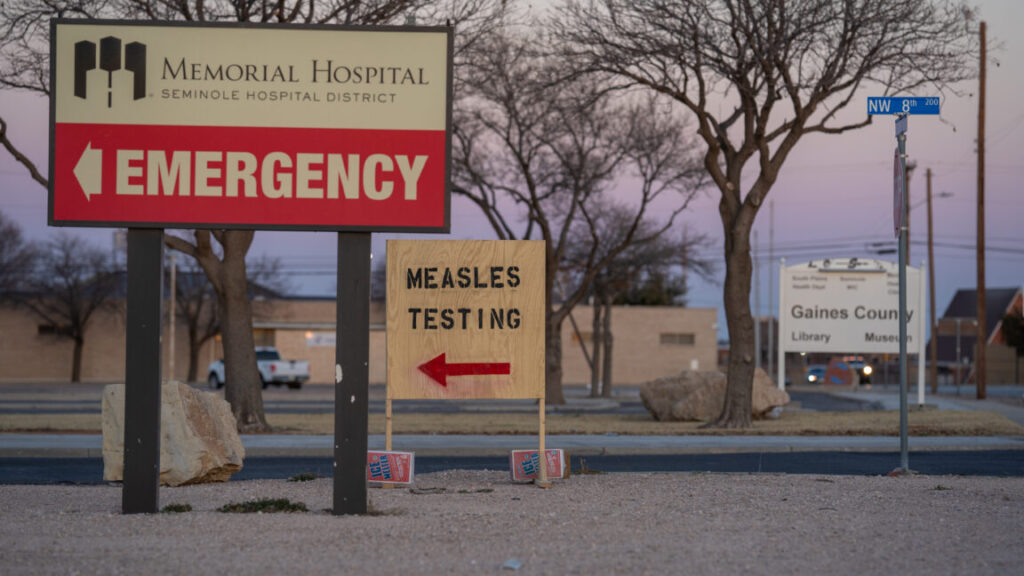
A measles investigation amid a large, ongoing outbreak at the Arizona-Utah border has hit a roadblock as the first probable case identified in the Salt Lake City area refuses to work with health officials, the local health department reported this week.
There have been over 150 cases collectively across the two states, mostly in northwestern Mohave County, Arizona, and the southwest health district of Utah, in the past two months. Both areas have abysmally low vaccination rates: In Mohave County, only 78.4 percent of kindergartners in the 2024–2025 school year were vaccinated against measles, according to state records. In the southwest district of Utah, only 80.7 percent of kindergartners in the 2024–2025 school year had records of measles vaccination. Public health experts say vaccination coverage of 95 percent is necessary to keep the disease from spreading in a community.
While the outbreak has largely exploded along the border, cases are also creeping to the north, toward Salt Lake County, which encompasses the city. Utah County, which sits just south of Salt Lake County, has identified eight cases, including a new case reported today.
Uncooperative case
Salt Lake County likely has a new one, too—the first for the county this year—as well as possible exposures. But, they can’t confirm it.
County health officials said that a health care provider in the area contacted them late on Monday to tell them about a patient who very likely has measles. The officials then spent a day reaching out to the person, who refused to answer questions or cooperate in any way. That included refusing to share location information so that other people could be notified that they were potentially exposed to one of the most infectious viruses known.
“The patient has declined to be tested, or to fully participate in our disease investigation, so we will not be able to technically confirm the illness or properly do contact tracing to warn anyone with whom the patient may have had contact,” Dorothy Adams, executive director of Salt Lake County Health Department, said in a statement. “But based on the specific symptoms reported by the healthcare provider and the limited conversation our investigators have had with the patient, this is very likely a case of measles in someone living in Salt Lake County.”
Pornhub will soon be blocked in five more states as the adult site continues to fight what it considers privacy-infringing age-verification laws that require Internet users to provide an ID to access pornography.
On July 1, according to a blog post on the adult site announcing the impending block, Pornhub visitors in Indiana, Idaho, Kansas, Kentucky, and Nebraska will be “greeted by a video featuring” adult entertainer Cherie Deville, “who explains why we had to make the difficult decision to block them from accessing Pornhub.”
Pornhub explained that—similar to blocks in Texas, Utah, Arkansas, Virginia, Montana, North Carolina, and Mississippi—the site refuses to comply with soon-to-be-enforceable age-verification laws in this new batch of states that allegedly put users at “substantial risk” of identity theft, phishing, and other harms.
Age-verification laws requiring adult site visitors to submit “private information many times to adult sites all over the Internet” normalizes the unnecessary disclosure of personally identifiable information (PII), Pornhub argued, warning, “this is not a privacy-by-design approach.”
Pornhub does not outright oppose age verification but advocates for laws that require device-based age verification, which allows users to access adult sites after authenticating their identity on their devices. That’s “the best and most effective solution for protecting minors and adults alike,” Pornhub argued, because the age-verification technology is proven and less PII would be shared.
“Users would only get verified once, through their operating system, not on each age-restricted site,” Pornhub’s blog said, claiming that “this dramatically reduces privacy risks and creates a very simple process for regulators to enforce.”
A spokesperson for Pornhub-owner Aylo told Ars that “unfortunately, the way many jurisdictions worldwide have chosen to implement age verification is ineffective, haphazard, and dangerous.”
“Any regulations that require hundreds of thousands of adult sites to collect significant amounts of highly sensitive personal information is putting user safety in jeopardy,” Aylo’s spokesperson told Ars. “Moreover, as experience has demonstrated, unless properly enforced, users will simply access non-compliant sites or find other methods of evading these laws.
Age-verification laws are harmful, Pornhub says
Pornhub’s big complaint with current age-verification laws is that these laws are hard to enforce and seem to make it riskier than ever to visit an adult site.
“Since age verification software requires users to hand over extremely sensitive information, it opens the door for the risk of data breaches,” Pornhub’s blog said. “Whether or not your intentions are good, governments have historically struggled to secure this data. It also creates an opportunity for criminals to exploit and extort people through phishing attempts or fake [age verification] processes, an unfortunate and all too common practice.”
Over the past few years, the risk of identity theft or stolen PII on both widely used and smaller niche adult sites has been well-documented.
Hundreds of millions of people were impacted by major leaks exposing PII shared with popular adult sites like Adult Friend Finder and Brazzers in 2016, while likely tens of thousands of users were targeted on eight poorly secured adult sites in 2018. Niche and free sites have also been vulnerable to attacks, including millions collectively exposed through breaches of fetish porn site Luscious in 2019 and MyFreeCams in 2021.
And those are just the big breaches that make headlines. In 2019, Kaspersky Lab reported that malware targeting online porn account credentials more than doubled in 2018, and researchers analyzing 22,484 pornography websites estimated that 93 percent were leaking user data to a third party.
That’s why Pornhub argues that, as states have passed age-verification laws requiring ID, they’ve “introduced harm” by redirecting visitors to adult sites that have fewer privacy protections and worse security, allegedly exposing users to more threats.
As an example, Pornhub reported, traffic to Pornhub in Louisiana “dropped by approximately 80 percent” after their age-verification law passed. That allegedly showed not just how few users were willing to show an ID to access their popular platform, but also how “very easily” users could simply move to “pirate, illegal, or other non-compliant sites that don’t ask visitors to verify their age.”
Pornhub has continued to argue that states passing laws like Louisiana’s cannot effectively enforce the laws and are simply shifting users to make riskier choices when accessing porn.
“The Louisiana law and other copycat state-level laws have no regulator, only civil liability, which results in a flawed enforcement regime, effectively making it an option for platform operators to comply,” Pornhub’s blog said. As one of the world’s most popular adult platforms, Pornhub would surely be targeted for enforcement if found to be non-compliant, while smaller adult sites perhaps plagued by security risks and disincentivized to check IDs would go unregulated, the thinking goes.
Aylo’s spokesperson shared 2023 Similarweb data with Ars, showing that sites complying with age-verification laws in Virginia, including Pornhub and xHamster, lost substantial traffic while seven non-compliant sites saw a sharp uptick in traffic. Similar trends were observed in Google trends data in Utah and Mississippi, while market shares were seemingly largely maintained in California, a state not yet checking IDs to access adult sites.
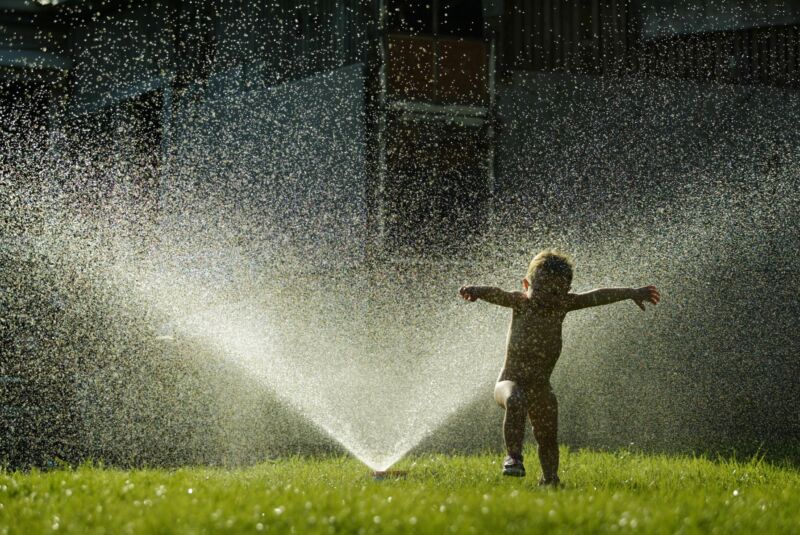
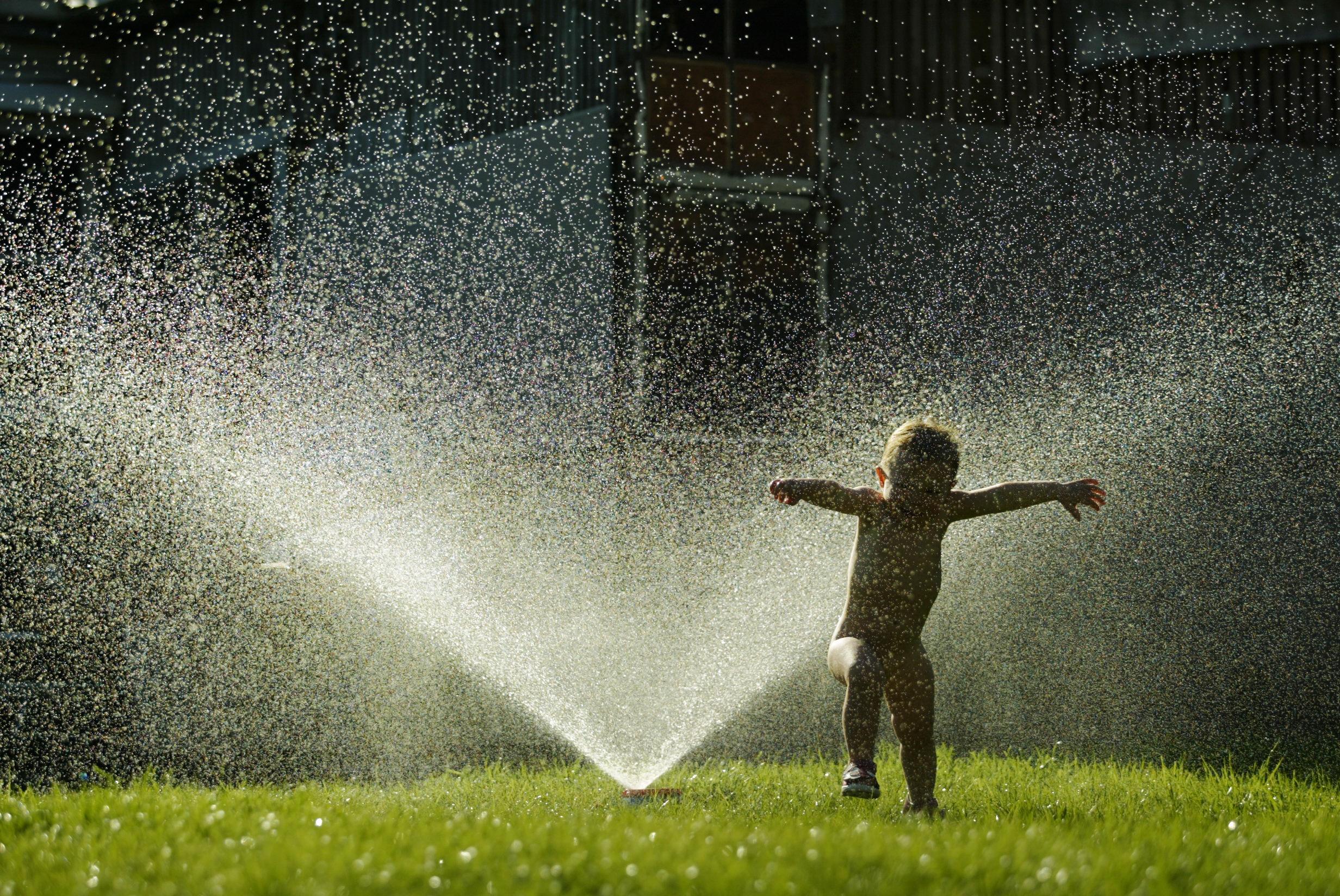
Enlarge/ A child cools off under a water sprinkler.
In 1989, a city in Utah upgraded its drinking water system, putting in a whole new system and repurposing the old one to supply cheap untreated water for irrigating lawns and putting out fires. That meant that the treated water suitable for drinking flowed from new spigots, while untreated water gushed from the old ones. Decades went by with no apparent confusion; residents seemed clear on the two different water sources. But, according to an investigation report published recently by state and county health officials, that local knowledge got diluted as new residents moved into the area. And last summer, the confusion over the conduits led to an outbreak of life-threatening illnesses among children.
In July and August of 2023, state and local health officials identified 13 children infected with Shiga toxin-producing Escherichia coli (STEC) O157:H7. The children ranged in age from 1 to 15, with a median age of 4. Children are generally at high risk of severe infections with this pathogen, along with older people and those with compromised immune systems. Of the 13 infected children, seven were hospitalized and two developed hemolytic uremic syndrome, a life-threatening complication that can lead to kidney failure.
Preliminary genetic analyses of STEC O157:H7 from two of the children suggested that the children’s infections were linked to a common source. So, health officials quickly developed a questionnaire to narrow down the potential source. It soon became clear that the irrigation water—aka untreated, pressurized, municipal irrigation water (UPMIW)—was a commonality among the children. Twelve of 13 infected children reported exposure to it in some form: Two said they drank it; five played with UPMIW hoses; three used the water for inflatable water toys; two used it for a water table; and one ran through sprinklers. None reported eating fruits or vegetables from home (noncommercial) gardens irrigated with the UPMIW.
The report on the investigation, published in the Centers for Disease Control and Prevention’s Morbidity and Mortality Weekly Report, did not name the city in Utah. But press releases from a county health department identified the affected city as Lehi, about 30 minutes south of Salt Lake City.
Further genetic testing of STEC O157:H7 isolates linked all of the children’s infections together, as well as to water from five of nine UPMIW exposure sites and samples from the reservoir where the irrigation water is sourced. Microbial source tracking indicated that the contamination could have come from the feces of birds or ruminants.
The county health department and the city put out press releases and informational mailers. They warned residents about the risks of UPMIW, telling them not to drink it or let children play in it. “Do not use irrigation water for bounce houses, pools, slip-n-slides, or any other recreational activities. It is common for children to swallow or get water in their mouths while playing.”
The notices also said that the CDC recommended against watering lawns with the water, though the county advised residents to merely “use caution” when allowing children to play on grass irrigated with UPMIW. “Keep an eye on them,” the advisers warned, and try to prevent them from putting their hands or anything from the lawn in their mouths. “E. coli is hardy and can stick.”
This is not the first time that irrigation water has been linked to outbreaks. In 2010 and 2015, two other Utah cities reported campylobacteriosis outbreaks linked to cross-connections between UPMIW and drinking water lines.
The researchers say such outbreaks can be avoided by efforts to prevent contamination in irrigation water, such as treating water, cleaning reservoirs, and covering them. And, of course, clearly labeling irrigation water and keeping residents informed about its dangers are key to preventing infections.
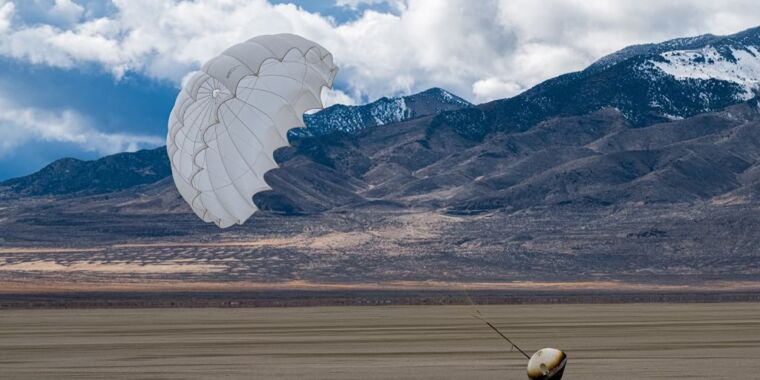
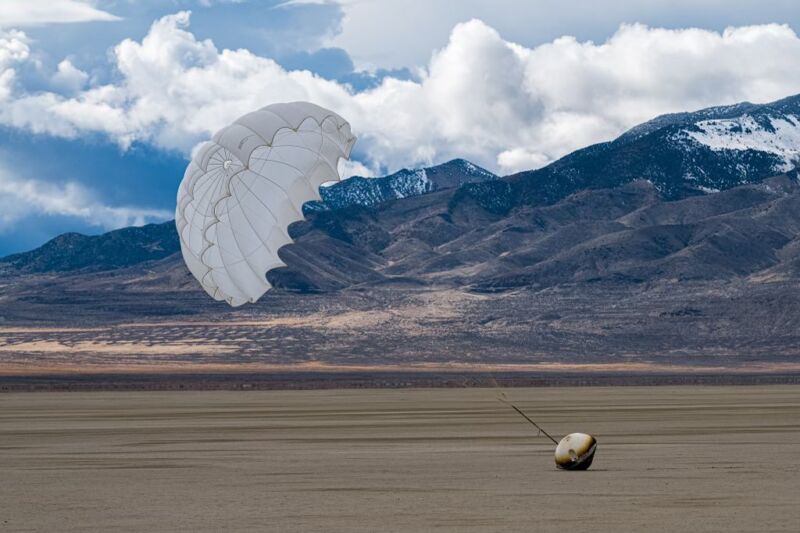
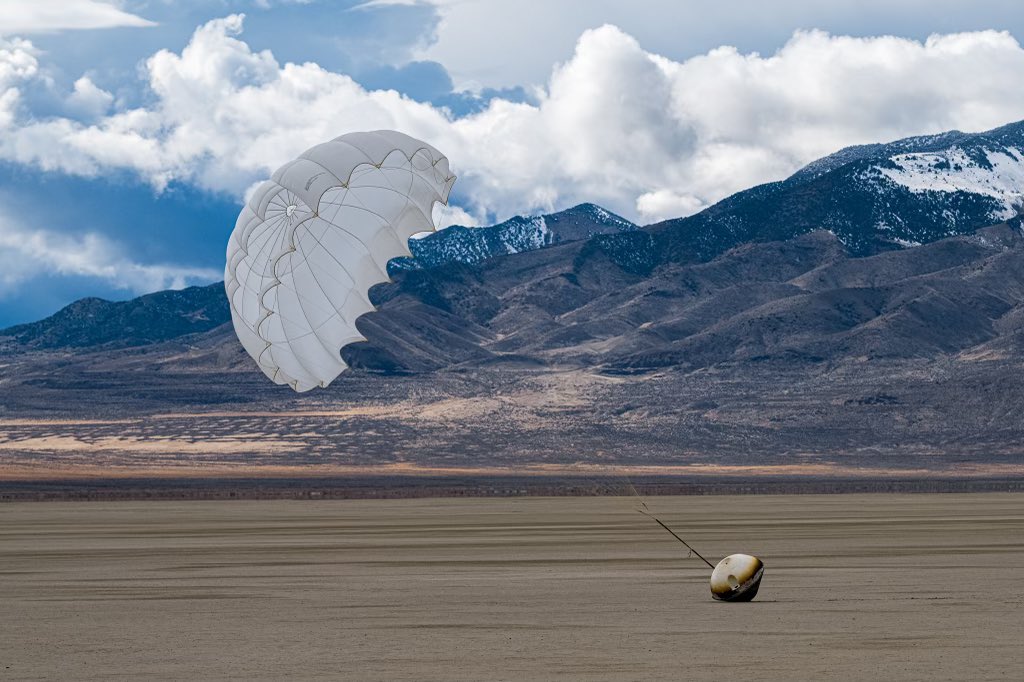
Enlarge/ Varda’s reentry capsule soon after landing at the Utah Test and Training Range.
Varda Space Industries is finally able to celebrate. For nearly eight months, the in-space manufacturing company’s first mission was essentially stranded in low-Earth orbit, but not because of any technical malfunction or a restriction imposed by the laws of physics.
Instead, the spacecraft couldn’t return to Earth until Varda and three government entities—the US military, the Federal Aviation Administration’s Office of Commercial Space Transportation, and the FAA’s Air Traffic Organization—all got on the same page. This was far more complicated than anyone envisioned, and Varda had to bypass landing opportunities in July and September because it couldn’t secure governmental approvals.
Finally, earlier this month, the FAA approved a commercial reentry license for Varda’s space capsule, which was somewhat larger than a mini-fridge, to fall back into the atmosphere and parachute to a landing in the remote Utah desert southwest of Salt Lake City. Varda’s landing zone was at the Utah Test and Training Range, a sprawling military facility primarily used for weapons testing.
Varda’s capsule landed in the Utah desert at around 4: 40 pm EST (2140 UTC) last Wednesday. Approaching from the north, the craft’s heat shield protected it from scorching temperatures during reentry. Then, the capsule deployed a 6.2-foot-diameter (2.1-meter) parachute to slow its velocity for a relatively gentle landing.
A recovery team went out to retrieve the nearly 200-pound capsule and connect it to a helicopter line for a short flight to a nearby processing facility, where engineers would prepare the spacecraft for transport back to Varda’s headquarters in El Segundo, California.
The mood at Varda following the successful landing was “as cheerful as it gets,” said Delian Asparouhov, who co-founded the company in 2020 with former SpaceX engineer Will Bruey and scientist Daniel Marshall.
“I always felt confidence in our team’s ability to accomplish this,” Asparouhov told Ars. “It was just a question of time.”
Waiting game
Varda achieved several firsts with this mission. The Utah Test and Training Range (UTTR) has some experience in supporting spacecraft landings, but this was the first time a commercial spacecraft landed at a military test range, adding another layer of regulatory and bureaucratic oversight. In September, NASA’s OSIRIS-REx mission deposited a cache of asteroid samples at UTTR.
Varda was the first company to secure a commercial FAA reentry license under streamlined commercial spaceflight regulations known as Part 450. This licensing paradigm is regularly used for commercial launches (there were 117 FAA-licensed launches last year), but this was the first time any company went through this process for a reentry.
Only two companies received commercial FAA reentry licenses before Varda—Lockheed Martin for a single test flight of the Orion spacecraft in 2014 and SpaceX for more than 40 commercial flights of its Dragon crew and cargo spacecraft. Both companies have operated under previous licensing regimes before the FAA introduced the revised Part 450 protocol in 2020.
The FAA’s commercial space office is responsible for licensing commercial launch and reentry operations, with a primary interest in ensuring that these activities don’t endanger the public. But FAA air traffic controllers had to find a time to clear a broad swath of airspace around the trajectory of Varda’s descending space capsule. The FAA’s temporary flight restriction for Varda’s reentry was unusually large, particularly for such a small spacecraft, stretching more than 400 miles (700 kilometers) long and 60 miles (100 kilometers) wide from southern Montana to western Utah.
The timing of Varda’s reentry, along with Varda’s access to the secure military facility, also had to be coordinated with the test range’s busy schedule of military exercises.