Xcode

xcode-26.3-adds-support-for-claude,-codex,-and-other-agentic-tools-via-mcp

Xcode 26.3 adds support for Claude, Codex, and other agentic tools via MCP

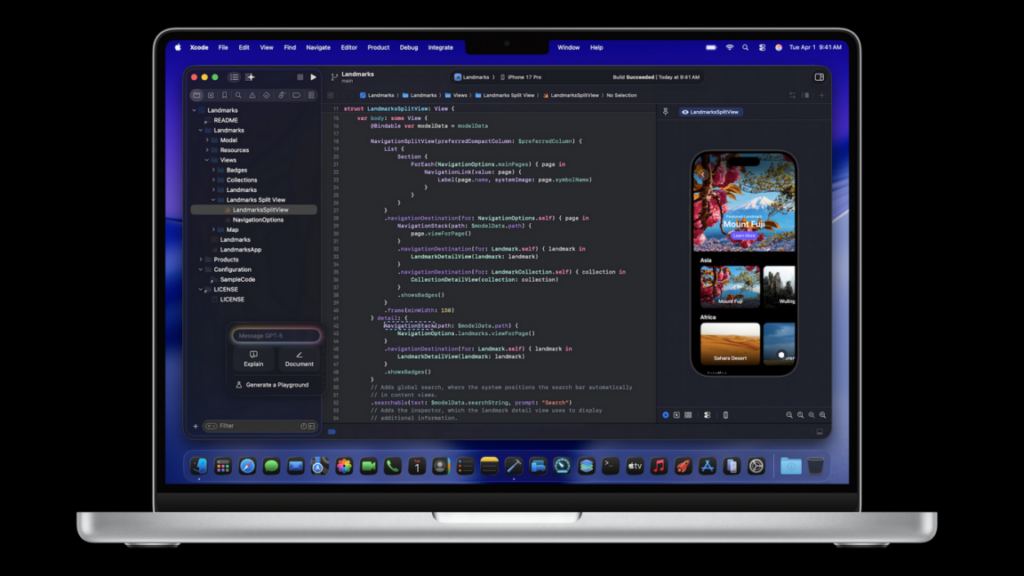
Apple has announced a new version of Xcode, the latest version of its integrated development environment (IDE) for building software for its own platforms, like the iPhone and Mac. The key feature of 26.3 is support for full-fledged agentic coding tools, like OpenAI’s Codex or Claude Agent, with a side panel interface for assigning tasks to agents with prompts and tracking their progress and changes.

This is achieved via Model Context Protocol (MCP), an open protocol that lets AI agents work with external tools and structured resources. Xcode acts as an MCP endpoint that exposes a bunch of machine-invocable interfaces and gives AI tools like Codex or Claude Agent access to a wide range of IDE primitives like file graph, docs search, project settings, and so on. While AI chat and workflows were supported in Xcode before, this release gives them much deeper access to the features and capabilities of Xcode.

This approach is notable because it means that even though OpenAI and Anthropic’s model integrations are privileged with a dedicated spot in Xcode’s settings, it’s possible to connect other tooling that supports MCP, which also allows doing some of this with models running locally.

Apple began its big AI features push with the release of Xcode 26, expanding on code completion using a local model trained by Apple that was introduced in the previous major release, and fully supporting a chat interface for talking with OpenAI’s ChatGPT and Anthropic’s Claude. Users who wanted more agent-like behavior and capabilities had to use third-party tools, which sometimes had limitations due to a lack of deep IDE access.

Xcode 26.3’s release candidate (the final beta, essentially) rolls out imminently, with the final release coming a little further down the line.

Xcode 26.3 adds support for Claude, Codex, and other agentic tools via MCP Read More »

in-xcode-26,-apple-shows-first-signs-of-offering-chatgpt-alternatives

In Xcode 26, Apple shows first signs of offering ChatGPT alternatives

The latest Xcode beta contains clear signs that Apple plans to bring Anthropic’s Claude and Opus large language models into the integrated development environment (IDE), expanding on features already available using Apple’s own models or OpenAI’s ChatGPT.

Apple enthusiast publication 9to5Mac “found multiple references to built-in support for Anthropic accounts,” including in the “Intelligence” menu, where users can currently log in to ChatGPT or enter an API key for higher message limits.

Apple introduced a suite of features meant to compete with GitHub Copilot in Xcode at WWDC24, but first focused on its own models and a more limited set of use cases. That expanded quite a bit at this year’s developer conference, and users can converse about codebases, discuss changes, or ask for suggestions using ChatGPT. They are initially given a limited set of messages, but this can be greatly increased by logging in to a ChatGPT account or entering an API key.

This summer, Apple said it would be possible to use Anthropic’s models with an API key, too, but made no mention of support for Anthropic accounts, which are generally more cost-effective than using the API for most users.

In Xcode 26, Apple shows first signs of offering ChatGPT alternatives Read More »

apple-tiptoes-with-modest-ai-updates-while-rivals-race-ahead

Apple tiptoes with modest AI updates while rivals race ahead

Developers, developers, developers?

Being the Worldwide Developers Conference, it seems appropriate that Apple also announced it would open access to its on-device AI language model to third-party developers. It also announced it would integrate OpenAI’s code completion tools into its XCode development software.

Craig Federighi stands in front of a screen with the words

Apple Intelligence was first unveiled at WWDC 2024. Credit: Apple

“We’re opening up access for any app to tap directly into the on-device, large language model at the core of Apple,” said Craig Federighi, Apple’s software chief, during the presentation. The company also demonstrated early partner integration by adding OpenAI’s ChatGPT image generation to its Image Playground app, though it said user data would not be shared without permission.

For developers, Apple’s inclusion of ChatGPT’s code-generation capabilities in XCode may represent Apple’s attempt to match what rivals like GitHub Copilot and Cursor offer software developers in terms of AI coding augmentation, even as the company maintains a more cautious approach to consumer-facing AI features.

Meanwhile, competitors like Meta, Anthropic, OpenAI, and Microsoft continue to push more aggressively into the AI space, offering AI assistants (that admittedly still make things up and suffer from other issues, such as sycophancy).

Only time will tell if Apple’s wariness to embrace the bleeding edge of AI will be a curse (eventually labeled as a blunder) or a blessing (lauded as a wise strategy). Perhaps, in time, Apple will step in with a solid and reliable AI assistant solution that makes Siri useful again. But for now, Apple Intelligence remains more of a clever brand name than a concrete set of notable products.

Apple tiptoes with modest AI updates while rivals race ahead Read More »

microsoft-warns-that-the-powerful-xcsset-macos-malware-is-back-with-new-tricks

Microsoft warns that the powerful XCSSET macOS malware is back with new tricks

“These enhanced features add to this malware family’s previously known capabilities, like targeting digital wallets, collecting data from the Notes app, and exfiltrating system information and files,” Microsoft wrote. XCSSET contains multiple modules for collecting and exfiltrating sensitive data from infected devices.

Microsoft Defender for Endpoint on Mac now detects the new XCSSET variant, and it’s likely other malware detection engines will soon, if not already. Unfortunately, Microsoft didn’t release file hashes or other indicators of compromise that people can use to determine if they have been targeted. A Microsoft spokesperson said these indicators will be released in a future blog post.

To avoid falling prey to new variants, Microsoft said developers should inspect all Xcode projects downloaded or cloned from repositories. The sharing of these projects is routine among developers. XCSSET exploits the trust developers have by spreading through malicious projects created by the attackers.

Microsoft warns that the powerful XCSSET macOS malware is back with new tricks Read More »